Can we also talk about how everyone’s clip art looks so much alike? All those tubular-limbed primary-colored simple sausage people make me wince. I guess when you’re making the 10,000th SaaS you just want to be like the others.
“The style appears to serve as the illustrative arm of an intentional deployment of cheerful minimalism to mask the insidiousness of multinational tech corporations with friendliness and approachability.”
https://eyeondesign.aiga.org/dont-worry-these-gangley-armed-...
I disagree that this is a fashion -- logo design over the last 100+ years has consistantly shifted this way, while the media they are communicated in has engendered lower and lower attention span, vastly faster exposure rates per day, massive audiences.
The information in the logo is being reduced for specific reasons. I agree that this is de-facto loss of diversity and culture for delivery, somewhat analagous to factory methods of goods production.
I don't think it's just analogous, I think it's directly related. Taylorism imposed on society by the most greedy amongst us is, in my opinion, the cause of this as they've become (or perhaps, always were) the axiomatic drivers of policy and power in western society and culture.
My opinion is that this trend is due to a signal we're seeing where people are being pushed towards efficiency goals in their lives constantly due to pressures presented on them much of which flourished during the industrial revolution and carried through technology in the information age.
I used to enjoy looking at something and taking 20 minutes to explore what exactly it is and assess it, it's uniqueness or lack thereof, and so on. Now, 20 minutes is too much time, when I want or need something I just need Solution for what I need so I can move to the next step of my life. I don't have time to figure out what your product or service is, I need Solution and you either offer it or not, I don't care about your aesthetics or how nice it is (I do but thats often just a bonus anymore as long as it accomplishes the goal).
Heck, I don't have the time to check the space of Solution competitors to find what I need, I even outsource that to third parties to tell me what's good and not good. There are too many pressures in modern life for me to care and you better tell me what it is you do and better do it because it will effect my efficiency which directly impacts how much actual free/leisure time I do or don't have outside of my constant efficiency pressures at every turn, from everyone.
In a world with less pressures of efficiency and ROI, we're more willing to explore things when failure is acceptable and the risk is more worth the potential of enriching our lives by taking a chance on Solution and see what it's all about. Hyper competitive societies don't allow this slack space. If you take this path you better hope the risk was worth it or you're wasting piles of time and money you already didn't have.
While efficiency is important for healthy progress in society and a lack of pressure leads to complacency and stagnation, it's possible to go to extremes in either direction and I'd say weve crossed that point as a society on the productivity push. Some amount of leisure and excess are needed for human happiness. We see this everywhere, "does X, fast, cheap, best."
« By appealing to everyone with these clean lines, gradients, and rounded shapes, no one feels particularly compelled by them. »
To be honest, I think this bit of fashion is just a pendulum that swings back and forth every decade or two.
One curious thing I noticed on the swing back in the opposite direction around the early 90s (when many logos changed from circles and constant-width strokes to ellipses and more 'stressed' letters): the new logos somehow seemed to me to be "cleaner" than the previous ones, even though that's also what I'd felt when things were going the other way.
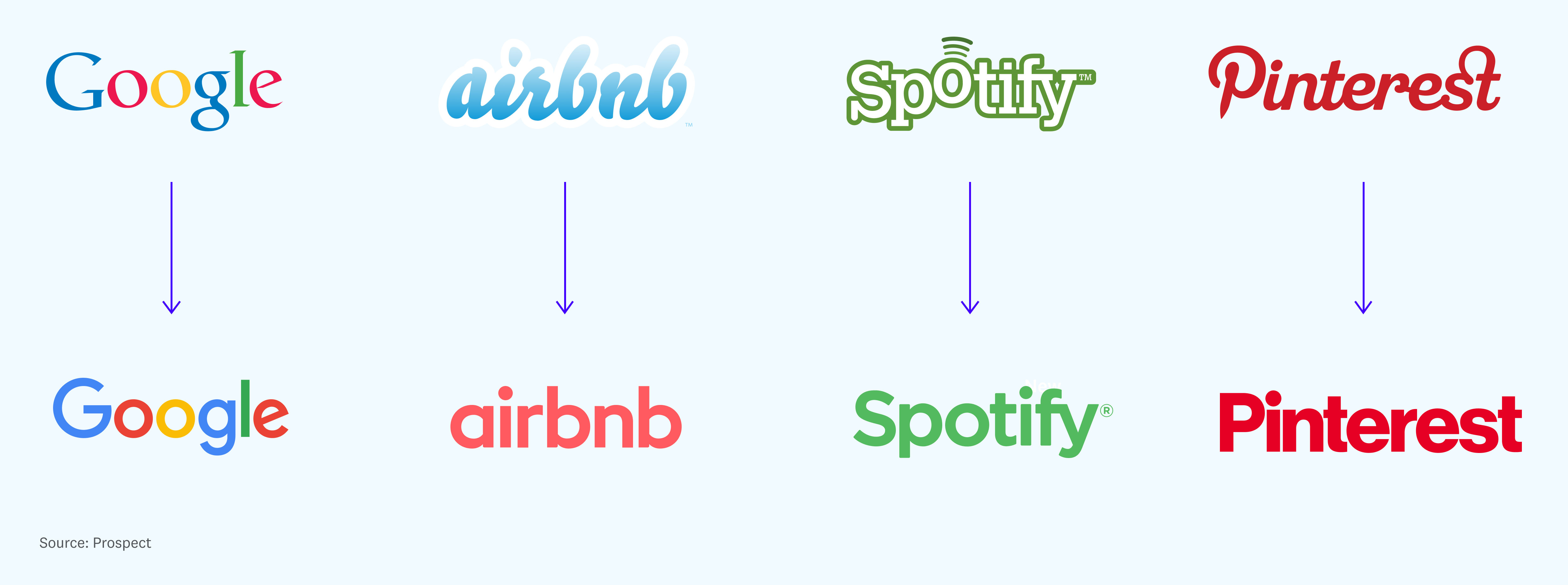
The new Pinterest logo is downright offensive, given how great the original was.