Hacker News new | ask | show | jobs
by bombcar 1740 days ago
> They calculated how much in monthly housing costs a person working 40 hours a week for 52 weeks a year at the minimum wage hourly rate in their state could afford. They then compared that to the median monthly homeowner and rent costs derived from the U.S. Census Bureau’s 2019 American Community Survey.

This … signifies nothing? Take a hypothetical state that consists of three people and three houses, one rented by me at my minimum wage job for $350 a month, and the other two rented by Bill Gates and Warren Buffett at $55m/month.

The median is way unaffordable to me, yet I have a comfortable rent payment.

Comparing minimum to minimum would be a more useful metric.

4 comments

I think they're using the median instead of the mean for exactly this reason. It's a more robust measure central tendency.

Looking at those rental prices it looked very accurate to me.

The real problem is why would they compare minimum wage with median rental prices?

Both are distributions.

Because many, many people are paid minimum wage: wages are not the same kind of distribution as prices.

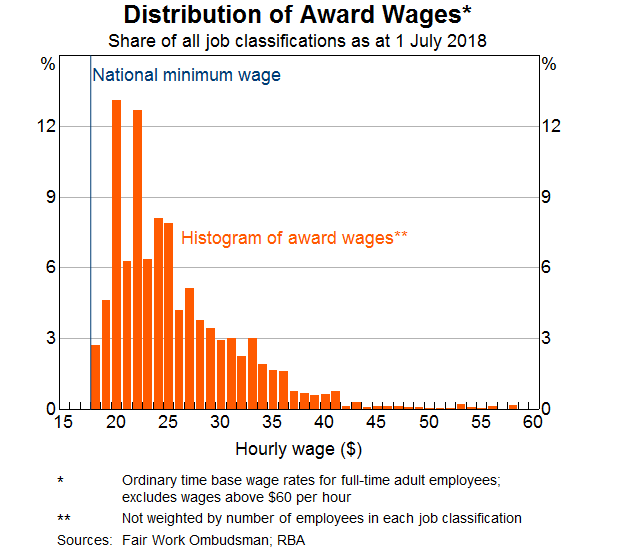
I don't know exact figures, but I'm absolutely certain that if you plotted the distribution of wages, you'd see a hugely disproportionate number at or just above the minimum wage. Y'know, because there's an artificial pressure (the law) preventing anyone from paying less.

Housing prices, meanwhile, are not subject to the same kinds of constraints. They likely follow a much more normal distribution (though not, I suspect, a normal distribution in the statistical sense).

Everything I'm seeing indicates there's a "hump" starting at minimum wage and increasing to an amount around $20 an hour, where it begins dropping again, but I've only found state-wide graphs such as https://www.rba.gov.au/publications/bulletin/2018/sep/images... (Australian)

I guess a minimum of 15 and a hump at 20 would be "at or just above" but 25% is a decent amount.

Well, and remember that in the US (which is where the article is about), minimum is less than half that.
>Comparing minimum to minimum would be a more useful metric.

Nope. This is minimum wage and sadly there are plenty of people with an income lower than that. You have to chart both progressively and simultaneously.

Bottom %1 income to bottom %1 rent, 1-2, 2-5, 5-10, 10-20 etc. I'm not familiar with the data so those bucket sizes and positions are almost certainly capable of being greatly improved.

The next question, and the one clearly being examined is raising the minimum wage. Seeing how it affects everyone all the way down is informative there.

So it’s a bad metric, because if you used it to measure your imaginary unrealistic state, it would fail? If you want to argue that it’s a poor choice, argue from something that’s a little closer to reality.
https://reports.nlihc.org/oor

Yep, it’s still not affordable in 93% of US counties for full time minimum wage workers to afford a modest 1BD apartment.

Full time work even at minimum wage can be hard to get in many places, where employers like Walmart deliberately schedule workers less than full time to avoid paying benefits.

That shows modest two bedroom but is still a much better dataset than the one originally posted.

Interestingly enough around here they’re advertising double to almost triple the legal minimum for entry-level service jobs such as McDonalds or gas station clerk and apparently are not having many takers.

Sorry I pulled a quote from an article that referenced that link, but in retrospect that landing page wasn’t citing my claim very well. The full report on page 17 shows hours needed to work per week to afford a 1BD apartment at minimum wage. The 93% number came from a prior year.

> No local minimum wages are sufficient to afford a one-bedroom rental home at the Fair Market Rent with a 40 hour work week.

https://nlihc.org/sites/default/files/oor/2021/Out-of-Reach_...

Even their infographic doesn't align. You can see plenty of shades for the 40hr workweek. Note that they don't break down the state by state summary for 1BR.

I personally know people living alone in low minimum wage major cities who defy this suggestion. Sure, not always in glamorous places. But I'm willing to bet across most of the east coast of the US you'll find counterexamples.

You can also see something interesting - at least in my state it shows a four bedroom as being about twice a "zero bedroom" - hence roommates likely are occurring.
> where employers like Walmart deliberately schedule workers less than full time to avoid paying benefits.

Your meme is at least 5 years out of date.