Google Backup & Sync is being replaced by Google Drive for Desktop, née Google [Drive] File Stream.
Unlike Dropbox, where filenames are searchable by name on Everything, here that doesn't seem to happen -- at least the indexing takes more than 15 minutes with UI frozen.
An interesting tidbit: Google Filestream allows mounting on a folder. Google Drive for Desktop doesn't support it yet. Another interesting tidbit: the configuration settings in Google Drive for Desktop was migrated to a JSON setting stored on a registry setting (just in case you try following the settings of Google Drive Filestream).
Ditto. The sudden inability to mount Google Drive to a folder instead of a separate volume in macOS finally got me to get off my ass and migrate to a self-hosted Nextcloud, something which honestly was pretty far down on my to-do list, so if Google hadn't made Google Drive so much more unusable out of nowhere then they could have continued harvesting data from me for who knows how much longer. They had to put in effort to lose me as a customer.
You won’t regret setting it up. I was hesitant at first as well but three years later with zero-downtime and 100% auto-update success I can honestly say I’ve spent less than 30 minutes administering it.
Currently have it running on DO with daily droplet snapshots and it’s a nice reassurance that wherever happens, I can get back to a working state and never lose any data.
My storage requirements are low and I’m currently using the 25gb or so of space that comes with the droplet. Unfortunately I can’t comment much on a Nextcloud setup with block storage.
How solid and reliable is conflict handling on Nextcloud (especially edge cases)?
I did extensive testing on this before adopting Dropbox, but am looking for an alternative now that Dropbox seems to be locking files and plastering ads for their other services instead of working unobtrusively in the background.
While we use a big share with 10+ users, I personally didn't get many conflicts during the Nextcloud installation's lifetime. I got a couple of "You changed this in two computers, and I need to sync both" states, and it duplicated the files with appending the hostname or something else useful. At the end, I either merged them myself or thought "meh, this copy is not needed anymore, anyway" and deleted one of them.
If other users got any conflicts, and got anything borked, I'd have known, since I'm the admin of the installation. However I can't guarantee anything. I think it's working reasonably well for other people, too.
It has some mitigation strategies, and has a pretty extensive list of transient files (like Microsoft Word lock files), so everything works pretty straightforward for us.
It's creating far less problems than I expected, though.
I think my parent comment gets pretty close to the heart of the issue. I don't think it deserves its downvotes. It is a problem of employee incentives.
There are multiple internal approaches to building things. Several of these approaches get funding and head count based on the amount of influence of the people who back them.
Decisions about which product to present to the public are made on technical merit with little consideration to consistency in user experience. The resulting chaos leaks to the end user.
Once a product has launched successfully, the best members (not just engineers) of the team that built it diffuses back into the main body of Google to work on other cool projects (they now have the required political momentum). Product enters stagnation phase.
In 2 - 4 years a technologically slightly better alternative is picked. No one thinks about how to make this switch seamless for their users. End users suffer even harder.
Plenty of people think about it, but the incentives are not set up to center these thoughts in the conversation about what to do. As with most publicly visible problems at any company, this is at its heart a failure of leadership. (Or a success of leadership, if it is indeed what the market and cost structure of the business rewards. I do not have sufficient insight into the financial side to know which. Just because a business makes a decision that is unpopular with its customers does not automatically mean that the decision is bad for the business.)
I agree, it is hard to say whether a decision that fucks over customers is actually bad for Google.
For example, the decision to start charging users for storage beyond 15GB. Even though I am not happy about it, I am paying and it looks unlikely that I will leave the Google ecosystem anytime soon.
The interesting thing about Google, though, is that they have so many products that they can actually run experiments over different approaches to product development.
Unfortunately, I doubt many people at Google would want to experiment with a product development approach by putting their career progression at risk.
I also worked at Google. Now I'm using Google's Flutter to build a mobile app. I worry that Flutter will stagnate and become unusable on mobile before I can afford native rewrites. Flutter's mobile support is already stagnating. Flutter Team has left many mobile features half-implemented: iOS widgets [0], dark mode [1], location [2], and camera [3]. They even hired an outside company to work on Flutter mobile extensions [4]. Flutter's engineers have moved on to web and desktop. Others have written [5] about this.
Beware depending on any Google tool for your business.
I see you're being downvoted, but I do wonder to what degree that might be true. Working on a team that maintains something old isn't terribly glorious. Rename the product, and now you have a "product launch" on your resume.
I'm in the Drive for Desktop beta program and it combines the Backup & Sync functionality with Drive File stream, so you can sync 'My Drive' to any folder on your computer in addition to having a drive letter for file streaming. It also supports multi-account support. I've had some performance issues with it so it still needs work.
I guess this doesn't help on Windows, but with the stable release of Drive on macOS I just symlinked the volume to the location of the original directory.
It's lazy and greedy and arrogant. It's catering to the lowest common denominator, pushing users into a cycle of manipulation and constant change, preventing any nuanced use of software, forcing users to increased dependence on a walled garden.
It's a dark pattern - don't let people use the software in unexpected ways that might take potential profit away from another service or future feature. If any use gives more value than was intended, that use will be curtailed, then properly monetized elsewhere, or simply (and more often than not) shut off.
If combinations of available settings reveal an actual bug, sometimes it's easier to take away the options than to fix the bug. But if it's simply a case that the software is doing things the developers don't want for any of the above reasons, they claim users are too incompetent to be trusted, and that they're removing the option for the good of the user.
It's a gross and vapid perverse incentive endemic to FAANG.
Good solutions exist for complexity and user configurations, like snapshots, reset to default, and so on. There's no excuse for mature software to lose configurability.
Google does have a history of specifically avoiding exposing settings to users.
See: some of the Chrome feature requests about making things user-configurable (off memory, related to download / execute behavior for enterprise web-launched apps), which Google closed with "Adding a setting would be incompatible with Chrome's design goals"
I think Occam's Razor, when it comes to Google's enterprise tools, suggests that nobody who is important to Google has complained about this. The understanding being that you can't get your voice heard unless you're a customer with 10,000+ seats.
You just have to be a workspace customer at all. I have ~80 seats and the feedback menu in the Drive for Desktop interface has gotten me direct replies from the product team, which has helped them collect the info they need to diagnose issues in the app.
It's fairly well documented that many projects in Google happen because that's pretty much the only way to move up the career ladder, and once the promotions have been doled out then the project loses its original stewardship...until someone else is looking for a promotion and sets their eyes on rebuilding that project. (Case in point, the numerous failed attempts to deliver or even brand/market a messaging app).
Naturally, as is it is these days, any new product or redesign is conceived in terms of an MVP. You could argue that the industry as a whole has taken this concept far too literally over the last decade, to the point of being cultish about it.
I don't dispute the parent poster's point in general, I just think it's more indifferent than lazy/greedy/arrogant, unless it comes to search or ads. That's arguably worse, but Google's reputation for delivering increasingly mediocre versions of its products (or shitcanning them entirely) does precede it.
Maybe: as opposed to companies that exclusively rely on income from happy users of their software. As long as users are locked into Google's platform it doesn't matter to their bottom line if an individual product is at best "good enough". Google can make money out of the user's engagement in other ways.
Configuration adds complexity and is a huge source of confusion for users. Google drive strikes me as something that should just work and be so simple that you do not have to configure it.
There does not seem to be any genuine reason to make this change a setting because the main objection is just "I don't like it" rather than "it stops me from doing x" or "it makes x harder"
It would be much less painful to just have users get used to the new behavior than to support a setting for forever. For people who want full power, custom clients exist for google drive which can work however you want.
We see a constant trend where users move towards products which just work rather than require manuals and configuration. Seems only sane that general public products like google drive should cater to this and if you want full power over everything, you have 3rd party clients, nextcloud, ftp, etc.
I don't think it's safe to reason from what the "main" objection is.
I see one of the comments on that page is:
« I just installed the new Google Drive desktop client (Win 10 pro) and the new virtual drive it creates triggers a non-compliance issue with ClearPass OnGuard that my employer requires (because the drive is not encrypted) and thus prevents me from connecting to their VPN. »
Maybe this OnGuard thing is being foolish, but that's no comfort to the user.
Maybe, but if corporate policy requires all storage to be encrypted and the tool to enforce that policy can't verify that whatever Google's software is doing is compliant, maybe not.
Different policies might be appropriate for software that is used by non-experts in a personal capacity and software that is part of professionally managed IT systems used for business purposes with regulatory compliance obligations. A lot of the modern trends from the likes of Google, Apple and Microsoft might make sense for the former group but they are a significant concern for the latter and for prosumer or small business users who might want to operate more like the latter but are stuck with software aimed at the former.
> Configuration adds complexity and is a huge source of confusion for users.
Sometimes confusion is the appropriate state. Companies (or at least products) often have to choose between retaining the most users (or worse, customers) and catering to a subset who know what they want and are willing to learn to use it.
Sadly Google these days always seem to go with the former, and not to care about the latter. This completely turns me off their products and ecosystem.
I guess companies are more interested in mainstream users than in technical users. The former are a larger group that seems easier to attract and retain, they mostly use defaults and don’t care that much about dark patterns.
Google has been following this approach for years now, simplifying the UX in a way that both 1. makes the product easier to use and 2. in a way that benefits Google.
Google has merged the url bar and the search bar in chrome, they force defaults on google search, and not long ago [1] we were discussing removing detailed cookie controls.
I would like to posit the idea that all feature changes target #2 far more than #1: to benefit Google as an org.
What if the emphasis of mainstream users is overstated? I find it more likely that an organization could be shaping features to coax its users into submission to make the org's life easier.
"Yes, mainstream users want this simplification. No, we can't share the data or methodology in which we surmised this. Yes, this makes our life vastly easier, but we want to excuse it by pinning it on mainstream users."
I've seen power apps (so by definition all the users are very technical and should not be patronized) that use the same reason to cut features instead of saying outright that it's too much to support. Maybe for a big org like Google it would be an admission of embarrassment.
I've come to accept that it's just a cost cutting measure for larger tech companies, why offer users an option when you don't need to? It costs extra to document, test and offer support for.
I can't really think of any software from a major tech company that I use frequently and that's been updated to give me _more_ toggles to customize the app. It's always to take things away.
For example on a small company we had one user that needed RTL support, this ment we create backend code to store his perferences, front end code to add UI for it and testing the feature.
We implemented because for a small company each user is important where big companies or projects(Firefox,GNOME will force this minorities to go elsewhere)
Sure, but as I said I was in a small company, 2 developers only that this was the first time we worked with RTL. The project was not targeting a global audience or a casual home user, it was something about helping with your job, only supports english... my point was that we did not answer with it is just 1 customer we can ignore them , we decided we can do the work, gain a new customer this week and maybe a few more in future , every one is important. If we code the things right we don't need to touch this code at each update.
Apple actually does really well at this where it matters. Their accessibility settings allow a huge amount of customization for making the devices easier to use for disabled people. They just don't have android rom style settings like changing the unlock screen to swipe down rather than up or turning the battery indicator in to a circle.
It's just... easier for engineers. Less to test, less code, less to think about. And right now, all software is being built at the pleasure of the software engineers - this is why you're also seeing shift towards things like Electron apps and less options and worse UX. It's just easier for the guy programming it and noone really cares about user experience because there's no real competition.
I mean, what are you going to do, use a 3rd party client for Google's services? You're not allowed to - at least not on the same service level.
Wild guess... but this sounds like the drive letter isn't really a feature but actually an implementation detail leaking through that they are trying to dress up as a feature. At least that would explain their insistence on users hiding the drive instead of removing it.
I believe, previously they just had a daemon running on the client PC that synced a local folder with the cloud storage. (Like Dropbox)
Now they seem to have switched to some sort of "fuse-but-on-windows" virtual device driver that accesses the cloud storage directly and presents it locally as a virtual drive. (Like OneDrive)
That's exactly what it is, and what the old Google Drive File Stream was.
Reading the comments here and in the linked forums, it seems I'm one of the few used to how Google Drive File Stream worked, and most of the complaints are coming from people more used to the folder-based variant, which has been now shoehorned into the other paradigm.
I think so. I'm totally not familiar with the pros and cons of mounted drives but I assume there are some operations that are possible or easier to do when it's a mounted virtual drive vs a plain folder? Something related to file streaming where you need to detect that a file is accessed on the fly and "stream" it if it's not already available on local disk?
The old one would often cause "this app is preventing Windows from shutting down", which normally would eventually resolve itself, but it was an annoying delay. Hopefully this new one is better in this regard.
I was very annoyed at the "upgrade wizard", it felt like of steps and very disruptive. One screen with a few checkboxes should have sufficed, perhaps an optional "advanced" button for those who want it.
Relatedly, I got more than one pop-up saying the new version was coming to which I felt "this is really not something you should bother me about before the actual upgrade".
Calling that an upgrade is interesting editorializing, forced downgrade is more like it. This is about as helpful as being forced to add an icon to your desktop, o well easy enough to use other software.
Seriously, I haven't tried Google Drive for Desktop but I won't even bother, given their track record.
Rclone is simply amazing, the developers are responsive, it supports every backend on the planet. It's a single lightweight binary written in Go, runs on Linux, Mac, Win, x86 and ARM, every feature you could ever need, thoroughly documented… oh, and open source. I mean, what else could one want?
Looking at the rclone feature set, it’s not clear if it provides a daemon to continuously synchronize a folder. I imagine that this is high up on the list of what “normal users” care about.
For power users, though, rclone does look quite nice.
Reason 421 to ditch Google. They have a couple of things I find handy, but wouldn't trust them with my data if they paid for it (and they don't).
It's not that I inherently don't trust them with privacy (though why should I?), it's the constant bullsh!t and bait and switch.
And even that, I tried to pay them for something the other day (I felt I had to while I considered other options), for the pleasure of paying them, they wanted my passport, utility bill and other details. Erm, nope.
They've collectively taken a dive off the deep end.
I never felt I'd get to a place where I feel I trust Windows on a laptop more than I trust Google.
Funnily enough I trust them to keep my data safe more than pretty much any provider.
Safe from everyone except themselves (google) of course, but then I litterally cant think of any provider/person I trust to not read stuff I put on their computer.
I don't. Just a few hours ago I noticed I started getting a bunch of guitar-related ads (like courses) after searching last night for a list of all the existing Guitar Hero guitars.
Could this be the first step to migrate away from the folder sync? So eventually you would have just the virtual drive approach.
Not an expert here, but I believe the folder sync is technically more difficult to get right and there’s likely lot of edge cases that give you lots of trouble.
That seems plausible to me! I know at Dropbox we always spent a lot of time “playing nice” with the operating system while still providing a very deep and seamless integration. So much complexity and working with gnarly and changing APIs.
I am pretty sure this is one of the last steps not first steps.
Been using this type of google drive for years now, mounts a virtual drive (with ability to always sync some folders locally + cache of contents).
I do miss the idea of my local copy being a backup of the cloud contents, and having to be a bit more thoughtful about syncing up chunks of documents and folders for being disconnected. Given how large the amount of data actually stored is, and how little gets frequently used, it makes life a lot easier.
In terms of bugs, I'd like to add a particularly interesting one, where for some reason, the latest Google Drive can cause UWP Icons to disappear. Now, this is some odd interaction between Google Drive and Windows, but it is... strange [0].
If you have a server and like provisioning stuff, do yourself a favor and make a Nextcloud. You can run it off pretty much any hardware made in the past 10 years, and you straight-up don't need to deal with asinine workarounds like this. It's just like the old days, you and a WebDAV folder, as God intended.
If you can't set up a server but still want a good sync solution, use Syncthing. It's a decentralized solution that doesn't require a main server, and lets you create incredibly intricate sync solutions.
Why can't they just do the same as dropbox or onedrive, where they use Windows file system filters on a regular folder (no mount points).
To all the people who suggest alternatives, our entire org is run by xooglers and they put everything in Google Drive. I have no choice but to use this crap. To make matters worse, I cannot use any third-party client (or even roll my own) because it is not allowed by the security policy.
I was once replied by a google engineer,
“We put a lot of thought in things we do, we do whats best for users”.
Well every time that arrogance goes wrong I paste this, to reinforce my belief on how google functions.
Frustration with Google sheninangans turned me into a mainstream user who now accepts defaults and in retrospect, I don't miss a thing. Wonder if this is by design.
It needs to run with elevated privileges in order to do this, right? So into the trash it goes. This is right up there with keyboard and mice configuration software running as daemons with administration privileges.
Yes. You don't see it often, but drives can be mounted per user session instead of at the system level.
The easiest way to see this is to use subst to map a drive and then try to navigate to that drive from a UAC-elevated command line. (You won't see the drive since it exists in a different session.)
Mapped network drives and drives shared over remote desktop are other examples of per-user mounts.
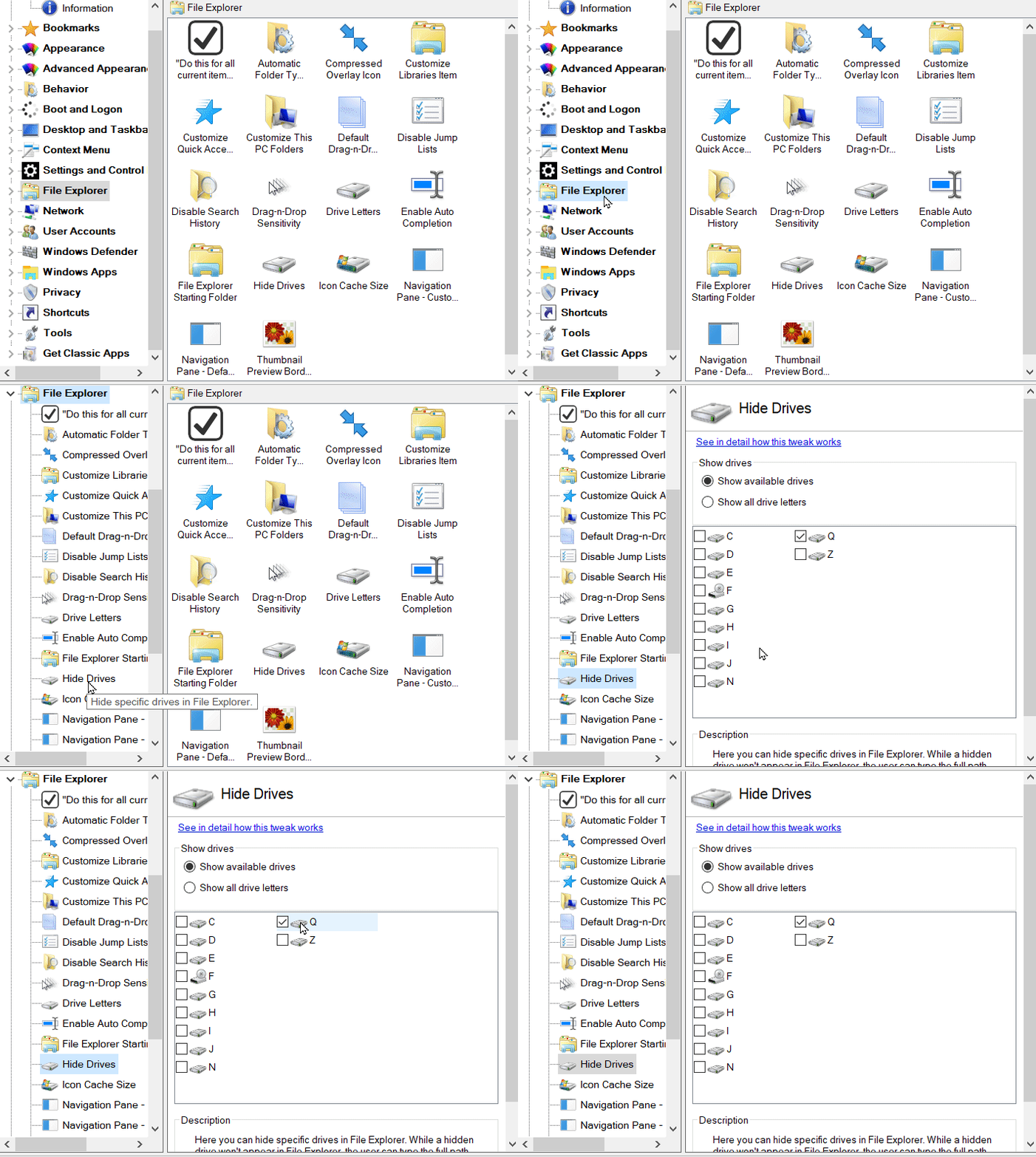
Unlike Dropbox, where filenames are searchable by name on Everything, here that doesn't seem to happen -- at least the indexing takes more than 15 minutes with UI frozen.
An interesting tidbit: Google Filestream allows mounting on a folder. Google Drive for Desktop doesn't support it yet. Another interesting tidbit: the configuration settings in Google Drive for Desktop was migrated to a JSON setting stored on a registry setting (just in case you try following the settings of Google Drive Filestream).