Hacker News new | ask | show | jobs
by ogurechny 1831 days ago
A lot of valuable work on Blender side, but the main goal is questionable, and author explains why.

Pre-calculated lighting had very little to do with physical correctness, it was purely an artistic placement of light sources in a specific map processed with a specific tool (official or third party) with specific defaults. Two adjacent rooms could be lit in a very different manner because map maker decided it looked good; two maps coming from different sources could not be expected to share any common lighting principles. Quirks like overbright values were not even consistent among officially supported renderers, and were inherited by later Quake and Source engines (which would add their own quirks and light processing options). To put it shortly, there was no reference for the final result except the final result itself, and it often was unstable (changing textures, geometry, or processing constants would shift the look too much, and require fixes).

To make the game look as intended, you have to somehow rely on original lightmaps that are tightly coupled with original low resolution geometry and textures. Given that people still argue which of the original renderers gives the “true” picture, I have my doubts about making a new one that pretends some average light model is good enough for everything. Even for episode 1, hand-placed lights had to be reintroduced into the system, and ad-hoc fixes had to be done, but manual fixes are not an option for all the existing maps.

1 comments

> but the main goal is questionable, and author explains why.

Kind of, but on the other hand:

> people still argue which of the original renderers

Now you have N+1 renderers - I'm not sure why the new one would be any more questionable than the last N-1. Obviously you shouldn't pretend this is somehow "the way it was meant to be rendered", but they don't seem to claim that; rather, this is one additional option of how to render it, with novel upsides not shared by the previous ones (but also with it's own set of downsides).

This isn't new. In the very beginning, people made custom patches for LIGHT.EXE to fix bugs and introduce exciting new options, then made their own tools. After the source release, ports started adding everything their authors considered cool (bump mapping! every cool game has it!). Modern rendering technologies are used, too — though I really doubt something as simplified and optimized for the goal of being playable on contemporary hardware as Quake is a good test case. It feels like using a rotating cube to showcase ambient occlusion, visual effect shaders, etc. You'd better use more complex data.

I'm saying that all of that doesn't converge. For lighting, we have original map data with original lightmaps, and that's it. How to interpret these? We can often reason about the port author used to check how the map looks, and sometimes guess whether author was lazy (guys, any map that is not pitch black is playable) or made very specific choices that have to be presented more or less intact. This makes any decision, even purely technical, an artistic choice. Should we render it this way? Sure, why not. Should we add motion blur? Sure, why not. Should we add lens flares? Sure, why not. And so on, and so on.

This might look like rambling, but there is an example of nonsense that is so ubiquitous most people don't even understand there is a problem: rendering resolution. To run software Quake in “mere” 640×480 with 25+ fps in 1996, you had to use the top home PC configuration available. And, contrary to modern expectations, first generation of hardware accelerators did not perform much better, there were no 60 fps 1280×960 crazy rides. They allowed to maybe play at the same ~25 fps (often in puke HiColor) if you did not have a monster 200 MHz Pentium, and be happy about it. Professional OpenGL accelerators are often mentioned, but their fillrate was actually less than that of a Voodoo, and they targeted the same typical resolutions (the difference was that they implemented crazy realtime pixel shading like reflection mapping in hardware, and offered the same fillrate in scenes using it, hence the crazy price tags). So 640×480 was Ultra Super High Definition in which people would realistically play Quake, and most would definitely use a lower one. Consequently, the complexity of 3D objects and textures match that specific range of screen resolutions.

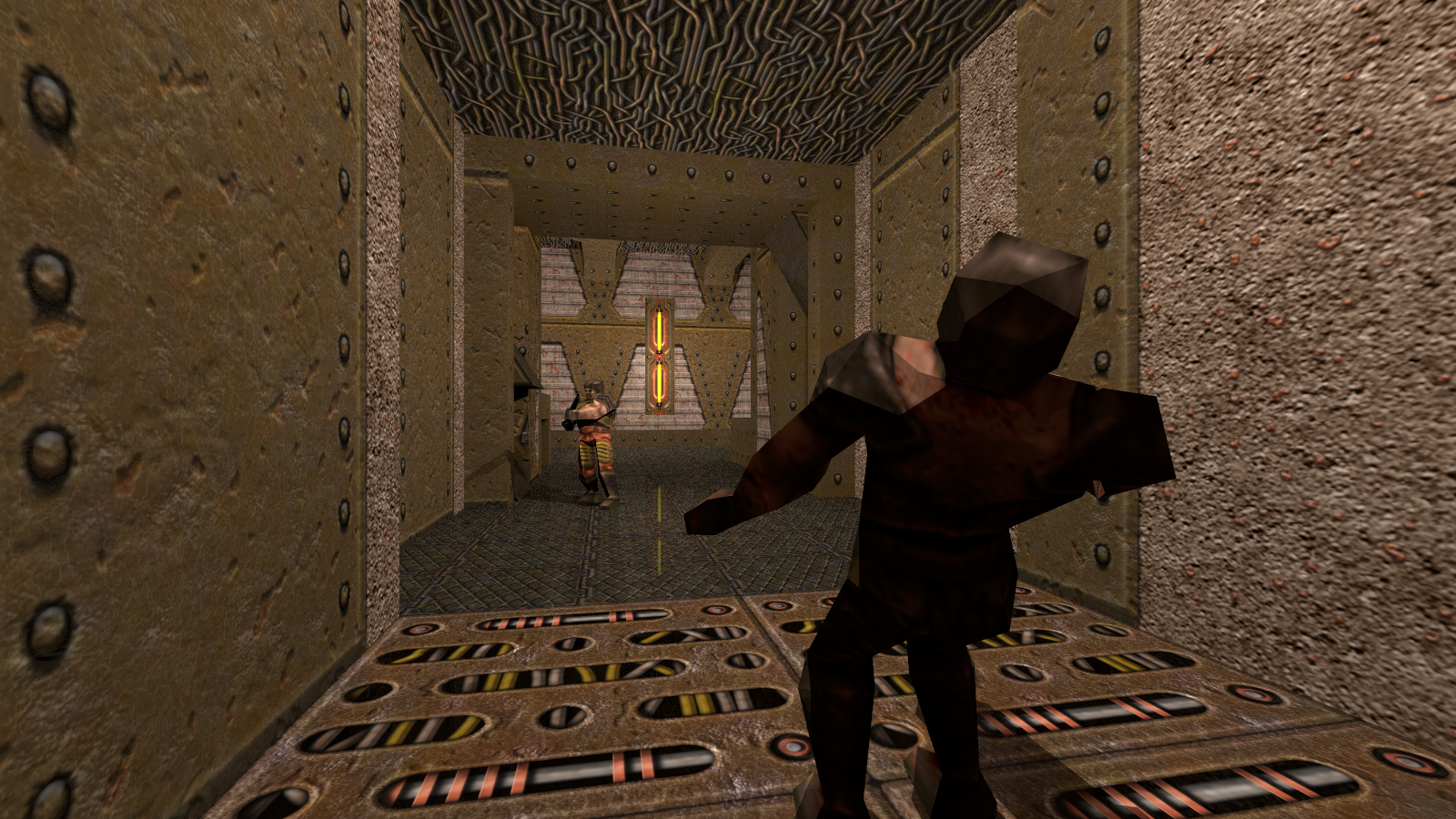
What does anyone playing an old 3D game, streaming, or recording videos do today instantly on the first run? Setting game resolution to native, FullHD and higher. And then the game starts to look like empty amateurish junk from mid-2000 because neither geometry nor textures are matching the rasterizer resolution. Those giant flat polygons with sharpest edges never were the intended look of the game. People feel that something is wrong, add lots of common and uncommon texture filtering, make high resolution substitutes, but it all looks like a makeup on a corpse. The fix is not using the improper resolution in the first place. But this is so common that a lot of young viewers believe that this is how “retro games” looked like. They even make their own works based on that assumption.

My rose colored glasses of sentimentality says that going from p166 to voodoo1 was going from 320x240 to 640x480, where you could find people much better.

But yeah, you never saw the blockheads of https://blog.habets.se/static/2015-03-27-e1m1-2c2b74e-0102.p...

Triangle count in models were just never a thing I remember seeing.

At the same time, though, we had nothing to compare to. It was perfectly normal that the legs move the same way when you ran forward as when you ran sideways.

So it's not just "what did we see then with eyes from 2021?", but "what did we see then with eyes from 1996?".