|
|
|
|
|
|
by a1369209993
1831 days ago
|
|
|
> but the main goal is questionable, and author explains why. Kind of, but on the other hand: > people still argue which of the original renderers Now you have N+1 renderers - I'm not sure why the new one would be any more questionable than the last N-1. Obviously you shouldn't pretend this is somehow "the way it was meant to be rendered", but they don't seem to claim that; rather, this is one additional option of how to render it, with novel upsides not shared by the previous ones (but also with it's own set of downsides). |
|
|
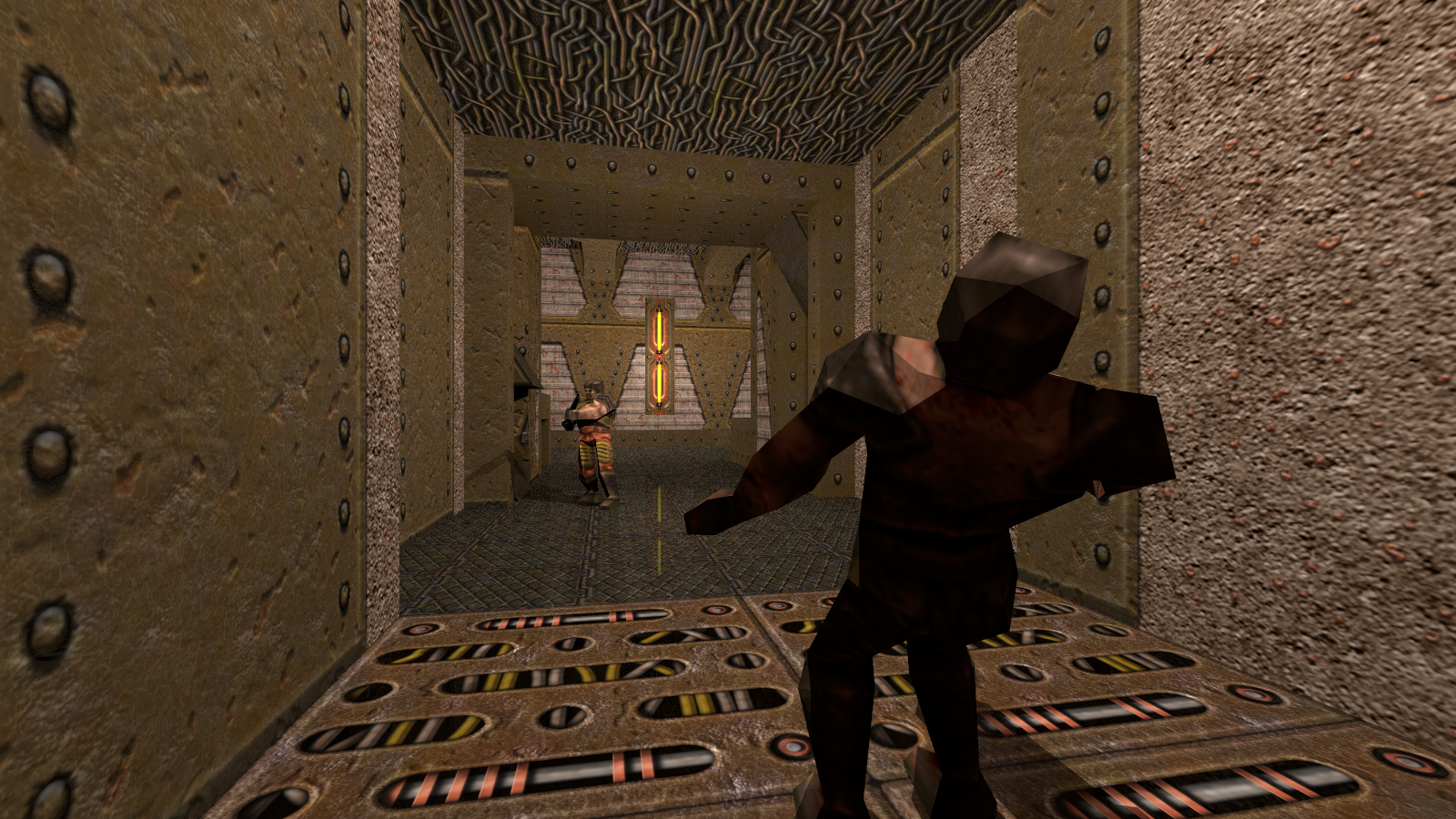
I'm saying that all of that doesn't converge. For lighting, we have original map data with original lightmaps, and that's it. How to interpret these? We can often reason about the port author used to check how the map looks, and sometimes guess whether author was lazy (guys, any map that is not pitch black is playable) or made very specific choices that have to be presented more or less intact. This makes any decision, even purely technical, an artistic choice. Should we render it this way? Sure, why not. Should we add motion blur? Sure, why not. Should we add lens flares? Sure, why not. And so on, and so on.
This might look like rambling, but there is an example of nonsense that is so ubiquitous most people don't even understand there is a problem: rendering resolution. To run software Quake in “mere” 640×480 with 25+ fps in 1996, you had to use the top home PC configuration available. And, contrary to modern expectations, first generation of hardware accelerators did not perform much better, there were no 60 fps 1280×960 crazy rides. They allowed to maybe play at the same ~25 fps (often in puke HiColor) if you did not have a monster 200 MHz Pentium, and be happy about it. Professional OpenGL accelerators are often mentioned, but their fillrate was actually less than that of a Voodoo, and they targeted the same typical resolutions (the difference was that they implemented crazy realtime pixel shading like reflection mapping in hardware, and offered the same fillrate in scenes using it, hence the crazy price tags). So 640×480 was Ultra Super High Definition in which people would realistically play Quake, and most would definitely use a lower one. Consequently, the complexity of 3D objects and textures match that specific range of screen resolutions.
What does anyone playing an old 3D game, streaming, or recording videos do today instantly on the first run? Setting game resolution to native, FullHD and higher. And then the game starts to look like empty amateurish junk from mid-2000 because neither geometry nor textures are matching the rasterizer resolution. Those giant flat polygons with sharpest edges never were the intended look of the game. People feel that something is wrong, add lots of common and uncommon texture filtering, make high resolution substitutes, but it all looks like a makeup on a corpse. The fix is not using the improper resolution in the first place. But this is so common that a lot of young viewers believe that this is how “retro games” looked like. They even make their own works based on that assumption.