There's a good reason to demolish much of that. It is overwhelming [1] in scale very ugly and not even painting it would help much. This building on the photo of Elista is nothing to look at.
But that photo from Makhachkala looks rather pretty and on a human scale. I imagine when the trees are green it must be a nice place (judging only from this one photo, don't know it IRL).
I agree it's indeed pretty ugly, but if you want to destroy every building looking that ugly, you will have to tear down half the cities in Europe -- and probably also many other places.
Honestly, without the written cyrillic, this could be many places in e.g. France or Italy.
I can only say I've been to a few cities here and there and nowhere did I feel as overwhelmed by the scale as in Moscow. Many of the cities remained not that high, London or Paris do not have such buildings in their city centers.
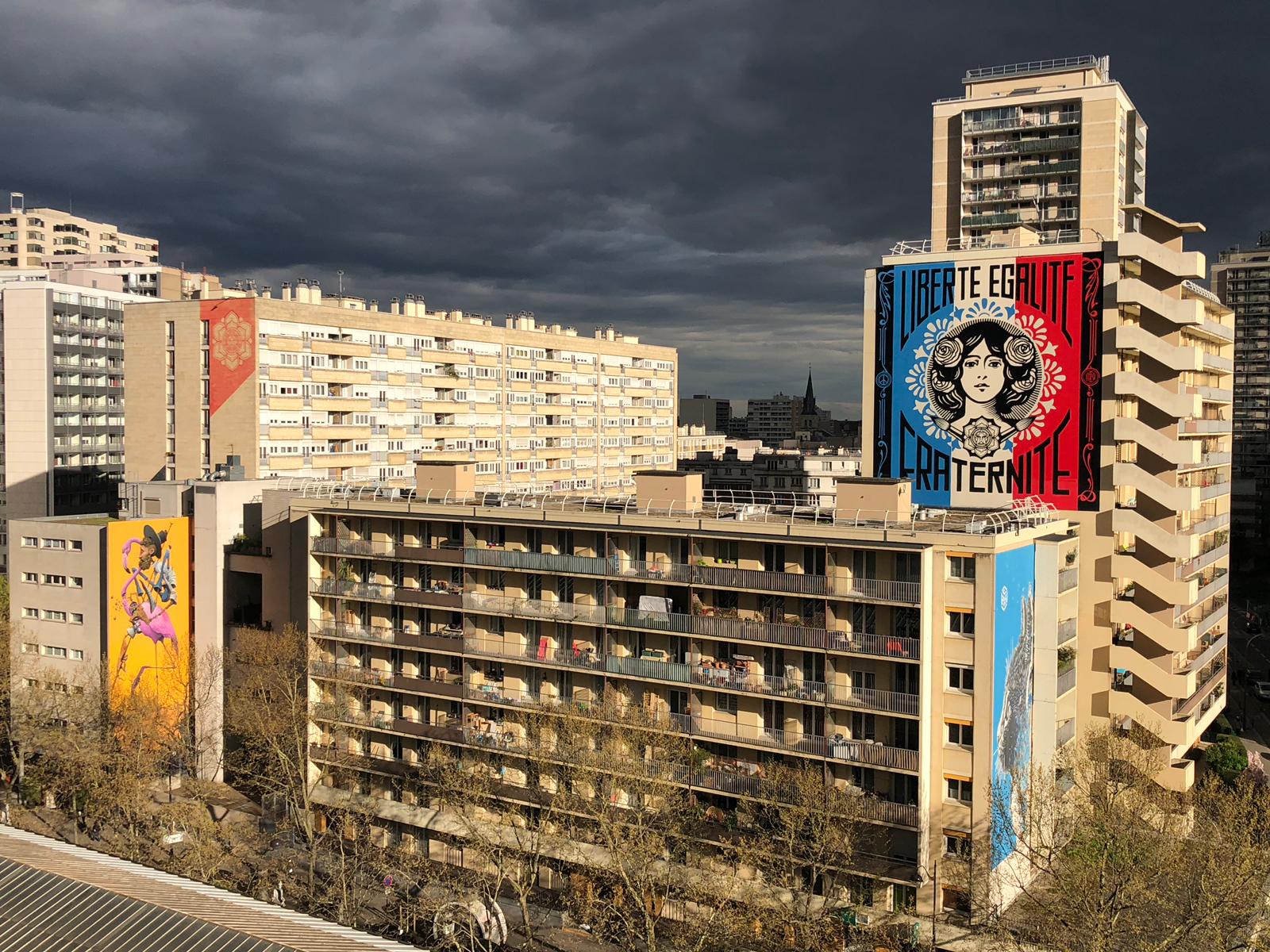
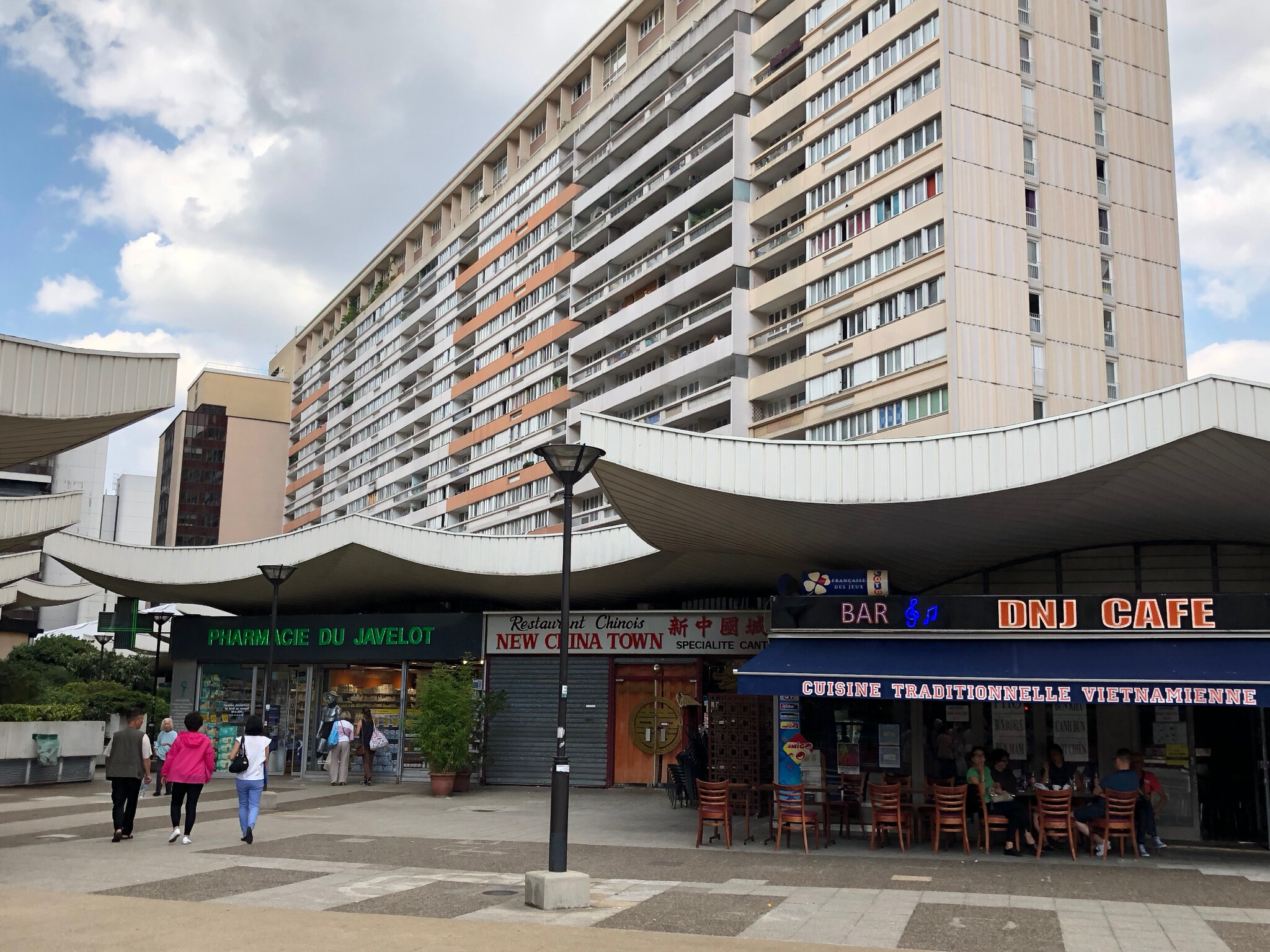
> That Paris thing is certainly bad, but it looks rather like a backside
I live in Paris; believe me, the best and the worst are two streets away. There are quarters in the 18th or the 13th that make OPs photo look like a dream.
Now there is a lot of subjectivity here, and to be honest, I'm not fond of the Warsaw building either, so I might be a very poor judge of modern architecture.
I agree that many if not most of these buildings are ugly. Many should be preserved though; normally this is done by a decision of a local body including architects and other experts.
These things aside, for someone visiting Crimea, for example, these buildings do matter a lot. They basically move you in time. You can actually get a strong feeling of things that you know maybe from very early childhood or mostly from books or documentaries. It is very, very different from anything you could see in the West.
Orientalism is the term coined for the Euro- or America-centric views of the Eastern Hemisphere during the Soviet period and the 19th century. The idea that there was this cohesive concept of "The Orient" as a Mysterious Other, waiting to be settled or tamed by the righteous West, when in reality the "orient" was just a place populated by regular people with their own culture to be sure but perhaps not so different from small-town USA (or wherever) as one might think.
What I suppose they're driving at when they say that "expedition" carries "orientalist associations" is that describing a trip to post-Soviet states in today's world as "an expedition" is reductionist in that it implies those places are akin to the savage frontier into which Europeans and Americans ventured in search of land to appropriate from the indigenous populations.
Now, I'm sympathetic to the idea that a Dagestan native might take umbrage at a trip to their home being referred to as an expedition, as if Dagestan is wild and untamed frontier ripe for staking land claims and colonization. It's somebody's home, hypothetically.
But considering the author is a Russian who probably speaks English as an nth language, I'm not so sure that I'd agree with the TFArticle's characterization of the term "expedition". I speak French and my command of the vocabulary is not nearly as good as in English for me. Words have subtext and nuance, and unless you master a language you're bound to choose inapt words that might give off the wrong connotation inadvertently.
It reads like virtue-signalling to me on the part of Valeria Costa-Kostritsky.
> Orientalism is the term coined for the Euro- or America-centric views of the Eastern Hemisphere
Somewhat ironically, the "Orientalism" you are referring to is an American-centric interpretation, which doesn't really have global acceptance as a theory. Orientalism was attempted to be redefined single handedly redefined in 1978 by an American professor (Edward Said with a book of the same name).
Notably, America is pretty unique in considering "oriental" an offensive term - Europe & elsewhere use the term freely without any negative connotations.
> Europe & elsewhere use the term freely without any negative connotations.
You are wrong, some do, some don't. I would debate that its reduction is usage is because of the negative connotations, but let's leave it at that.
Edward Said has been hugely influential also in Europe's academia and intellectual discourse. I would also be astonished if there had been no influence in "the orient".
I'll go one step further against this idea that "oriental" is some offensive term. Where I am, smack dab in Asia, oriental is used without an issue, being included in the names of buildings and companies.
I'm betting that the "offensiveness" of the term, if it ever takes root here, would likely be a invasive American import than homegrown.
> Europe & elsewhere use the term freely without any negative connotations.
that's not true - a friend of mine, an European academic in (east) Asian studies - told me the whole academic field in Europe considers the term outdated and incorrect.
> The idea that there was this cohesive concept of "The Orient" as a Mysterious Other, waiting to be settled or tamed by the righteous West
That's an interpretation I never heard. Here in France (and in Europe as far as I know), Orientalism is an artistic current from the 18th to the early 20th focused on taking inspiration from the faraway, exotic, attractive Eastern cultures. To make a crude comparison, it would be much closer to “weeaboos” (albeit larger in scope, ranging from Maghreb to Afghanistan) than to the White Man Burden.
Although there were a lot of cliches born there (the Turkish harems, the Arabian cheikhs, the wild and free Bedouins, the proud and fierce Afghan warrior, etc.), there was definitely no feeling of need of settling or taming, as the whole point was the fascination for these cultures that hadn't really seeped through Europe until then.
I think you’re talking past each other. Parent is referencing Edward Said, but mixing in an Americanism about “taming the frontier” that doesn’t really apply. Said’s talking more about colonialism.
> Orientalism is an artistic current from the 18th to the early 20th focused on taking inspiration from the faraway, exotic, attractive Eastern cultures.
You’re not wrong, but Said’s work really changed the way that movement is generally understood.
> Said’s work really changed the way that movement is generally understood.
With all due respect to Said, I'm not yet willing to accept the complete redefinition of a term well-anchored in European art history for over two centuries on the basis of a book by a single American scholar -- book which is, moreover, highly debated by other academics of the field.
Do you think that the usage in TFA that started this dumb thread was about art history?
Your original response to parent was “I haven’t heard this before, so it must be wrong”. That’s a very boring way to approach the world.
Now you’ve pivoted from saying the usage is unfamiliar to dismissing it as “highly debated by other academics in the field”, implying that you are familiar with it after all! Okay.
Considering that all of Africa and parts of the Middle East were partitioned and colonised by the European powers in the late 19th century, and India had been colonised much earlier, and China had been pacified by the Opium Wars (and still hasn't forgiven the UK for those) I'm not sure how you can say there was no interest in settling or taming.
The artistic cliches were froth that made these distant locations somewhat comprehensible to home audiences. Not incidentally, they also sold them as investment opportunities and potential locations for personal commercial and military adventures - and occasionally artistic and erotic adventures too.
Because you're conflating a geopolitical current (colonialism & imperialism) with an artistic one (orientalism) -- in fact, the artistic current actually predates colonialism in the concerned geographical regions, with e.g. Ottoman art becoming fashionable in the 18th century or Antique Egypt fascinating Paris after Napoleon's expedition in the early 19th century.
Just like nowadays, exhibiting a taste for Vietnamese or Bengali culture doesn't imply that you are a staunch supporter of children's slavery, 19th century people fantasizing about lascivious odalisques and fierce Cheikhs or Byron writing about Transoxania doesn't have much to do with the Concessions harbours.
Good distinction. But that conflation is exactly the purpose of contemporary use of the word "orientalism". It makes it impossible for Westerners to engage with these cultures while maintaining social or aesthetic acceptability; intentionally, the only option left open is to sit down and shut up.
I for one will be glad to witness the demise of modern architecture, and a return to human friendliness. I'm tired of being crushed by some grand architect's great ego piece, or "utilitarian" philosophies of living spaces.
One example taken directly from my life is that the exterior of older buildings offer dramatically more shelter from the elements to both passerby and the homeless. Modern buildings will rarely have doorways or awnings to shelter in.
And when they do they are often built to a gigantic scale that is drafty and relatively exposed.
Nooks and crannies vs 90 degrees of flat concrete.
Brick, wood, stone vs stainless steel and glass.
Window sills with moulding you can sit on. That's warm because its made of wood.
I don't know if I should be disappointed by the pretty philistine reactions here. In the MDM in Warsaw I find so satisfying the fact that monumental reliefs show office and factory workers, mothers etc. instead of political leaders or so-called great people. I'm well aware that this is Stalinist 1950s architecture but to some extent you can enjoy art in abstraction from its historical context. I would likely agree that overt references to communism should be visibly contextualized or closed in a museum.
Monumental, uncompromising modernism to me expresses the desire to boldly go, as a civilization, and conquer nature both inside and outside of us. Today this desire is very controversial for pretty much all mainstream sensibilities - but I don't think we should rob the future generations of a chance to interact with this on their own.
Disliking Soviet architecture doesn’t make one a philistine. Especially when much of it was forced upon the populace at the point of a gun.
Regarding Warsaw specifically, most of those monuments are still in existence because they didn’t depict actual people, only generic workers. There were plenty of other monuments of individual political leaders that have been torn down since the collapse of the USSR.
In any case, many of these buildings are interesting but I’m not sure I’d ascribe a positive aesthetic opinion to them. Most of the best urban design in ex-Soviet countries is in pre-Soviet cities.
> Disliking Soviet architecture doesn’t make one a philistine.
Surely not - what does is declaring one's taste the main test for demolishing stuff or not. It may not be strictly architecture, but for a long time in the 20th century folklore scholars refused to document things that weren't "pure" enough in their folkloriness, but were "contaminated" by references to the urban/modern culture. We lost quite a bit of cultural history because of that. There should be some humility here, the generations after you can have different tastes.
> Especially when much of it was forced upon the populace at the point of a gun.
I can sympathize in some of that logic - that's why I said that we should have the right to move or alter things that are blatantly against our values. It's good that the monuments of Lenin and such were torn down. But if we follow that to the extreme, maybe the whole historical city of St. Petersburg should be demolished (if you know how it was built), and the Pyramids, and maybe even most of the old royal residences and castles around the world.
The question isn’t really what “we” should tear down, it’s what the specific country wants to do. And I don’t think most people would agree with your designation of what “good values” are supposed to be.
Warsaw is filled to the brim with Socialist Realist architecture, which itself was far, far more political than basically any form of pre-20th century architecture like that found in St. Petersburg. It was explicitly designed to convey an ideological program that was forced upon the country.
It’s also the remnant of a state which terrorized and oppressed the country for half a century. Not to mention that Warsaw was only rebuilt because the Soviets let the Warsaw Uprising fail and then let the Nazis destroy the city block by block.
It’s a false equivalence.
All that aside, I’m sure there will be plenty of the buildings preserved for posterity. I wouldn’t worry too much about that...there are simply so many of them.
> The question isn’t really what “we” should tear down, it’s what the specific country wants to do. And I don’t think most people would agree with your designation of what “good values”
I'm not saying what the good values are, this is purely your invention. The only thing I assume is that maybe people want to be led by some coherent logic in what they do, regardless of the specific values that they have. Aside from pointing out that destruction, well, destroys things.
The old architecture wasn't built because it was just "pretty" either. If you don't see oppressive politics and an ideological program that was forced upon the country in tsar Peter I's works it just means that you 1) are forgetting some history, 2) aren't reading the architecture close enough (as mainly art historians are taught its deeper idioms) or 3) just care less about things than happened a sufficiently long time ago. Which is what will also happen with people's perception in the future, sadly or not.
edit: I didn't see your last paragraph when writing my response, and maybe wouldn't be prompted to write if I did. All I can say is, maybe.
I'm pretty sick of modernism, having grown up in a Canadian city that made heavy use of it in he 50-70s. There are some gems, but mostly it doesn't make for an appealing style when a lot of the office and apartment buildings bet heavily on it. Some of more luxury modernist homes and government buildings are exceptions, but you do have to have a sense of why they're neat, because they otherwise feel very conservative.
As a person? Kind of an idiot. As an architect? Most of his stuff predated the stuff I'm thinking of, and most his work is at least interesting to look at, despite apparently being not very well-designed overall. I don't know if you'd necessarily look to him for examples of modernism
ah we're doing the thing where we judge photos of concrete soviet-era buildings taken during the winter, as if the rest of the northern hemisphere doesn't look bleak without foliage as well.


But that photo from Makhachkala looks rather pretty and on a human scale. I imagine when the trees are green it must be a nice place (judging only from this one photo, don't know it IRL).
[1] The Ship https://www.google.com/maps/@55.7108903,37.6218164,3a,75y,21...