Hacker News new | ask | show | jobs
by DigitalSea 1860 days ago
There are quite a few papers out there on the subject. As someone who has studied a little bit of sociology, I can tell you there are numerous sociological factors which basically determine that wealthier people have access to better food, better medical care and live healthier lives in comparison to lower-socioeconomic people. Where you live alone determines your health equity, if you live in a remote area or small town away from a large city, your access to fresh and non-processed foods is heavily reduced.

This is a great paper I suggest you read: https://academic.oup.com/epirev/article/29/1/29/433380 -- this is a good starting point, there are others spanning back the last three decades or so.

It is also worth noting that it's not necessarily how much money you have that is the contributing factor, it can be other factors. The lack of green areas or pathways to walk/exercise (especially prevalent in remote Australian communities), the number of hospitals or doctors close by. But, ultimately, lack of health services and fresh food are correlated to obesity both of which are determined by your location which, in turn, is determined by your financial status.

2 comments

> if you live in a remote area or small town away from a large city, your access to fresh and non-processed foods is heavily reduced.

Do you really think this? I know the sticks. You apparently don't. You can live off potatoes, eggs, and oatmeal and not be fat. Those are available anywhere.

There is a "poor" culture, there is an "elite" culture, and then there is a "responsibility" culture. I grew up financially poor in a manufactured home in the sticks, but my culture of my parents was that of "responsibility". Know the difference.

"The Road to Wigan Pier" had a great bit about this, which hits the nail on the head based on my experience being working class:

The basis of their diet, therefore, is white bread and margarine, corned beef, sugared tea and potatoes—an appalling diet. Would it not be better if they spent more money on wholesome things like oranges and wholemeal bread or if they even, like the writer of the letter to the New Statesman, saved on fuel and ate their carrots raw? Yes, it would, but the point is that no ordinary human being is ever going to do such a thing. The ordinary human being would sooner starve than live on brown bread and raw carrots. And the peculiar evil is this, that the less money you have, the less inclined you feel to spend it on wholesome food. A millionaire may enjoy breakfasting off orange juice and Ryvita biscuits; an unemployed man doesn't. Here the tendency of which I spoke at the end of the last chapter comes into play. When you are unemployed, which is to say when you are underfed, harassed, bored and miserable, you don't want to eat dull wholesome food. You want something a little bit 'tasty'. There is always some cheaply pleasant thing to tempt you. Let's have three pennorth of chips! Run out and buy us a twopenny ice-cream! Put the kettle on and we'll all have a nice cup of tea! That is how your mind works when you are at the PAC level. White bread-and-marg. and sugared tea don't nourish you to any extent, but they are nicer (at least most people think so) than brown bread-and-dripping and cold water. Unemployment is an endless misery that has got to be constantly palliated, and especially with tea, the Englishman's opium. A cup of tea or even an aspirin is much better as a temporary stimulant than a crust of brown bread.

So yeah quite irrational, but it is comforting.

>The ordinary human being would sooner starve than live on brown bread and raw carrots.

The only people who think that have a very privileged upbringing. My SO worked in an archaeological site in central Asia, and the vast majority of the hosts meals were just raw onions and stale flatbread.

Not irrational at all. I've often wondered at some ascetic values of the very rich: cold showers, building a cabin with your own hands, short duration of rough wilderness living, and in your quoted case, abstemious diet. Humanity spent generations trying to escape those conditions, poor people will never willingly engage in them. Is it because the rest of rich people's lives are elevated away from those conditions, so it's a choice to embrace it, and thereby redefining the thing's perceived values?

Yet another data point on why the poor are playing the lottery, eating crisps and not virtuously buying and cooking rice and lentil, there's a game-theory-ish idea that the poor understands that as much hard work and lentil they could shovel, they stand little chance of getting out. So with the money they have they buy the best value thing possible, discounted for future possibilities; and those best value things are junk food, lottery tickets, sometimes expensive (relative to their circumstance) and flashy things like clothes or phones.

"if you live in a remote area or small town away from a large city, your access to fresh and non-processed foods is heavily reduced."

This simply isn't true. Most food deserts are in the poorer areas of the cities because nobody is bringing fresh produce in there to sell. If you live in the country or small town, many of these places have farm stands, farmers markets, and local farmers providing seasonal produce to the local stores.

Not to mention, lower density housing generally means that there is enough land to have a veggie garden, depending on the specific circumstances.

Rural areas being chock full of farmers markets is mostly nostalgia, anyone I know who lives in the country is far more likely to shop exclusively at Walmart than anyone in the city, and likely to prefer more non-perishable food (i.e. processed) because daily or multiple times a week shopping trips are infeasible.

The farms in rural areas are generally focused on growing a single thing (either one type of livestock, or all corn, etc.), entirely for wholesale, farmers markets are a distraction for most of them, outside of smaller farms that are more of a lifestyle / hobby thing a lot of the time.

Farm stands sometimes exist, but they're an exception rather than the rule in most places, and unless you're in an area known for growing fruit or something like that (and primarily selling to tourists driving by) it'll be one-off things like sweet corn in season or eggs.

You're both kind of right here. The farmers market stuff is mostly BS.

In the rural areas the weekly/biweekly shopping routine involves everyone (rich and poor alike) dragging their butts to the one strip mall in a 1-2hr radius and that strip mall will have at the bare minimum a super-walmart with a good fresh produce section or a Walmart with a grocery store beside it because that's the place where rich middle and poor from the entire area shop and it needs to cater to them all in order to get them to drag their butts there and do business. The poor will buy less and fill in the gaps with Dollar General food (which is bad food at a bad price).

The poor urban areas which can't economically support supermarkets and who's residents can't economically justify traveling the range they'd need to travel to get to those supermarkets (because the run down not always running cars that underpin the transportation of the rural poor are not as economically viable in cities) so they're stuck buying food at CVS, the bodega or whatever convenience store is accessible.

If you draw the food desert line at "no Whole Foods and no farmers market" then they both suck. But if you zoom in on the area below that the rural areas have a slight edge.

Why are farmers markets BS?

"If you draw the food desert line at "no Whole Foods and no farmers market""

I don't think anyone is claiming that.

The idea that farmers markets are commonplace in rural areas is mostly BS. They exist in cities for sure, but you pretty much need an urban population (and probably a fairly well-off population) to really support a farmers market.

Just because farms exist in an area doesn't generally mean the people in that area are getting their food from those farmers (at least directly). That's mostly a relic of an old vision of farms that grew every type of produce and had a variety of livestock instead of the corporate monoculture farms that dominate today.

Sure, the truly rural people aren't going to farmers markets, but the people in small towns and suburban areas do (this is in contrast to the "big city" in the original comment). Most rural people use a store for most stuff and then go to farm stores/stands/neighbors for other things.

There are still farms that produce a variety of produce. Many of them only produce them as a small percentage of their operation. For example, the dairy farm down the road plants sweet corn, tomatoes, peppers, watermelon, cantaloupe, and (not food, but) manure. I know of several other farms that do similar things.

"because daily or multiple times a week shopping trips are infeasible."

Do they not have a refrigerator? Once per week trips (maybe even less) were the norm for me growing up, and I had plenty of fresh fruits and veggies.

I've lived in multiple rural areas. Yes, many people do get food from Walmart. I can see some of the more remote people preferring some processed food. I can also see those remote people growing and processing their own (canning, like I do). Many people use frozen veggies, which I don't consider processed and are nearly as good as fresh. Most of the "fresh" stuff you see is actually months old due to the way the supply chain works. It arguably loses as much or more nutritional value than the frozen stuff. This situation is completely different from the actual food deserts you get in the city. The rural people have the option to buy fresh but may choose not to. These people living in food deserts in the city don't have the option of fresh produce in the stores they go to. They generally don't have space to grow their own either. This lack of choice is the big issue.

Every area I've lived in has had farm stands and farmers markets. It has also had local stores that contract with local farmers for seasonal produce. Individual vendors/farmers do tend to have limited selection by focusing on one or two crops. But there are usually multiple farmers focusing on different things (and coordinating through the local grange). Yes, the majority of farms are monoculture soy or corn. These other farms are usually 90% that but maybe 10% other crops, like pumpkin, corn, watermelon, tomato, cantaloupe, onion, potato, honey, hops, etc. There are also CSAs that you can join for a variety of produce, including meat and dairy. My parents live in an area where the local dairy still has delivery service - that's right a good old fashioned milk man.

> Do they not have a refrigerator? Once per week trips (maybe even less) were the norm for me growing up, and I had plenty of fresh fruits and veggies.

Yeah, I think we're agreeing - I'm saying that going to the grocery store once a week or less is probably going to result in purchasing a smaller percentage of fresh produce (certainly not none, but for meats in particular any less than once a week is starting to get sketchy in terms of keeping things fresh when refridgerated.)

CSAs for sure exist, but I see way more usage of them in urban areas. You're certainly not prevented from using them in rural areas (although delivery might not be available and pickup might be far less convienent than it would be in an urban environment).

This might be a function of where we're from, but in the countryside here hobby side farms by actual farmers are relatively rare and usually aren't producing enough to be considered much more than an in-season treat. I've never heard of milk delivery still being a thing (despite knowing a bunch of people living on farms), so I suspect you just have a different regional experience.

> The farms in rural areas are generally focused on growing a single thing (either one type of livestock, or all corn, etc.), entirely for wholesale,

And most of the farms are not only going to be growing just one thing, but the same one thing as other nearby farms (of which there won't be very many, since farms have been consolidating into ever larger operations for many decades).

I grew up in a rural area and I think I can count on 1 hand how many times I saw a farm stand. People do not shop at farm stands and farmers markets in rural areas that often.
I'm in a very small town right now and it's a reasonable driving distance from farms. It looks to me like the average farm stand is simply some clever person buying crates of produce at the wholesaler.

No shortage of healthy food at the local grocery stores of course.

I expect that people who wave their arms about 'food deserts' could probably stand to visit either small towns or urban areas and form an opinion based on actual experience.

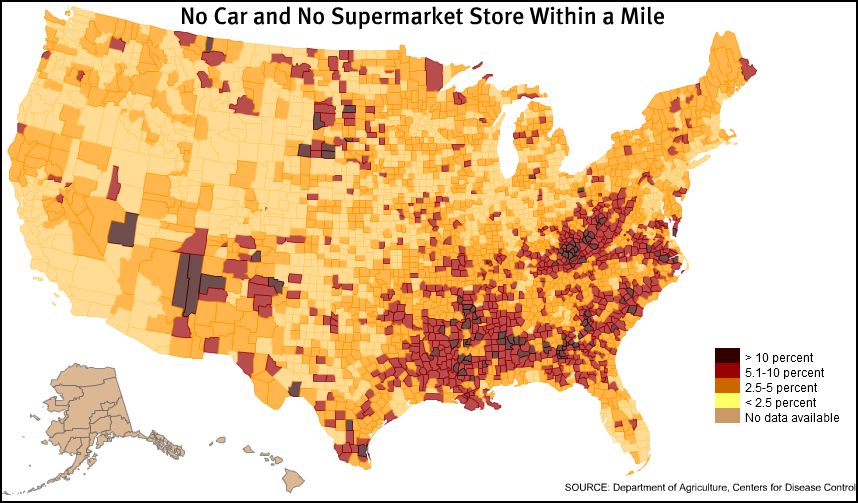
Conjecture here because I don't honestly know, but I think some of what you're observing might just be that food deserts are very regional. If you look at this image [1] you can see that it's basically just the Southeast/Appalachia. Rural Midwest, West, etc don't seem to have this issue nearly as much.

[1] https://cdn2.vox-cdn.com/assets/4565435/food_deserts_map.jpg

What area do you live in? I've had the opposite experience in a few states.
>ost food deserts are in the poorer areas of the cities because nobody is bringing fresh produce in there to sell.

Talking about things that simply aren't true.... Every major city in the US has a large farmer's market present and typically more than one happening in neighborhoods all over the city. These cities also have free/cheap public transportation to get people to the farmer's market. Additionally, you don't need a farmer's market to obtain healthy food, supermarkets are just fine.

The is just trope along the same lines of black people can't get their own ID's or figure out the internet. It's an incredibly racist way of thinking. They're not stupid or incapable people. If they want to they can certainly obtain healthy food.

"The is just trope along the same lines of black people can't get their own ID's or figure out the internet. It's an incredibly racist way of thinking."

I never said black people. That's your own bias talking.

I agree that people can travel to a supermarket (and that supermarkets have healthy food). It's much more difficult to take a weekly trip for a family's needs in public transportation as opposed to loading up a car. More frequent trips tend to incur higher opportunity cost due to the commute times.

IDs are a completely different matter. The need for those trips are about once every 4-6 years and generally lower expense too.

>I never said black people. That's your own bias talking.

I made a comparison to it being similar, I did not say it exclusively affected black people and this is why I used the terms "along the same lines". Reading comprehension please.

>It's much more difficult to take a weekly trip for a family's needs in public transportation as opposed to loading up a car. More frequent trips tend to incur higher opportunity cost due to the commute times.

I disagree. All the elites and hipsters in big cities live this way on purpose so it can't be that hard. I find it ironic that the same people who push for more public affordable transportation will turn around and say it's too hard to use and personal transportation is better when it comes to minorities. Additionally, if we follow your logic then rural people are vastly more affected by this than anyone living in the inner-city since they have to travel much longer distances and don't even have public transportation available.