Hacker News new | ask | show | jobs
by rwhitman 1920 days ago
The related articles at the bottom of that post are revealing.. painting a picture as something of an epidemic of drone swarms that government agencies are unequipped to make sense of. Some at sensitive sites such as a missile base on Guam and a nuclear power plant. Mysterious drone swarms surveilling Colorado and Nebraska. All in 2019 early 2020.

Another article revealing that a Turkish company has developed military "suicide" drone swarms and some opinions on how poorly equipped the US DoD is for these types of low cost drone swarms. Technology that's readily available and affordable to just about anyone with deep enough pockets, not just poor state adversaries like North Korea but also drug cartels etc.

Really concerning that with all the tax dollars spent on defense research, these types of activities can take place en masse with no real strategy for countering them

8 comments

The recent conflicts including the recent nagorno-karabakh is a very interesting change of pace in modern warfare.

Ukraine and Syria taught us that you still need a standing army and money to handle conflicts which involve a bunch of different armed ideological groups, foreign sponsored fighters and local terrorists/rebels. Azerbajan, Syria, most African countries and Russia are paying mercenaries to not have their names on certain conflicts and not lose nationals.

And the Armenia vs Azerbajan conflict was interesting because it is one of the first nation vs nation, army vs army war. Since both had decent Air defence systems, very few aircraft were directly used to fight or drop any bombs. Instead, they used missles, drones and suicide drones, which were more accurate then missles and cheaper than actual drones.

None of these conflicts so far really touched on the use of a Navy, because the conflicts were all local or in neighboring countries. So maybe its telling that navies are only useful with how China employs them, to enforce and scare of fishermen in their own waters or deterr other navies (like the Phillapines vs China sea debacle). And to transport troops across continents.

All us this + cyberwarfare and propoganda is this new era.

The Armenia vs Azerbajan war of ~October 2020 is super informative towards the future of war. Though the poster is a noob account, their assessment is good for a brief HN comment.

If you are at all interested in how conflicts are going to proceed in the early 21st century, reading up on this war is essential:

https://en.wikipedia.org/wiki/2020_Nagorno-Karabakh_conflict

One thing that was mentioned is suicide drones. The umbrella term is 'loitering munitions', as they describe a wider range of platforms with similar intents. You can read more about them here:

https://en.wikipedia.org/wiki/Loitering_munition

For reference: The US has the Switchblase 600, a man-portable anti-armor drone/missile with a ~50mi range and ~40min of loiter time total, with a 'dash' speed of 115mph. It's controlled via touchscreen.

https://en.wikipedia.org/wiki/AeroVironment_Switchblade

Were you aware that the Marine Corps took down some Iranian dones using their MADIS system.

https://www.military.com/daily-news/2019/07/18/heres-new-mar...

This was a bit novel in that they strapped a wheeled MADIS (an anti-drone "gun" on a humvee chassis more or less) to the deck of a naval ship and used it successfully to take down a potentially hostile drone. I know that the US Marine Corps and US Army take counter-UAV operations very seriously via electro-optical (laser), microwave, and various "other" electronic means to disrupt / destroy drone operations.

The army selected eight systems to fit the bill: https://www.c4isrnet.com/unmanned/2020/06/26/army-selects-ei...

It's pretty undeniable that something significant is going on and has been for quite some time. What is now called drones might have been called UFO's or airships in a previous decade.

And you see the same old characters saying "certainly this is a covert project from another branch/country." That argument seems quite nebulous and plausible if you watch a lot of Marvel movies, but if you know the defense industry, and consider how long that argument has been used (since the Foo fighters of WW2), it falls apart. The US gov is behind the private sector in computing software and hardware by over a decade (and has been for a while), and really anything making a lot of money these days commercially is well ahead of the defense counterpart (small drones, rockets, etc.) Look to the pay rates for engineers working on TS projects and you can see why. The talent has been going to SV since the early 90's. The other countries with significantly smaller budgets? I doubt we'll find anyone from a contender country that can speak to the efficiency of their research on HN, but projecting from the much better funded and more advanced US and the efficiency of bureaucracies in general, it seems unlikely there's anything from China or Russia that can sneak up on us so easily, let alone do maneuvers described in some other incidents going back 70+ years.

> https://www.thedrive.com/the-war-zone/36085/troubling-drone-...

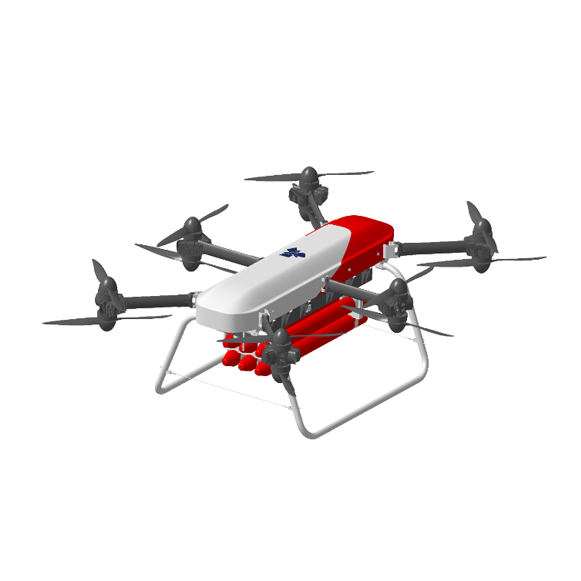
Looks like an unashemed intimidation operation, given that there is nowhere in Guam a civilian can bring a car sized quadcopter, and island's tiny population.

It pretty much screams of somebody trying to say "we can fly our foo-drones over your missile battereys, and ship any time"

Of all countries, there is only one on record with car sized, gas powered quadcopters.

Which country?
It seems far fetched to imagine any country would intimidate a power like US flying their easily recognisable drones. Just the risk of an accident causing a crash into the ship, and igniting a bigger conflict is sufficient enough for any country to not attempt such a thing. There are better ways to test your tech than doing something like this to a super power.

Also not sure how they were confident enough to deduce it was a drone. Clearly it was like 1000-1500 feet above them in dark.

We just chose to call a UFO a UAV. That's what I learned from the article.

Or.

May be it was just a test. They wanted to see how people would handle a situation like that.

> It seems far fetched to imagine any country would intimidate a power like US flying their easily recognisable drones

"intimidate a power like US" is what China, and Russia are doing with monthly regularity around the world with zero pushback.

The only time ever USA gave a direct response was this https://en.wikipedia.org/wiki/Battle_of_Khasham and even that was made more out of fear than a deliberate pushback, despite it sending kremlin into weeks long stupor.

The Chinese CH-4 perhaps? Not sure.
Those are quite a few assumptions you're making to conclude "aliens" (which seems to be your implication).

First and most of all, you're assuming that this is a high-tech, difficult to mount operation. While the article does mention a few details in this direction (the speed and flight time, the number of drones), they only suggest that this would be a problem for consumer-level drones, not something that would be difficult for a military or commercial drone.

You're also conflating these reports with unspecified other reports going back 70 years to try to paint a more mysterious picture. This does not follow in any way.

> You're also conflating these reports with unspecified other reports going back 70 years to try to paint a more mysterious picture. This does not follow in any way.

There isn't enough info on this incident to make a meaningful conclusion, or to rule out that it is a group of sophisticated CalTech students launching their drone swarming research project from a research vessel with no idea the consequences of what they're doing. But there's a pattern of these incidents, and some (such as the incident in the same area with the Tic-Tac described by Commandor Fravor) don't have such an easy out.

> First and most of all, you're assuming that this is a high-tech, difficult to mount operation.

I think you overestimate how far consumer drones can fly or underestimate the radar capabilities of destroyers. The fact that a launch source was not identified is significant, whether we assume it came from domestic researchers or a hostile submarine in a US military training area outside of major civilian/military centers.

They are called loitering munitions. By comparison, consumer gear is nowhere near to their capabilities. And I understand they fly autonomously better than a Tesla (sorry Elon).

I'm surprised there was no message left behind, in a bottle, saying "Thanks for all the selfies."

Sorry, but when you dropped "The US gov is behind the private sector in computing software and hardware by over a decade (and has been for a while)" you lost all credibility. This is just completely inaccurate. Why even have classified programs if they're DECADES behind? Furthermore, I'd take a closer examination on who is funding the academics and reaping the benefits of the research. What an armchair comment.
Aye, there are a lot -- a LOT -- of well paid IT types around DC. Lots with clearances, and fancy pedigrees.

Isn't an accident NoVA, Southern MD, and the greater DC area are tech hubs.

Entirely a separate discussion from if the US DoD can handle drone swarms. They've spent the last 2 decades occupying two middle eastern countries and have been hemorrhaging money away in the process. That money could have gone towards civilian needs, but even if it didn't and the $$$ stayed with the military, the opportunity cost of going hard on counter-insurgency as a national strategy for 20 years is now clear.

Wow. Not only DoD have drone swarms, they have been at the forefront of research, invented the concept of drone swarms, and have been testing them for at least 15 years. Search for DoD Unmanned Aircraft Systems Roadmap 2005-2030
> This is just completely inaccurate. What an armchair comment

I assume you are actually fully in the armchair, and have no idea what you're talking about.

> Why even have classified programs if they're DECADES behind?

So your enemy doesn't know what you have. Same as it has always been? In areas where the private sector cannot profit outside selling to the military (e.g. missiles/radar), then obviously the government is ahead because nobody else is really working on them. But perhaps you've watched too many sci-fi movies. We don't have a SHIELD with flying aircraft carriers.

Seems to me this would be a perfect opportunity to use lasers to shoot down drones. We have the technology in both targetting and lasers. I suppose that means someone has already thought of it and is working on it at raytheon or boeing.
https://youtu.be/1DXpPmpmcak

In 10 years it is not even going to be considered a threat. How are drones worse than mortar shells?

Just a guess. I have no idea how to make a mortar shell nor how to aim it accurately. For a drone I just tape some explosives to it and then fly it remotely via camera to the exact thing I want to blow up. I probably don't know enough about it but it seems like something I could do right now. Just go down to the local electronics or camera store, buy a drone. Not sure where I get the explosives.
Flying it via camera is very limiting, you have to be close enough.

However it's quite possible and indeed not that hard to build a long range, autonomous RC plane. You just need to use the sensors typically found in any smartphone: GPS, camera (for ground imaging), accelerometer, magnetometer and so on, add inexpensive barometers and ultrasound or optical sensors for altitude, and mix all that up with the proper algorithms to end up with really accurate positioning. In fact you can even have accurate positioning when losing GPS.

If you're not concerned about speed, a simple and cheap powered model sailplane made of styrofoam could easily be made to fly for hours on battery. Cost: a few hundred dollars worth of parts.

For that last part just give this number a call and those boys will hook you up: 800-225-5324
>How are drones worse than mortar shells?

They're not worse. They're about the same.

From a pro-authoriatairian POV they're worse because the powers that be aren't seriously trying to keep them out of the hands of the commoners. The powers that be aren't doing that because nobody there are serious economic arguments against doing so and the danger to them is currently hypothetical. There's perceived risk that someday drones might someday help the BadGuys(TM) force a concession or topple a government.

Frankly, I don't see the big deal. The more asymmetric weapons systems and warfare techniques proliferate the more reason people have to be on good terms with each other. It's harder to bully people who can drone you or hack your power plant.

It's much harder to aim a mortar shell than a drone.
"The threshold necessary for small groups to conduct warfare has finally been breached and we are only starting to feel its effects. Over time, perhaps in as little as 20 years, and as the leverage provided by technology increases, this threshold will finally reach its culmination—with the ability of one man to declare war on the world and win" John Robb 2007
I live in a fairly small country, where most population is in the capitol. I was just thinking the other day how you could probably take over the whole place with 1-2 million drones that probably cost <1B total. I don't think we're in any way prepared to handle that
Issue the people with nets, balloons, and shotguns. Declare a national drone hunting holiday.
The vast majority of global civilian population doesn't have access to firearms.
True, but you can't fight a massively distributed attack using a very small concentrated force of professional soldiers; hence the population needs to be issued with weapons and training in an emergency for civil defense. Conventional weapons like tanks and fixed emplacements just become easy targets.
Well then maybe that, too, is a problem that needs solved?

Regardless, a slamfire shotgun only requires two pipes and a nail. Ammo is still an issue, but it's a start.

What if the drones have explosives? They could take out 100k people before we know what's happening
Why go through the trouble of using drone, just use a barrage conventional missiles, hypothetical country is unlikely to have anti-rocket system like iron dome
I'd assume systems like that require something like an army are regulated and in control of nation states. My point was something like a few hundred thousand drones could probably stealthily be acquired by a wealthy individual. If it's autonomous and remotely controlled you might not even know who's behind it
OK, but in this scenario, the wealthy individual is trying to do what? Take over the country?

Fine. Let him. When he does so, he quits being anonymous. Then assassinate him and restore the previous government. Bonus style points if you assassinate him with a drone.

Missiles are just simple suicide drones, really
IF that's the goal, a Neutron Bomb[1] would be far more efficient. From Wikipedia: "Lawrence Livermore National Laboratory director Harold Brown and Soviet General Secretary Leonid Brezhnev both described neutron bombs as a "capitalist bomb", because it was designed to destroy people while preserving property."

[1] https://en.wikipedia.org/wiki/Neutron_bomb

Drone-whacking day?
> most population is in the capitol

Half of the US population wished it was in the capitol, too. /s

I wonder if flak cannons might make a comeback here. Basically like a big shotgun.
Flak cannons are a little different than a shotgun. They explode into shrapnel once they reach the end of their fuse. They're more similar to a grenade launcher than a shotgun, imo.

I think a comeback is unlikely though. The travel time of shells combined with the agility and size of drones would make them very hard to hit. They work really well on large targets because (like a grenade launcher), anything close is "close enough". They were a good counter tactic for the relatively slow and lumbering B17's; they're easy to lead and there are important components everywhere. Drones are tiny and fast; the important bits on a B17 are much larger.

I wouldn't be terribly surprised to see something akin to a flak cannon that fires EMP shells, though. Flak cannons reduce their coverage over range as a matter of expansion. EMPs do not, and are only limited by the amount of energy we can pack into a shell/rocket. Rockets are honestly probably a better choice, because they can "track" the swarm if it tries to take evasive maneuvers. Shells don't really have that option.

Worst case scenario, nukes can be used as an EMP. We did make nuclear artillery shells for a time, though I'm not aware of an anti-aircraft EMP variant.