Hacker News new | ask | show | jobs
by smarx007 1966 days ago
Nothing against cool RPi projects but be aware that a motherboard with a NAS-grade Celeron, like ASRock J4105M, sells for $85 or so (but needs RAM, $20 for 4GB roughly). At $105, this leaves this carrier board around $35 of budget if you can get RPi CM4 4GB for $70. Plus all the doubts about reliability mentioned above.
4 comments

Presumably that board will need a separate PSU, RAM, storage for a boot drive, etc?

Also it only has two SATA ports so would need a PCIe expansion card to match the four ports offered by the Pi board?

I suspect the Pi is also significantly more power efficient?

There are similar motherboards with 4 SATA ports. I have an older Gigabyte GA-J3455N-D3H with 4 SATA ports and two gigabit network controllers that cost in the same ballpark as GP's model.

RAM is accounted for in GP's description.

Regarding the boot drive, you can either boot from the data disks (say via a common ZFS pool or a common raid + lvm) or if you're happy with a SD card for the PI, I suppose a small USB drive would do the trick.

Regarding the PSU, but you'd need a beefy adapter anyway for running 4 drives, which isn't cheap, and there are cheap pico-atx PSUs available. I bought a compact case + PSU for my board for 50 euros around two years ago [1] that's still going strong (although I'm only running a single SSD in it), so the PSU alone should be less than that.

There's of course the power efficiency question and I presume this setup would be somewhat more power hungry than an RPI. The Intel specs for the J3455 give it at 10W TDP. I have no idea how much RAM consumes, but it's likely a few more watts.

[0] https://www.gigabyte.com/Motherboard/GA-J3455N-D3H-rev-10#ov

[1] https://www.inter-tech.de/en/products/case/mini-itx-nuc/itx-...

Well there are mITX boards with 8 or more SATA ports, and a lot of mATX boards with the same.

But the key differentiator IMHO is ECC and 10G. If one picks a board like https://www.gigabyte.com/Motherboard/C246N-WU2-rev-10 it then becomes possible to put a i3-9100/etc on it and gain ECC support. Given the 8 onboard SATA ports, and a 10G+ nic in the PCIe slot, you have a NAS that can best nearly everything on the market below a couple thousand dollars. There of course is a pretty wide range of atom/xeon boards with BMC's, and all of the above including the 10G. In the past I ran a https://www.asrockrack.com/general/productdetail.asp?Model=C... which has 12 sata ports, ECC and a BMC.

But, yes it will consume more than a rpi, and CPU power rating isnt everything. Having 8+ sata ports, bmcs, 10G ethernet, etc all up the board power consumption. But on the other hand, that i3 is rated for 65W, but idles at ~5 on a modern board, which is in the ballpark of the 2-3W of my RPi4 (which only swings a watt or so, and doesn't include the USB3 hub+devices).

So, given the NAS spends a lot of its time idle, and the power only spikes (and never to anything close to 65W) when its being used, it seems the extra power is worth the extra performance. I could probably fix the max frequency at 2Ghz like the RPi and save even more power.

> Regarding the PSU, but you'd need a beefy adapter anyway for running 4 drives

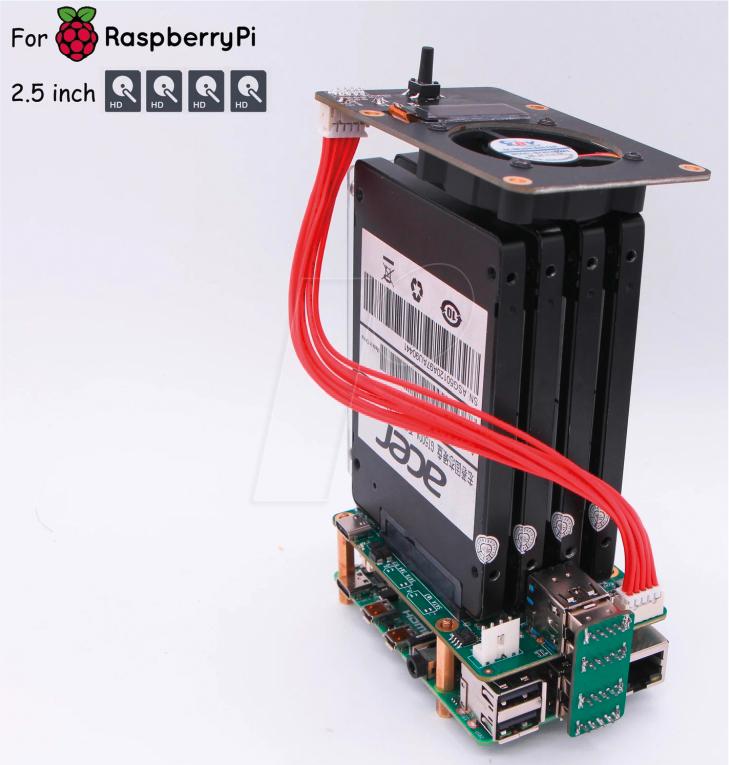
How about 2.5 inch drives? I'm thinking about: https://cdn-reichelt.de/bilder/web/xxl_ws/A300/RPI_NAS_4XSAT...

Regarding power usage, I'm not very familiar with how those drives compare [0]. To be honest, power consumption was of interest for the build I was talking about because I wanted it to be fanless (I actually ended up adding a very silent fan, just for peace of mind). For my NAS needs, I'm building in a recycled server, so power usage isn't as much of a concern.

However, I did look for 2.5" drives (the server comes with a 2.5" backplane) and there don't seem to be many "consumer" drives in this format that are both high capacity (>2 TB) and non SMR (I'll be running ZFS). I'm also not looking to spend very much, so SSDs are out.

[0] Seagate specs for 2.5" Barracuda: https://www.seagate.com/www-content/datasheets/pdfs/barracud...

The startup current is 1.2 A under 5V. So if you're running four of them, you'll need 24 W just for the drives. Not sure if the "cheap" enclosures are able to stagger drive startup.

My Gigabyte motherboard cannot, so it would require a PSU large enough to drive both the board (CPU + RAM + etc) and the drives for a little while. So with four drives, you'd be looking at 50 W to be sure it fits.

50W is way more than I am willing to operate. I want it to be extremely low powered. I think that a 2.5 inch SSD might be a better fit for me then, maybe M.2 if there's a adapter for the PI.

SSD and low cost is still possible, but one has to make compromises in terms of storage size. A 1 TB network drive would be enough for my use case, be it 4 x 256 SSD's or one big.

Peak power is significantly different from operational power on many of these setups. The intel setups, frequently idle at a 1/10th or less the rated power. The rpi4 OTOH, isn't nearly as dynamic, particularly if your running 64-bit debian. Its still just a few W, but its not going to drop down into the mW range when its idle because debian/etc doesn't have particularly good power mgmt on that board.

So in the end the rated W can be quite misleading, particularly for home use where the NAS will tend to sit idle a large part of the day.

I went looking for 2.5 inch NAS/ video recorder drives this past weekend and came up empty handed. I’d hoped to install them into a mini-pc NVR. The form-factor doesn’t appear to lend itself to the reliability drive manufacturers target for this class of drive. They’re optimized for high write speeds and very high write loads. You can of course use consumer laptop drives in a NAS, but write speeds will be lower and reliability may suffer.
> speeds will be lower and reliability may suffer

1Gbps is the max. anyways for my home setup, no matter how fast the drive is and I have a backup for important stuff, I'm not dependent on enterprise NAS drives.

I want: extremely small, low cost and very low watt usage.

The main issue is that larger capacity drives (> 2TB) seem to be SMR in the 2.5" range. I've looked and haven't found a PMR one (except maybe for "enterprise" drives which cost more than an SSD). Depending on how you want to use those drives, you may be having a bad time. For example when rebuilding a ZFS pool. [0]

If your use case / setup allow you to deal with the complete loss of your array (which, granted, is not 100% likely) or don't use ZFS, then I suppose you could look at Seagate's 2.5 Barracuda line. They're relatively cheap given their capacity and I don't think they're particularly unreliable in and of themselves.

[0] There are many people talking on the internet about ZFS performance with SMR disks. Here's a quick find:

https://arstechnica.com/gadgets/2020/06/western-digitals-smr...

I recently picked up two 36 bay sata super micro 4Us on ebay for ~$600 each.

The real cost is drives, not the thing you plug them into.

I was thinking the same thing.

I love the pi and have many of them. But their beauty seems to come out at the edge where things are low power and they replace nonsense IOT devices.

To replace a server or desktop is a stretch. That's where using a pi is death by 10,000 papercuts. The super-competitive low end PC market gives you so many things for free, like good power supplies, a wide variety of cases and silly things like power switches and a clock with a battery.

Last year I built a nas system around the Asrock j4105 itx board, using a flashed dell perc h200 as an hba, in a fractal node 304.

I had looked at arm options, including the kobol 64 and boards from hardkernel, but decided that paying a bit more for x86 would make things a lot easier.

It's working well so far: low power draw and near silent, allows for proper zfs on linux support, hardware accelerating transcoding for Jellyfin streams, and at a bit over half the cost of a 6 bay x86 Synology.

I've noticed this regularly with RPi projects. They are interesting, but the costs are often at least as high as an, often more powerful, x86 equivalent.
Keep in mind that the original goal of the Raspberry Pi foundation was directed toward education.

Raspberry Pi has inspired a lot of people to get their hands dirty with Linux and embedded systems, even if it’s not the optimal device from a pure engineering perspective.

In that regard, I’d call the Raspberry Pi a resounding success.

This NAS board is only for the Pi CM4 "Compute Module" - that is aimed at enterprise/embedded solutions, not education like the standard Pi boards.

I think for this, it's absolutely appropriate to compare to other solutions on market. Even the official Pi foundation data sheet describes CM4 as for "deeply embedded applications".

https://datasheets.raspberrypi.org/cm4/cm4-datasheet.pdf

I would also recommend to carefully examine low-cost x86 options, they often do come out ahead given they usually include all the stuff the Pi Foundation don't supply you - a boot volume, case, power supply etc.

Yes, I know, and I've used it in a project already. The CM4 still operates within the same Raspberry Pi ecosystem. Anyone familiar with the Raspberry Pi software will feel right at home on a CM4.
I agree, and I think they are phenomenal at that. There isn't anything else that combines the versatility, stability, and cost quite so elegantly for single Pi use cases for education or light desktop use. I use several VLC clients feeding monitors, for example, and they are fantastic.

But I also see things like 10 node clusters with a total of 40GB of RAM, a bunch of slow cores, and materials costs of $500+. That's harder for me to understand, outside of the "looks cool" metric.