You haven't addressed a single point. Being an expert should help a person to make arguments, and sometimes does, but it's not an argument in and of itself.
The author being a non-expert in the field is useful to know. It doesn't have to be proof of something to be useful information in creating a more whole image. Even if that weren't the case, another point the parent made was that, in their opinion, the quality and tone of the article degrades conversation rather than contributing to it, which is another form of non-proof that is perfectly reasonable to express as an opinion. The parent may have spoken with a disrespectful tone, but "You haven't addressed a single point", is equally flippant and antagonistic. In fact, it's worse, since you're addressing it directly to a participant in the conversation.
> Critics of 5G agree6–8—but its supporters do not9 10—that the overall population levels of exposure to RF-EMFs will be greatly increased by the 5G roll-out. One compelling argument for that view is the ‘inverse square law’ of EMF exposure: intensity varies as the inverse of the square of the distance from the emitting source.11 With plans afoot internationally to put a 5G booster antenna on ‘every second or third lamp-post’, it is difficult to believe that overall population exposures will not increase substantially
Yes, there will be more antennas. Does not address the question of power levels: part of the point of more antennas is that each individual station can have lower power output. No mention of "watts", antenna ERP, or indeed power anywhere in the article.
> International health protection agencies and their scientific advisory bodies have published several reviews over the last decade, of varying scientific quality, of the research evidence regarding potential adverse biological and health effects of RF-EMFs.5 12–15 These reviews—by Health Protection England,12 the International Agency for Research on Cancer (IARC),13 an Expert European Union (EU) Committee14 and the International Commission on Non-Ionising Radiation Protection (ICNIRP)15—have, with one exception, not converged around a strong warning about such effects
In other words, current investigations do not support evidence of harm.
> Moreover, a growing number of engineers, scientists, and doctors internationally have been calling on governments to raise their safety standards for RF-EMFs, commission more and better research, and hold off on further increases in public exposure, pending clearer evidence of safety.18–21 Some politicians have listened: France, Israel, Cyprus and Russia have banned WiFi in preschool and restricted its use in primary schools. Belgium has banned the sale of mobile phones to children under seven. In response to such concerns, several jurisdictions have recently blocked the installation of 5G antennae systems in their communities: Brussels, Florence, Rome, as well as Glastonbury, Frome and Totnes in the UK; and widespread anti-5G campaigns are now emerging in Australia, North America and elsewhere.
This is true but is a kind of self-referential policy; places that have banned 5G have often done so for unscientific reasons! Saying that there are anti-5G campaigns is like saying there are anti-mask campaigns; it is not actually evidence of harm.
> more conservative jurisdictions’ guidelines, which are based on a wider variety of biological and health effects documented in recent decades
[citation needed] - no really, there are citations for other bits, where's the health effects citation?
> A striking feature of this public controversy is that various commentators—even those with advanced training in telecommunications physics and engineering—inconsistently refer to quite different specific technologies when they discuss the pros and cons of 5G
Well, yes, it's a marketing term.
Discussion of local councils and lampposts. Hard to see relevance. No details of harm.
> One’s overall assessment of the likelihood that an exposure causes a health condition should take into account a wide variety of evidence, including ‘biological plausibility
And "biological plausibility" is where it falls down, because I've not yet seen (and it's not expressed here either) a mechanism other than the raw heating effect of absorption used by the EU SAR metrics which has any plausible biological effect. See para on "non-thermogenic adverse effects" (what effects? How do they work? At what levels?)
> Finally, Carpenter has recently published a well-researched analysis of how source of funding correlates with study findings, across many peer-reviewed publications over the last few decades, of the relationship between various kinds of EMF exposure and several cancers.39 He shows convincingly that studies funded by private sector entities, with strong vested interests in maintaining their current use of the sources of EMFs under study, tend to find no association
OK, this is a genuine question that does need to be asked, because we know there's been problems with this before.
> innovations in radio frequency ‘pulsing,’ ‘polarisation’ and ‘modulation’
Non-physicist discovers QAM, is confused. Again, no explanation given of why this might make a difference.
> In other words, current investigations do not support evidence of harm.
You missed the exception he mentions. "IARC is the outlier in this respect, having determined in 2011 that EMFs are ‘possibly carcinogenic to humans’." (https://www.ncbi.nlm.nih.gov/books/NBK304630/)
They concluded that "With 'limited evidence' for carcinogenicity in humans based on an increased risk of glioma – a malignant brain tumour – among heavy users of mobile telephones, radiofrequency electromagnetic fields were classified as 'possibly carcinogenic to humans'"
This suggests more studies are required from a biological perspective in order to form an conclusions either way, which is his point in the opinion piece.
> Non-physicist discovers QAM, is confused. Again, no explanation given of why this might make a difference.
The full quote is;
"Furthermore, a comprehensive Canadian review of the same evidence states that some of the new RF-EMF technologies—such as innovations in radio frequency ‘pulsing,’ ‘polarisation’ and ‘modulation’—are so new that biological scientists have not been able to keep up—that is, no studies yet exist of these new technologies’ biological effects." (https://www.sciencedirect.com/science/article/abs/pii/S03784...)
The point he's making here, once again, is that this is a multi-disciplinary problem and we need further study from a biological perspective as there is not enough evidence to conclude either way.
You seem to think that, because he's not a physicist, that he has no idea what he's talking about.
You seem to think that, because he's not a physicist, that he has no idea what he's talking about.
Yes, appeals to authority aren't much use in the present climate. So, that's why he needs to offer convincing evidence. It sounds like he offers none (I haven't read it, just relying on the summary above). "Pulsing" is not exactly a new idea in radio technology, is it? There's only like a century or more of radio systems that do that. As for modulation, does he know what the M in FM radio stands for? The claim that these are new innovations that "biological scientists can't keep up" is just obviously false on its face so what is he talking about?
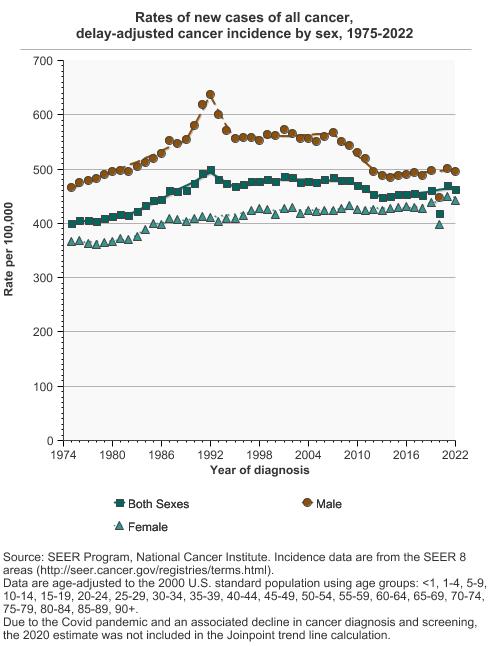
If you plot rates of cancer on a chart you'll find it's actually stable or declining for decades:
Even as ever newer mobile protocols were rolled out (and really they're more like protocol upgrades than changes to the basic physics), cancer rates were stable for women and declining for men. If mobile tech caused cancers then we'd see it in the statistics by now, there's been plenty of time. We don't.
BTW this guy is an epidemiologist, and I've been ranting for the past 8 months on HN that these guys definitely have no idea what they're talking about. The standards in this field are just ludicrously low, so I'm not surprised at all to discover one of them thinks 5G causes cancer :(
> Yes, appeals to authority aren't much use in the present climate. So, that's why he needs to offer convincing evidence. It sounds like he offers none (I haven't read it, just relying on the summary above).
My point was more that a physicist may be an authority on the technology itself, but would not necessarily be an authority on the affects it has on a biological system. That's why it has to be a multi-discipliniary approach rather than people being immediately dismissed for not being physicists.
Why would you think that a physicist would be more of an authority on causes of human disease than an epidemiologist?
> The claim that these are new innovations that "biological scientists can't keep up" is just obviously false on its face so what is he talking about?
Ok his wording is pretty over the top here, but he literally points to a study which suggests as much.
> I'm not surprised at all to discover one of them thinks 5G causes cancer
It was actually the IARC working group for evaluating carcinogenic risks to humans. He was merely referencing their study and findings.
And actually, once again, they're not saying that 5G causes cancer. They're saying that the evidence from their specific study suggests it might, but it's not conclusive, and that further studies are required to get better evidence either way.
Look I'm not saying that the evidence suggests 5G is harmful, I'm just taking issue with some of the specific dismissals presented above as I think they selectively cut out parts of the quotes that actually change their meaning somewhat.
I think they're likely more of an authority because physicists have been studying radio, EM energy and its effects on the atomic level for more than a century. Meanwhile, epidemiologists are not biologists. Look at Neil Ferguson, one of the world's most famous. His actual background isn't biology, it's ... physics!
If you want to get the views of biologists on the effects of EM on the body, then great! You'd want to talk to microbiologists about that. Physicists can probably also be informative, but epidemiologists can only look at graphs like the one I linked to previously. They're more or less data scientists, posing as disease experts, but what they're doing when you drill in is what anyone who knows R and a bit of stats could do.
The IARC finding seems to be phrased very ambiguously. I would read it as saying "we have no evidence, but absence of evidence is not evidence of absence". Which is true but not really helpful for moving the debate forward, as at some point absence of evidence does need to be taken as evidence of absence or else you'd be stuck in the precautionary principle of not doing anything forever.