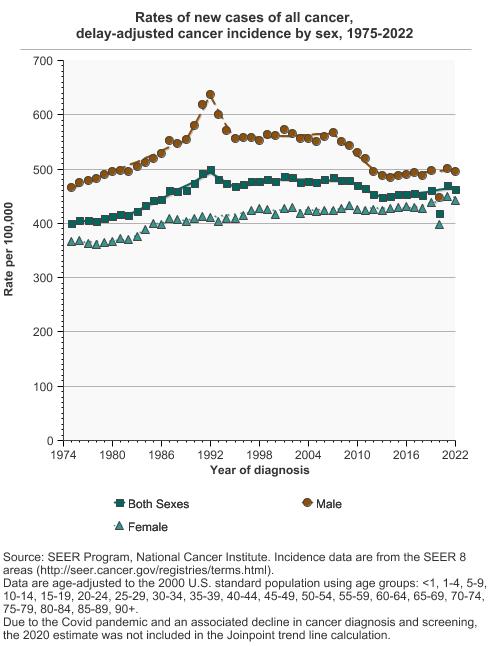
| You seem to think that, because he's not a physicist, that he has no idea what he's talking about. Yes, appeals to authority aren't much use in the present climate. So, that's why he needs to offer convincing evidence. It sounds like he offers none (I haven't read it, just relying on the summary above). "Pulsing" is not exactly a new idea in radio technology, is it? There's only like a century or more of radio systems that do that. As for modulation, does he know what the M in FM radio stands for? The claim that these are new innovations that "biological scientists can't keep up" is just obviously false on its face so what is he talking about? If you plot rates of cancer on a chart you'll find it's actually stable or declining for decades: https://progressreport.cancer.gov/sites/default/files/graphs... Even as ever newer mobile protocols were rolled out (and really they're more like protocol upgrades than changes to the basic physics), cancer rates were stable for women and declining for men. If mobile tech caused cancers then we'd see it in the statistics by now, there's been plenty of time. We don't. BTW this guy is an epidemiologist, and I've been ranting for the past 8 months on HN that these guys definitely have no idea what they're talking about. The standards in this field are just ludicrously low, so I'm not surprised at all to discover one of them thinks 5G causes cancer :( |
My point was more that a physicist may be an authority on the technology itself, but would not necessarily be an authority on the affects it has on a biological system. That's why it has to be a multi-discipliniary approach rather than people being immediately dismissed for not being physicists. Why would you think that a physicist would be more of an authority on causes of human disease than an epidemiologist?
> The claim that these are new innovations that "biological scientists can't keep up" is just obviously false on its face so what is he talking about?
Ok his wording is pretty over the top here, but he literally points to a study which suggests as much.
> I'm not surprised at all to discover one of them thinks 5G causes cancer
It was actually the IARC working group for evaluating carcinogenic risks to humans. He was merely referencing their study and findings. And actually, once again, they're not saying that 5G causes cancer. They're saying that the evidence from their specific study suggests it might, but it's not conclusive, and that further studies are required to get better evidence either way.
Look I'm not saying that the evidence suggests 5G is harmful, I'm just taking issue with some of the specific dismissals presented above as I think they selectively cut out parts of the quotes that actually change their meaning somewhat.