|
|
|
|
|
|
by shiftingleft
1985 days ago
|
|
|
I don't see how the problem corresponds to erasure coding.
Typically in erasure coding you know the locations of the erasures.
Here, you don't know the location. Maybe you can elaborate on how it relates to erasure coding? |
|
|
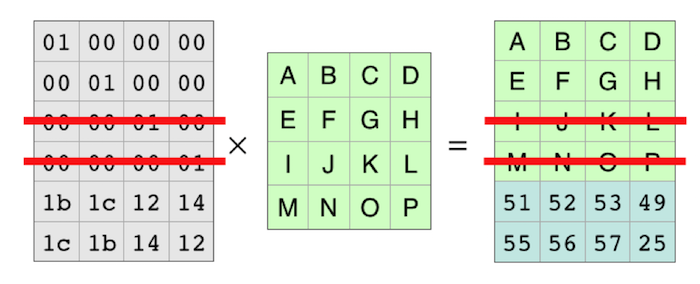
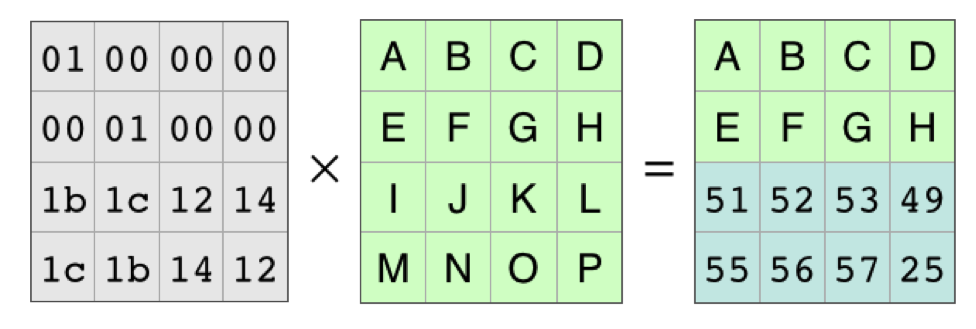
One way to construct a Reed Solomon code is to create a Vandemonde Matrix.
All of the "1" values are from a^0.As long as a^1, a^2, a^3... are distinct, then this matrix is invertible (aka: all rows / columns are linearly independent). In a GF(2^8) field, there are 2^8-1 distinct values (the values 0x01 through 0xFF), making a 255x255 matrix. The polynomial "x" (aka: 0x02) is often chosen to be the value of "a", but it can be any primitive element that loops around all 255 non-zero numbers and still work.
This Vandemonde Matrix has a very simple construction, but it is non-systematic (the data is "mangled" in encoded form, so we need to invert the matrix to decode). However, this non-systematic form is easier to see some patterns. Now lets take the 1st column:
Hmmm... look familiar? What happens when we multiply the data vector with this column?? It becomes a bit more obvious: Remember, in Reed-Solomon, you perform operations over GF(2^blah). So all multiplications are GF-multiplications. But these are all multiplications by 1, so we can just ignore the complications of GF-multiplication entirely. (Even in GF(): a multiplication by 1 is just the identity).To finish the matrix-multiply, we add everything together. But we do GF-addition (not regular addition). A GF-addition is also known as XOR. So the ultimate answer is:
Which so happens to be the first parity bit of the non-systematic Reed Solomon code. As such, we've proven the relationship between the "XOR trick" and Reed Solomon (Vandemonde construction).------------
The hamming-distance between codes is 1. We can correct floor(1/2) errors (aka 0 errors) and 1 erasure. As such, this "all 1s matrix" is a 1-erasure punctured Reed Solomon code.