|
Since you asked this question in two different locations, I'll give a 2nd answer here. One way to construct a Reed Solomon code is to create a Vandemonde Matrix. 1 a^1 a^2 a^3 a^4 a^5 ...
1 a^2 a^4 a^6 a^8 a^10 ...
1 a^3 a^6 a^9 a^12 a^15 ...
...
All of the "1" values are from a^0.As long as a^1, a^2, a^3... are distinct, then this matrix is invertible (aka: all rows / columns are linearly independent). In a GF(2^8) field, there are 2^8-1 distinct values (the values 0x01 through 0xFF), making a 255x255 matrix. The polynomial "x" (aka: 0x02) is often chosen to be the value of "a", but it can be any primitive element that loops around all 255 non-zero numbers and still work. This Vandemonde Matrix has a very simple construction, but it is non-systematic (the data is "mangled" in encoded form, so we need to invert the matrix to decode). However, this non-systematic form is easier to see some patterns. Now lets take the 1st column: 1
1
1
1
1
...
Hmmm... look familiar? What happens when we multiply the data vector with this column?? It becomes a bit more obvious: 1
1
1
[d0 d1 d2 d3...] * 1
1
1
1
1
1
Remember, in Reed-Solomon, you perform operations over GF(2^blah). So all multiplications are GF-multiplications. But these are all multiplications by 1, so we can just ignore the complications of GF-multiplication entirely. (Even in GF(): a multiplication by 1 is just the identity).To finish the matrix-multiply, we add everything together. But we do GF-addition (not regular addition). A GF-addition is also known as XOR. So the ultimate answer is: d0 XOR d1 XOR d2 ...
Which so happens to be the first parity bit of the non-systematic Reed Solomon code. As such, we've proven the relationship between the "XOR trick" and Reed Solomon (Vandemonde construction).------------ The hamming-distance between codes is 1. We can correct floor(1/2) errors (aka 0 errors) and 1 erasure. As such, this "all 1s matrix" is a 1-erasure punctured Reed Solomon code. |
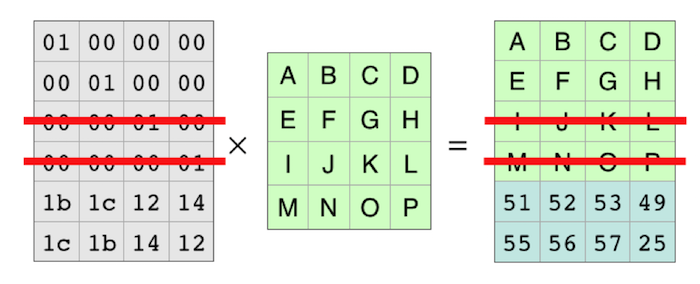
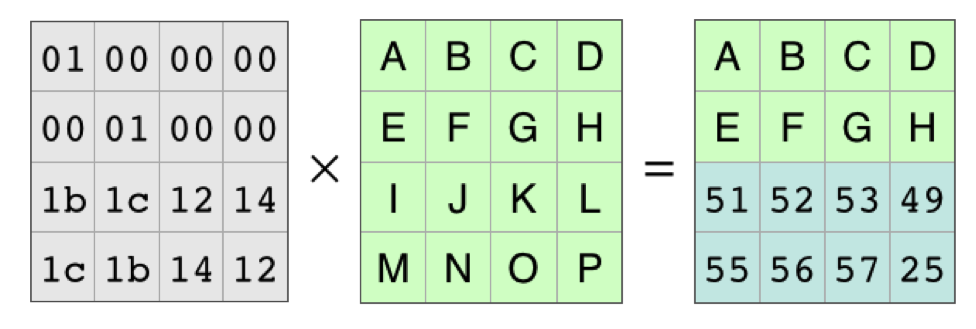
I'm familiar with some subset of coding and number theory, so you can assume at least some more knowledge (Galois Fields, or basics of RS codes for example).
Small nitpick: The Vandermonde matrix actually isn't square. It's a (k × n) matrix, (where typically k ≠ n). Therefore, it can't be invertible.
I see that many codes contain a parity bit (for example the extended Golay code), however I don't see how the operation of recovering "the missing number" could be implemented in terms of a code and its encoding/decoding algorithms.
I've found this on stackoverflow: https://stackoverflow.com/a/3492967/3868157
It describes a way to recover the missing number by constructing a Vandermonde matrix using the given numbers. This would correspond to constructing a generator matrix of a specific RS code [1]. However, after this I'm not so sure about the relation between encoding/decoding and recovering the missing number.
In the end they also factor a polynomial (that could be something analogous to the error locator polynomial?).
[1]: although I'm not sure if it's strictly an RS code