Hacker News new | ask | show | jobs
by bobthepanda 1984 days ago
Railroads did well into the '30s, and really declined by the '50s and '60s. This kind of decline happened everywhere in the world, except maybe Japan. But the introduction of HSR in Japan was done by government railways and actually bankrupted them, forcing them to split the debts into a "bad bank" and privatize JR Group.

Railways were going to decline because we spent a half trillion dollars building a competing highway system, which had several distinct advantages:

- by and large highway travel in the US is not charged a toll, which makes the per-mile marginal cost much easier to deal with

- highways are not charged property tax and railways are. Many a railroad during the decline ripped out tracks and electrification to reduce the value of their property and to goose up their balance sheet before potential mergers.

- in addition to not paying tolls, the amount of subsidy for highways from the general funds is much higher; compare that to Amtrak, which is so poorly funded a lot of its trains don't run more than once a day.

- minimum parking regulations are pretty much everywhere in the United States, and the requirements are generally much higher than what's needed, so last-mile is not a problem for cars; you have to arrange a journey to and from the train station

The main difference between here and countries that survived a railway decline is the absolute lack of interest from the government in keeping it alive. Amtrak was founded by Nixon with the intention of letting it die.

3 comments

Its amazing that China was able to significantly develop both road and rail infrastructures this centuries. It looks like many other countries prefer one or the other.
Outside of America most of the developed world has fine networks for both. It's just that the rails are optimized for passenger travel and the road is generally where freight goes. China is kind of odd in that they have both heavy freight and passenger traffic on their railroads; the HSR network was built in part to free up the traditional railway network to serve more freight trains.

Part of it is that China has a lot of money. Part of it is that right now China doesn't really care about debt (China Railways has $770B in debt). And part of it is that the population is so large that they can afford to essentially build a second whole railway network and a highway network. There's also a difference in strategy; European and Japanese rail development is slow, requires working with communities, and HSR is directly routed to city centers, whereas China for its HSR networks prefers connecting megahub stations outside of the city center, more similar to how airports work.

There's also the question of if they can actually afford to maintain this network long term; it features many more viaducts and tunnels than equivalent rich country networks, even in flat terrain. And some design decisions are questionable; it's not uncommon to see, for example, strange merging patterns for lanes or a lack of shoulders on the highway network.

Fix: Japan HSR makes $$$ especially on early lines you mentioned, local lines are (still) problem.
> Railroads did well into the '30s, and really declined by the '50s and '60s. This kind of decline happened everywhere in the world, except maybe Japan.

Genuine question: have you recently taken a train in Denmark, Sweden, the Netherlands, Germany or anywhere else in Europe?

Yes. Not in the mid 20th century though, that was decades before I was born.

Generally speaking, the midcentury was a rough time for railroads. The big private railway companies in Europe were nationalized by then. For your examples, lifted from the wikipedia pages:

- Denmark: World War II left DSB with a fleet of outdated and worn-out trains, and apart from a series of second-generation MO railcars and the class MT multi-purpose centercab engines built by Frichs, domestic industry was unable to provide the kind of motive power required. Instead, DSB looked to foreign suppliers. The 1960s were marked by an increasingly poor economy for DSB, leading to a steady staff reduction throughout the decade.

- Sweden: Between 1937 and 1985 no new railway was built in Sweden, except for short industry tracks and similar. Instead many lines with little traffic were closed down. Their traffic was decreasing because the car and truck traffic increased.

- The Netherlands: While the 1950s were a good time for the company, it started to decline in the 1960s, like most other railways around the world. Not only did the NS suffer from the competition of the car and other modes of transport, but it also suffered from a loss of income when natural gas started to replace coal as the main fuel in power stations and homes after a gas field was found near Slochteren. The NS had been involved in the transport of coal from the mines in Limburg to the remainder of the country.

- Germany: Transport of goods also had to compete with the ever-increasing competition from trucks. Furthermore, traditional services such as coal and iron ore shipments declined with the changes in the overall economy.

As a European very interested in rail transport I found that to be an excellent round-up, thank you for the comment.

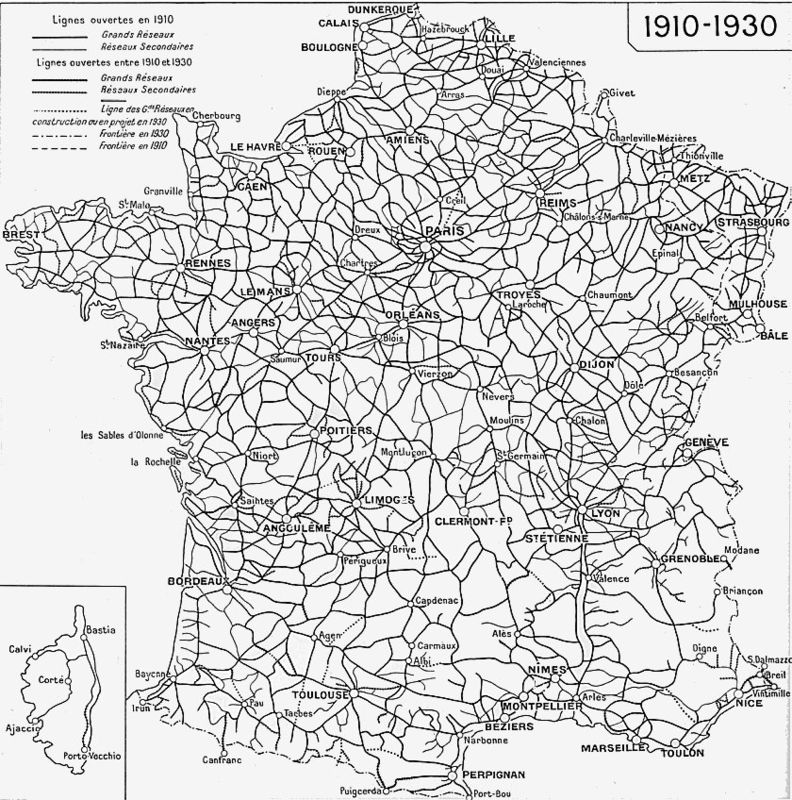
I'd add France to the list of countries which railway system went decisively downwards starting with the mid 20th century. Everyone focuses on the success of the TGV but the country's regional rail network was almost entirely dismantled. Just by comparing this map [1] of the network as it looked in the interwar period to the present one [2] one can see that decline very easily.

[1] http://p1.storage.canalblog.com/16/88/152398/30965632.jpg

[2] https://en.wikipedia.org/wiki/List_of_railway_lines_in_Franc...

[ditto the UK](https://en.wikipedia.org/wiki/Beeching_cuts), now 60 years later some of it is slowly being restored.

surrendering rights of way was an extremely expensive thing to do.