Hacker News new | ask | show | jobs
by hannob 1991 days ago
It's surprising because car drivers are used to the fact that rules are not or rarely enforced.

Just think about it: Technically it would be no big problem to enforce speed limits widely. The technology for speeding cameras isn't exceptionally complex, you could mass-produce them and deploy them basically in every street. I'm not aware of any country doing that.

8 comments

Absolutely correct about the technology. Qatar is doing that.

I lived in Qatar for 7 years, drove a car. All speed cameras are not visible. Some are marked with sign boards, but many are hidden permanently on a lamp post, or in a palm tree, or in anything. There are even mobile cameras, which an operator puts on a heavy tripod, & goes away, & camera takes photos of offenders & send back to data centre. Cameras are on highways, on streets, on intersections. Every traffic signal has built in camera. Fines go up progressively with each offense & over the limit. Owner of car gets a mobile notification as soon as his car speeds in front of camera. All fines are payable fully at yearly registration. If paid in some x days, there is a discount.On Holy Month of Ramadan also sometimes there is a discount.

The biggest is, there is no need of a man standing behind camera. Two photos taken apart a second or such are the proof. Owner can only contest it if he has gps recordings. Speed limit is speed limit. No +5 or +10.

But then, fine amount stings only if they are enough. For an expat like me, a fine of $200 is a lot. For a local Qatari 20ish year boy, thats nothing. Some of my photography club members had fines in tunes of $2500 a year, & totally normal.

> Owner of car gets a mobile notification as soon as his car speeds in front of camera.

So they have another camera about 20 seconds up the road to catch them reading SMS while driving?

Lol no, most of the times, either Employer/Companies, Rental/Lease Companies, or Fathers are the owners. The users/drivers are employees, or family members.
>> The technology for speeding cameras

Speed cameras are not the go-to tech. Nearly every car on the road has a GPS, either organic to the vehicle or inside the driver's phone. If we wanted to actually enforce speed limits it would be a trivial matter to have google forward the relevant information.

This was done by a few rental car companies many moons ago (circa 2001). Speeding laws don't know how to account for such data. Should someone speeding continuously over many miles be fined more or less than someone who speeds twice, each time only for a short distance? Traffic laws are premised on the systems by which people are caught (cops, traffic cameras etc). They are not adapted to the perfect knowledge that modern tech can provide.

https://www.drivers.com/article/428/

Of course, if we really care, it would be trivial to limit all cars to a particular speed while on public roads. Japanese motorcycles are already limited by industry agreement, iirc 300kph (see the Hyabusa fiasco). Merc/BMW cars are limited to 250kph. Those limit could be lowered via a simple software patch.

> If we wanted to actually enforce speed limits it would be a trivial matter to have google forward the relevant information.

So then you get a speeding fine for being a passenger?

Wouldn't people just turn off their phones?

> Of course, if we really care, it would be trivial to limit all cars to a particular mas speed while on public roads.

This is useless because most "speeding" would be within the limit for the country, e.g. there are places in the US with a speed limit of 85 MPH, whereas most of the problem is really people driving 70 in a 45.

And trying to enforce the actual speed limit on the specific road would be fragile and dangerous because if your vehicle detects the limit wrong it could force you to drive 30+MPH below the flow of traffic and cause an accident.

>> if your vehicle detects the limit wrong

Welcome to one of the most basic and most difficult problems for AI-driven vehicles: What is the speed limit? Temporary limits, work zones, school/park zones based on sunlight, weather, children/workers present or not, emergency vehicles beside road or not ... it is complex but also something every driver manages every time they get behind the wheel. While it is possible to drive dangerously slowly, far more people are being killed by driving too quickly than too slowly. The default is generally, if unsure, err on the side of slower.

It's interesting to compare this with the subcomments in https://news.ycombinator.com/item?id=25545467 with some interesting interpretations like

> It is unsafe to drive the speed limit if everyone is going 10-15mph over the posted limit.

> it is complex but also something every driver manages every time they get behind the wheel.

It's also something that humans are still better at judging than machines, because they have general intelligence. They can tell that a speed limit sign for a service road visible from the highway is not the speed limit for the highway. They can guess what a sign covered in rust or sludge might have said based on the road conditions or the speed of other traffic or personal knowledge of the area.

And when the machine gets it wrong more often, you don't want it to be overriding the human driver by force.

In the UK at least, it's relatively simple. If it's a red circle with a number in it, that's the speed limit - anything else is advisory. In my experience, cars with built in sign readers do an exceptional job of working out the current limit (more reliable than me, certainly!).
It should be trivial to convert every sign to have wireless transponder. Optical guessing sounds awful for wrong angles, wind damage, snow coverage, lighting issue.

Maybe correlate it with central database for sanity. Preferably daily updated git.

So no temporary work zones in the uk? What is the rule if the sign isnt there/visible? Do you then get to race through an obvious construction zone?
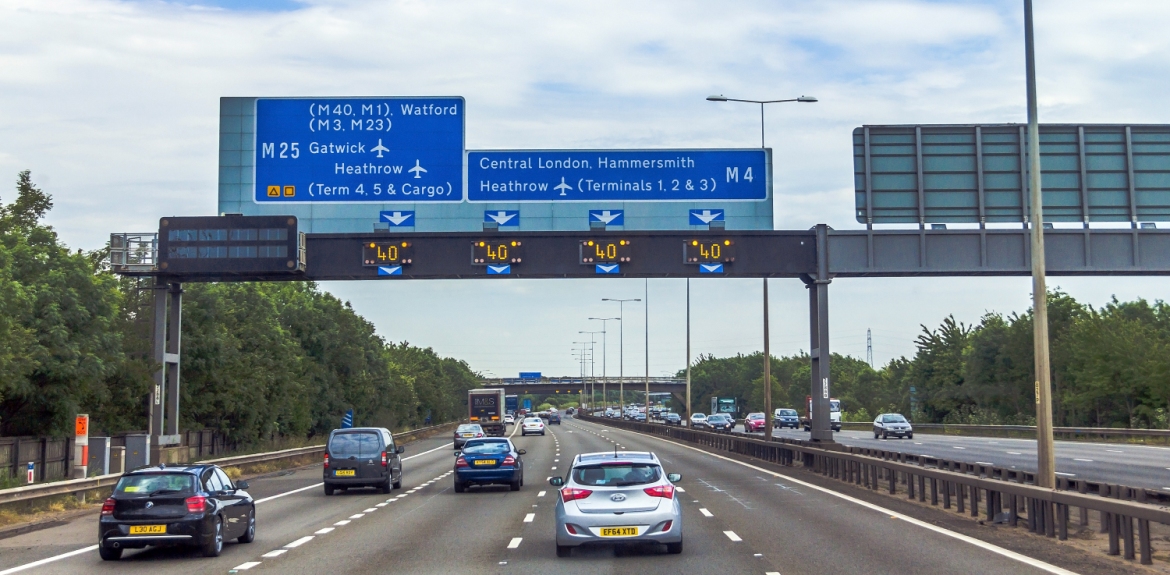
They tie an opaque bag over any incorrect signs, and erect temporary signs (of the same standard, international design) with the new limit. If it's a motorway or similar road, the electronic emergency signs will also show the reduced speed limit [1]. On a motorway, they're often on a gantry, i.e. completely impossible to miss.

I think I read somewhere that it's someone's job to make regular checks that the temporary signs (and covers) are still correct -- they are an important part of the worker safety requirement for the construction crew.

When a speed limit changes, the rule is for the sign to be shown on both sides of the road. There are then repeating signs for the current limit at some regular interval.

The UK is dense enough that having expensive electronic signs on all motorways isn't an unreasonable cost; I understand that's not practical in the USA or Australia.

[1a] https://i2-prod.birminghammail.co.uk/news/midlands-news/arti...

[1b] https://www.ageas.co.uk/globalassets/solved/30072018_road-sa... (possibly this style is no longer used, I drive very rarely in the UK so I'm not sure.)

If there's no sign to indicate that the speed limit is changed, how are you supposed to know what the speed limit is?

I've had speeding tickets forgiven in Australia because the sign simply wasn't visible enough due to overgrown trees and a 2 lane off ramp separating the sign from the road it applied to, let alone the sign missing altogether.

That brings back memories of Pokemon Go issuing bans after flights because you must be location spoofing to have travelled that quickly.

On some level, a device owned and controlled by the consumer and asserting a particular travel speed seems like the wrong place to put that kind of enforcement.

>it would be a trivial matter to have google forward the relevant information.

oof... Glad Google doesn't have that info about me.

Got bluetooth on your phone? Some cities are using bluetooth IDs to measure traffic flow, a phone or car's bluetooth ID as it passed sensors and calculating the speed based on the time taken to cover the distance. This isn't used for speed enforcement, they don't match the IDs to individuals/cars, but it certainly could be.

https://www.econolite.com/products/software/bluetoad/

"Advanced Traffic Management Systems Bluetooth Detection. TrafficCast proven algorithms for filtering and processing data inputs to compute real-time travel times and speeds."

Most Tire Pressure Monitoring systems also broadcast a unique ID that can be used to derive traffic patterns.
An interesting method that is widely used in Australia is “average speed cameras”. They set up 2 sets of cameras on a long highway and then time how long it took you to get from one camera to the next. It’s an excellent idea because you can’t just slow down for the camera and then speed up again.
A friend told me of a similar system which I think was in Malaysia, but some vendors setup food stalls at the side of the road before the exit cameras where people would stop and get a meal to extend their drive time.
Average speed cameras seem unbelievably dangerous to me. I haven't ever driven somewhere with them, but I suspect all I'd be thinking about was the speed limit, resulting in very dangerous driving. With all my focus on making to correct average I'd fail to properly track other drivers and potential hazards.

I'm much happier with a flow of traffic enforcement. Ticket those who speed excessively beyond what traffic is generally flowing and let the posted limit be more of a guideline.

If you're trying to game the detection system to minimize travel time then average speed cameras could encourage pathological behavior (which would hopefully also be caught by careless/reckless driving laws). They're dead-simple and not subject to cosine error and sensitive closed-source calibration techniques though. Even accounting for clock skew and clock drift, if an average speed camera says you were going x+2ϵ mph then it's safe to say you were going at least x+ϵ mph for at least some small interval and some very small value of ϵ.
There are no traffic lights for the ones I've seen here, so you can just set your cruise control. I would be doing this anyway on a long drive, which again is the only place I've seen these
California actually explicitly bans police setting up these kinds of speed traps
I‘ve seen them in the Netherlands as well. These are pretty great as they completely discourage any form of cheating that is dangerous (i.e. sudden braking), but incentivize smooth flowing traffic.
See red light cameras. You recieve a ticket through the mail and you get pictures and a video of the violation. There is a lot of people against it and some governments have legistation against the use of it.
I thought that was mainly because red light cameras often lead to an increase in collisions because a driver is more likely to stop unsafely if they are worried about the light changing
Which is, in turn, caused by the unsafe shortening of the yellow light commonly used in combination with red light cameras in order to maximize ticket revenue. Because with an adequately timed yellow light, few people actually run the red light and the cameras become an expensive money pit that can't pay for themselves.
In India, on some newer signals in last 5-6 years, I have seen that when Red is on, & is going to go to Green, the Red will start blinking in last 5 or so seconds. Then Green will be ON.

When Green is ON, & is going to switch off, it will start blinking & then off, & then yellow will start blinking. Its ok to drive through blinking green or yellow if safe. But common training os drive through blinking Green, but if you see blinking Yellow, then stop.

Plus, some of the lights have counter. It shows how many seconds are remaining for the lit color. An experiment led the Bombay Municipality to install Noise Sensors are one busy traffic light with counter. Every time there is a Red Light, & counter is less than 10, normally people start getting impatient & start honking to force the front ones to move. But on this light, if the noise is above certain decibel while Red, the counter resets.

IIRC there was also the argument that since an officer hadn't seen the crime committed it did not hold or something.

I recall hearing about legal cases which made the city I was in disable and then remove them because they became useless after the rulings.

We'd probably need a few other societal changes to make automatic enforcement of the posted speed limit manageable. As an example, if you're on a 50mph road in the USA and assume that your speedometer is calibrated within legal tolerances (and no further) then you'd have to set your cruise control to at most 43mph to ensure that you'd never speed (5mph speedometer error at that speed plus 2mph in speed variability from bumps/hills/etc), you could actually be averaging as low as 39mph in practice, and somebody else behind you with a speedometer off the other direction could think you're going as slowly as 35mph (on average, slower from time to time). I can say from experience that doing so is an easy way to be flipped off, sworn at, passed on the shoulder or a sidewalk, and have police called to your location (occasionally driving the speed limit plus 0-10mph results in similar levels of aggression), even though you can potentially be ticketed for going even a mile per hour faster (most police forces allow a lot more slop in your speed for precisely that kind of reason, but there are definitely a few who don't give a shit because they know you don't want to drive all the way back to the middle of nowhere to fight it) and even though driving that slowly is totally legal in most places.

None of that is insurmountable of course, and the easiest fix seems like just having the automated system only ticket you at some threshold above the limit while grandfathering in tighter speedometer tolerances. Aggression from driving the speed limit would probably decrease rapidly as tickets started arriving in the mail.

> Technically it would be no big problem to enforce speed limits widely

More than you suggest.

> The technology for speeding cameras isn't exceptionally complex

But speed cameras are just one piece of enforcement. With those and automatic license plate reading you get a piece of evidence that a car violated the limit at a particular time and place, but even if the law is that a set limit is a hard limit (which is not the case in much of the US, where posted limits are often prima facie but not dispositive limits), that's not all you need for enforcement. You also need legal process to weigh potential counterevidence, to deal with contested identity of actual drivers, etc. This isn't technically complex, but it adds a lot of overhead, which is why even places which legally allow this mechanism deploy it selectively, not comprehensively.

The same holds for a lot of other rules, from public transportation tickets over legal fireworks and drinking age to softer drugs and taxes. Society as a whole seems to be generally fine with smaller infractions and I consider this a good thing, tbh. I would be perfectly fine with a similar scheme for traffic laws.

The thing with speeding cameras is that they could easily be adjusted to allow for 20% (say at most 20kph) margin (which would be perfectly fine for me even on the German Autobahn), but drivers would learn that fact and adjust perfectly to just 1kph below that limit. This would then enrage puritans that would DEMAND that these MURDERES be PUNISHED. Sadly for some reason traffic law is an area of zero tolerance for some.

Unsafe driving is a real cause of a substantial amount of death, and unlike most causes of death it is not over represented in the elderly, giving it a massively outsized impact in terms of reduction in expected years of life. Motor vehicle collisions are reliably the leading cause of death of teenagers and young adults in many parts of the world. People are bad at appraising events that are rare with high negative impact, so most people, who have never experienced the consequences of unsafe (or drunk) driving consider it a minor issue.
Unsafe driving is not characterized by speeding a slight margin over the limit on good roads (see German Autobahn for statistics, these are among the safest roads on the planet). Similarly, I am pretty certain that driving 40 in a 30 zone (when 30 is safely possible) is not the cause of most, if any, deaths. Causes are varied, but generally the situations where one or two meters of road would make a difference are obviously rare.

So to emphasize my point: Permanent and ubiquitous speed control is the wet dream of many people, but it's a proxy. These people have a problem with cars. And there are many places where that is absolutely justified (dense inner cities for example, or streets in front of schools).

The increase in stopping distance from 30km/h to 40km/h is significant, more than 1-2 metres, and much of it is thinking/reacting time, i.e. still travelling at 40km/h. People are much more likely to survive an accident at a lower speed.

"The results from one of these studies is presented in figure 1, which shows a fatality risk of 1.5% at 20 mph [32km/h] versus 8% at 30 mph [48km/h]." [1] (in typically British fashion, the actual data is in km/h, but this general-public version of the document is presented with miles.)

The difference is even greater at the next gap (30mph→40mph, or 48km/h→64km/h). That was the subject of a road safety video a few years ago: [2]

[1] https://www.rospa.com/rospaweb/docs/advice-services/road-saf...

[2] https://www.youtube.com/watch?v=HeUX6LABCEA

Your source speaks of impact speed.

To achieve a difference in impact speed of 16kph, you would either have to go much faster, say 60 to 70kph before the accident or not brake at all.

There are of course situations where a driver cannot brake at all, but there the speed limit should be 10kph or less (and then going, say, 12, would again be more or the same).

On a road where 30kph is considered safe, 40kph is only slightly less safe.

I live in a city where 48 people were killed by cars last year. I am not fine with that.
Don't get me wrong, you shouldn't. But how many of these deaths would have been prevented by a 20% less speed?
That's a rather distasteful argument to make and reminds me of Covid deniers blaming underlying medical conditions for deaths.

Kinetic energy is m*v^2, so yes 20% makes quite a difference.

Also, what's the point of a speed limit of x if 1.2x (or x+19) is tolerated. There is no good reason for a margin.

Oh, come on. First of all, speed limits are chosen conservative for various conditions. Second, cars are usually better than expected. And finally, every rule has margins (see my examples above). There is no reason to consider speed limits special.
Maybe not in the US, but in both France and China, to name two countries I've been to, speed cameras were obvious on the highways and actually sent out fines.
There's a difference between having a speeding camera every now and then on the highway or consistently enforcing speeding limits.

I don't have a statistic on this, but my gut feeling would be most speeding happens in residential areas with low speed limit, and enforcement in many places is basically nonexistent.

In my experience, speeding is prolific and not tied to speed limit. I’ve read it’s actually tied to visual or physical cues the driver perceives as making speeding riskier or safer. Narrower lanes or walls are associated with slower speeds.