Hacker News new | ask | show | jobs
by sandworm101 1991 days ago
>> The technology for speeding cameras

Speed cameras are not the go-to tech. Nearly every car on the road has a GPS, either organic to the vehicle or inside the driver's phone. If we wanted to actually enforce speed limits it would be a trivial matter to have google forward the relevant information.

This was done by a few rental car companies many moons ago (circa 2001). Speeding laws don't know how to account for such data. Should someone speeding continuously over many miles be fined more or less than someone who speeds twice, each time only for a short distance? Traffic laws are premised on the systems by which people are caught (cops, traffic cameras etc). They are not adapted to the perfect knowledge that modern tech can provide.

https://www.drivers.com/article/428/

Of course, if we really care, it would be trivial to limit all cars to a particular speed while on public roads. Japanese motorcycles are already limited by industry agreement, iirc 300kph (see the Hyabusa fiasco). Merc/BMW cars are limited to 250kph. Those limit could be lowered via a simple software patch.

3 comments

> If we wanted to actually enforce speed limits it would be a trivial matter to have google forward the relevant information.

So then you get a speeding fine for being a passenger?

Wouldn't people just turn off their phones?

> Of course, if we really care, it would be trivial to limit all cars to a particular mas speed while on public roads.

This is useless because most "speeding" would be within the limit for the country, e.g. there are places in the US with a speed limit of 85 MPH, whereas most of the problem is really people driving 70 in a 45.

And trying to enforce the actual speed limit on the specific road would be fragile and dangerous because if your vehicle detects the limit wrong it could force you to drive 30+MPH below the flow of traffic and cause an accident.

>> if your vehicle detects the limit wrong

Welcome to one of the most basic and most difficult problems for AI-driven vehicles: What is the speed limit? Temporary limits, work zones, school/park zones based on sunlight, weather, children/workers present or not, emergency vehicles beside road or not ... it is complex but also something every driver manages every time they get behind the wheel. While it is possible to drive dangerously slowly, far more people are being killed by driving too quickly than too slowly. The default is generally, if unsure, err on the side of slower.

It's interesting to compare this with the subcomments in https://news.ycombinator.com/item?id=25545467 with some interesting interpretations like

> It is unsafe to drive the speed limit if everyone is going 10-15mph over the posted limit.

> it is complex but also something every driver manages every time they get behind the wheel.

It's also something that humans are still better at judging than machines, because they have general intelligence. They can tell that a speed limit sign for a service road visible from the highway is not the speed limit for the highway. They can guess what a sign covered in rust or sludge might have said based on the road conditions or the speed of other traffic or personal knowledge of the area.

And when the machine gets it wrong more often, you don't want it to be overriding the human driver by force.

In the UK at least, it's relatively simple. If it's a red circle with a number in it, that's the speed limit - anything else is advisory. In my experience, cars with built in sign readers do an exceptional job of working out the current limit (more reliable than me, certainly!).
It should be trivial to convert every sign to have wireless transponder. Optical guessing sounds awful for wrong angles, wind damage, snow coverage, lighting issue.

Maybe correlate it with central database for sanity. Preferably daily updated git.

So no temporary work zones in the uk? What is the rule if the sign isnt there/visible? Do you then get to race through an obvious construction zone?
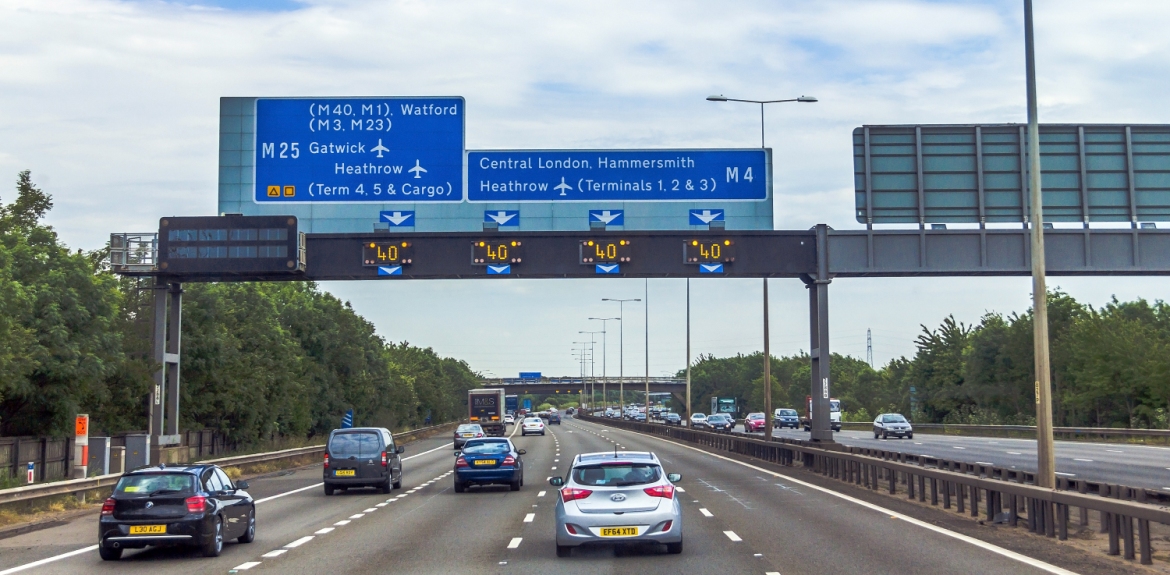
They tie an opaque bag over any incorrect signs, and erect temporary signs (of the same standard, international design) with the new limit. If it's a motorway or similar road, the electronic emergency signs will also show the reduced speed limit [1]. On a motorway, they're often on a gantry, i.e. completely impossible to miss.

I think I read somewhere that it's someone's job to make regular checks that the temporary signs (and covers) are still correct -- they are an important part of the worker safety requirement for the construction crew.

When a speed limit changes, the rule is for the sign to be shown on both sides of the road. There are then repeating signs for the current limit at some regular interval.

The UK is dense enough that having expensive electronic signs on all motorways isn't an unreasonable cost; I understand that's not practical in the USA or Australia.

[1a] https://i2-prod.birminghammail.co.uk/news/midlands-news/arti...

[1b] https://www.ageas.co.uk/globalassets/solved/30072018_road-sa... (possibly this style is no longer used, I drive very rarely in the UK so I'm not sure.)

If there's no sign to indicate that the speed limit is changed, how are you supposed to know what the speed limit is?

I've had speeding tickets forgiven in Australia because the sign simply wasn't visible enough due to overgrown trees and a 2 lane off ramp separating the sign from the road it applied to, let alone the sign missing altogether.

If you are surrounded by people in orange vests, or traffic cones directing you to a detour, you are in a construction zone and better not be doing highway speeds. The fact that the sign wasnt visible, or even wasnt present, will not help. This comes up in AI cars all the time. The camera is blocked from seeing the sign beside the road, perhaps by a truck in the right lane. Or maybe the temporary folding sign is blown over. You still have to recognize a construction zone. A bad sign might get you out of a basic speeding ticket, maybe, but it wont protect you from a dangerous driving ticket, or going to jail after running over a construction worker. And a great many juridictions mandate vastly reduced speeds when cops/ambulances/firetrucks/towtrucks are beside the road, meaning you have to recognize such situations regardless of posted signs.
That brings back memories of Pokemon Go issuing bans after flights because you must be location spoofing to have travelled that quickly.

On some level, a device owned and controlled by the consumer and asserting a particular travel speed seems like the wrong place to put that kind of enforcement.

>it would be a trivial matter to have google forward the relevant information.

oof... Glad Google doesn't have that info about me.

Got bluetooth on your phone? Some cities are using bluetooth IDs to measure traffic flow, a phone or car's bluetooth ID as it passed sensors and calculating the speed based on the time taken to cover the distance. This isn't used for speed enforcement, they don't match the IDs to individuals/cars, but it certainly could be.

https://www.econolite.com/products/software/bluetoad/

"Advanced Traffic Management Systems Bluetooth Detection. TrafficCast proven algorithms for filtering and processing data inputs to compute real-time travel times and speeds."

Most Tire Pressure Monitoring systems also broadcast a unique ID that can be used to derive traffic patterns.