Hacker News new | ask | show | jobs
by lidHanteyk 2230 days ago
During the Bronze Age Collapse [0], we lost the ability to write in many civilizations around the Mediterranean. Literacy rates could have been as low as 10% in these places, and so when systems collapsed, literacy couldn't be sustained. To this day, we have not yet recovered the ability to read languages like Linear A [2] and the Byblos script [3]. Not every civilization lost writing, and eventually the Phoenician family of scripts flourished and everybody switched to alphabets and abjads.

Could we be on the verge of losing the ability to fly? We would still have airplanes, and some parts of the world might retain the ability, but without Boeing, we could see a dramatic reduction in the amount of airplanes, flying, airports, and tourism.

[0] https://en.wikipedia.org/wiki/Late_Bronze_Age_collapse

[2] https://en.wikipedia.org/wiki/Linear_A

[3] https://en.wikipedia.org/wiki/Byblos_syllabary

5 comments

This is just ridiculous. Boeing CEO wants bailouts, this is why he released the statement.

Without Boeing other companies will emerge. There is no way in this day and age (globalization) tourism/traveling will cease to exist.

I would agree unlikely, but if the virus continues to be a problem, or others emerge then tourism as we know it could come to an end.

Once you have a drop in traffic, the remaining traffic could become more expensive to operate, further reducing demand, making air travel rare rather than everyday again.

It's only cheap now because of the number of people travelling it's a virtuous spiral up, but there is also a sister spiral you can travel down.

That kind of happened to supersonic travel. We don’t have Concorde any more but we still know how to make them, and there’s a lot of development into unmanned supersonic flight. Now I have a hankering to go to an airplane museum.
Supersonic travel in the Concorde era was never profitable due to expensive aircraft, insane fuel consumption, and sonic booms limiting possible routes. (Yes, BA/AF eventually figured out how to making operating them profitable simply by charging through the nose, but not at sufficient scale to build more planes, much less improve them.)

There are various startups like Boom who think a new generation of supersonics could be a profitable niche, but they were a long shot at best of times and much more so in these times. https://boomsupersonic.com/

Both planes & fuel are dirt cheap right now. As long as there's demand for travel (which is the real blocker right now), supply will spring up to fill it.
Which other companies, though? As of last year, Boeing and Airbus were 99% of the passenger plane market and 90% of the entire plane market [0]. Airbus is currently reeling from not just COVID-19 [1][3], but also a bribery scandal [2], and is in largely the same position as Boeing: Too big to fail, but nonetheless teetering on the edge.

The analogy with the Bronze Age is very neat. The two writing systems which ruled in the Mediterranean were Egyptian hieroglyphs and Sumerian/Babylonian cuneiform. Both were slow to use, difficult to spell, and non-phonetic. In contrast, the Phoenician-inspired scripts which popped up a few hundred years later were all phonetic, allowing people to more easily adopt them, and leading to Latin, Greek, and Hebrew.

I'm not saying that planes will vanish. I'm suggesting, rather, that there may be a dramatic reduction, on the order of 99% or more, in the amount of air travel, and that this reduction may last for over a generation. During that time, we may see entirely new, less centralized techniques for achieving air travel, which could not possibly have happened as long as Boeing and Airbus are still dominant.

[0] https://www.cnbc.com/2019/01/25/why-the-airbus-boeing-compan...

[1] https://uk.reuters.com/article/uk-health-coronavirus-airbus/...

[2] https://www.reuters.com/article/us-airbus-probe-idUSKBN1ZX2M...

[3] https://finance.yahoo.com/news/coronavirus-crisis-pushes-air...

I'd be willing to give you pretty strong odds, if you were willing to bet on your 99%+ reduction forecast.
Bet what, exactly? I already wagered and lost karma, and I'm wagering more just by replying to you.

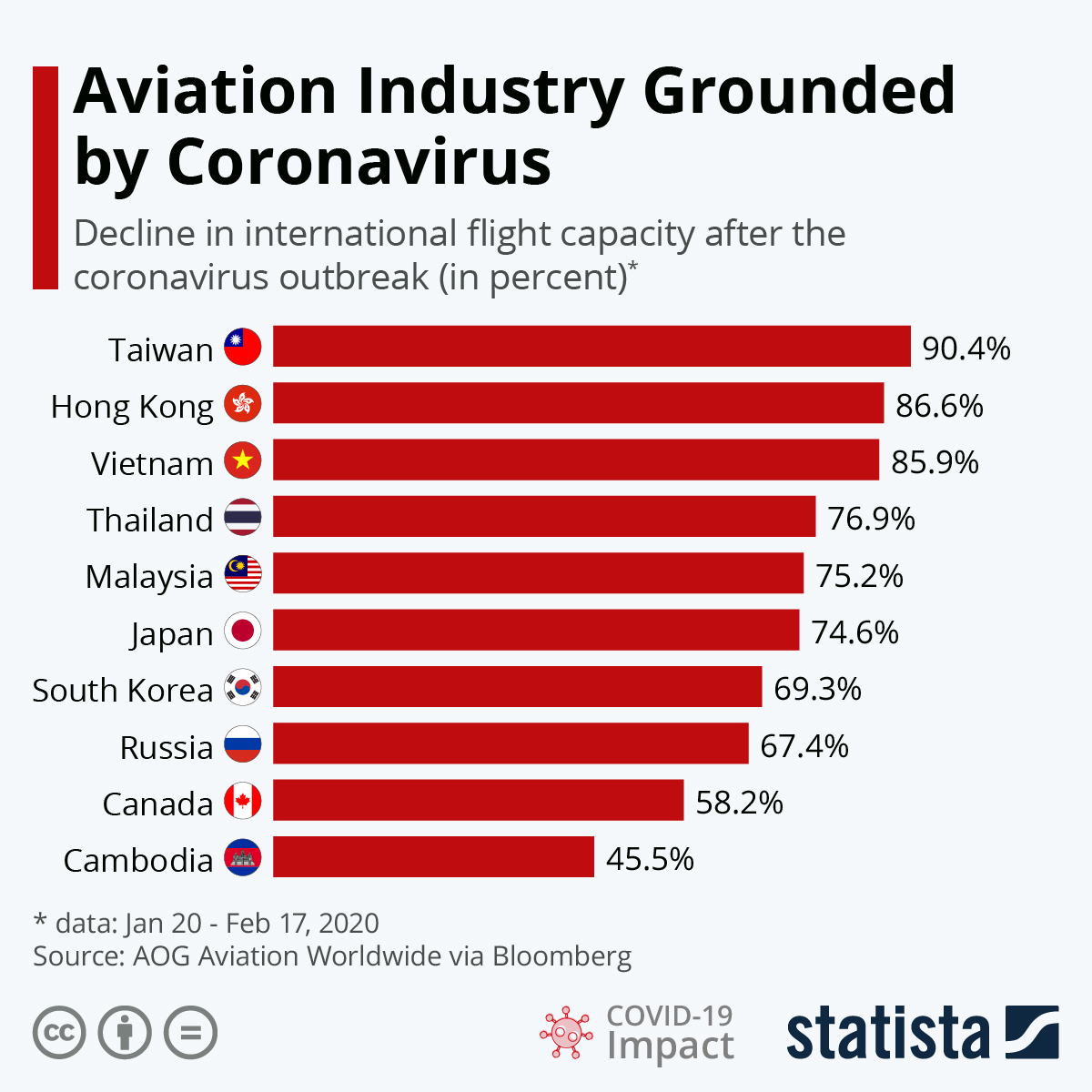
Air travel around the Pacific Rim is down by about half a nine to 1 nine [0]. Worldwide, airlines are taking beatings of about half a nine [1], which isn't that much, one would think, but airlines famously have supposedly tight margins of about 1% [2][3], and so even a minor system shock is impactful.

Sure, 99% reduction, 2 nines, is a bold statement. I'm merely imagining what would happen if both Boeing and Airbus went under. Without their facilities and engineering knowledge, it could take decades for a competitor to ramp up. Airbus themselves took decades to ramp up against Boeing, and they were purposely assembled for that task [6].

Most Boeings in the air are a little dated in terms of design, which has led to scandals (read: "crashes and loss of life") in the past few years. Specifically, the 737s and 747s account for 77% what Boeing's got in the air [4]. Similar numbers for Airbus, with again 77% of those planes being the A320s [5]. That's a lot of planes that rely on the duopoly for not just continued production, but also maintenance; aircraft are continuously costly and require expertise and care.

[0] https://cdn.statcdn.com/Infographic/images/normal/21027.jpeg

[1] https://www.nationalgeographic.com/travel/2020/04/charts-sho... Apologies, but JS will be required to render the graphs. Ugh.

[2] https://www.economist.com/the-economist-explains/2014/02/23/...

[3] https://i.insider.com/4fdb8a20ecad04051f000016

[4] https://en.wikipedia.org/wiki/Boeing_Commercial_Airplanes#Ai...

[5] https://www.statista.com/statistics/263394/airbus-aircraft-i... More JS, sorry again.

[6] https://en.wikipedia.org/wiki/History_of_Airbus

The Boeing statement was about an airline going out of business not Boeing itself.

Boeing does want bailouts but for the airlines. The chances are basically none that the US allows Boeing to go away.

Airlines on the other hand go bankrupt all the time.

Pretty hilarious that OP goes straight into the collapse of civilization and Linear B after he TLDR’s
> Boeing CEO wants bailouts

That, but without any strings to get in the way of, I don't know, stock buybacks?

Buybacks are fine, just offer the bailout paid in stock and allow the company to repurchase later.
> Could we be on the verge of losing the ability to fly?

No, why? Aribus and Boeing make a lot of the big planes. But they are far from the only game in town for making planes at all.

Even fewer planes isn't much of a problem. There were much fewer planes in eg the 1950s than today. But no one thought that would mean humanity would forget how to make planes.

Also bankruptcy isn't the end of the world. In some sense, it just means that the creditors take over control of the company from the shareholders. All the factories and engineers are still there.

For example, airlines go bankrupt all the time.

I’m really sorry you got voted down for this prescient comment. It is spot on that in times of societal distress we often lose progress and knowledge that was obtained before, often on purpose.

Think of the dark ages, or many of the populist revolutions of the 20th century (I personally am not for/against populism, but like other ideologies it holds many dangers when applied badly).

They got downvoted because the statement has nothing to do with the article. The CEO of boeing said nothing about Boeing, an airline manufacturer going bankrupt. He said that a carrier / airline could go bankrupt. If that happens all it means is that someone else comes along, buys all the assets and re-opens with much reduced costs, probably at a smaller scale for a while.
It is probably half true. Yes the article and facts are that it is some Airlines that could go bankrupt. And i guess that Boeing still have a lot of cash reserves. But, Airlines (ie clients) Bankruptcy could lead to very bad cascading effects on Boeing. Including its own Bankruptcy on a longer term. But certainly the US would not let that happen I suppose.
Though the leading statement is obviously a stretch, HN is all about curiosity and interesting questions. The CEO wanting a bailout is boring. Thinking about the nature of knowledge sharing in these kinds of industries is pretty interesting!
Thank you for explaining why you downvoted. Allow me to reply with the following observation: Boeing depends on airlines. Or, at least, Boeing's commercial division depends on airlines. A future where Boeing's commercial arm is shuttered and its defense works folded into a single entity would be congruent with my original post; there would be a grand reduction in air travel.

Boeing's biggest commercial customer, as I understand it, is Southwest, who owns about 5% of all Boeings in the air [0][1]. Thus, sure, Boeing doesn't need any one particular airline, but they certainly do need somebody to buy their planes, and each individual airline which cannot stay aloft is a potential lost customer.

Because planes are so expensive to manufacture, Boeing and Airbus typically take orders for aircraft in advance, presumably along with payment, in exchange for a hefty discount of over half off the advertised price [2]. Additionally, they take too many orders, expecting that they are overbooked on plane orders and some will be canceled [2]. This sort of accounting works well in times of trouble, as long as the system returns quickly to normal following the initial shock. For example, after 9/11, air traffic resumed after a week [3] and there was only about a 30% reduction in air travel, which lasted for about a year [4]. However, if there is a months-long depression in air traffic, then the reduction will be more severe; it's been about 45% to 90% reduced around the Pacific Rim [1] and could get worse.

Eventually, too many orders get cancelled, and production has to scale back, and once production starts diminishing, it's hard to regain capacity. The original article quotes the CEO as saying that it could be 3 years until we get back to prior levels of air travel; that is a long time for airlines to hold out, and a long time for Boeing and Airbus to keep getting orders.

[0] https://en.wikipedia.org/wiki/Southwest_Airlines_fleet#Curre...

[1] Read my cousin reply.

[2] https://en.wikipedia.org/wiki/Competition_between_Airbus_and...

[3] https://en.wikipedia.org/wiki/Closings_and_cancellations_fol...

[4] https://web.mit.edu/airlines/conferences/DC-2002_documents/0...

I don't think it would be due to lack of knowledge that we would lose the ability to fly. It would sooner be economic. Though I see your angle, it's important to note that most of the information we need to know how to fly is in the public domain or in the patent office. I'm not sure there are many secrets in aviation.
> During the Bronze Age Collapse [0], we lost the ability

Oh, kind of like how the US outsourced mask production to China, and became so deindustrialized that they couldn't make their own when needed?

The US never lost the ability to make masks. The issue is that unlike the tech industry, traditional manufacturing can't just spin up a thousand AWS instances to increase production 1000x fold, which is what the situation required.
You are correct manufacturing cannot scale overnight. But it can scale up if orders are placed especially if capacity is already in place. The US just decided it did not need that extra capacity until very late in the game.

From the below article:

"The Post reports Mike Bowen, owner of the largest surgical face mask producer in the US — Prestige Ameritech in Texas — contacted top officials in the Department of Health and Human Services on January 22, the day after the first US coronavirus cases were identified.

His pitch: Provide the funds needed to dust off four dormant manufacturing lines, and his firm would produce 1.7 million N95 masks every week. According to Bowen, he’d been raising the alarm for years that the US was too dependent on foreign countries (where nearly 90 percent of masks used in the country come from) for production, and argued his manufacturing lines offered both a way around that, and to ensure the US would have the masks it needed.

Rick Bright — the former director of HHS’s Biomedical Advanced Research and Development Authority (who was ousted in April, and later filed a whistleblower complaint alleging he was demoted for fighting for science-based preparations “over political expediency”) — pushed top HHS officials to accept Bowen’s offer, to no avail. Prestige Ameritech later exported a million masks to China."

... "The federal government went on to spend more than $600 million on contracts including mask production. Honeywell and 3M were given contracts worth more than $170 million to produce protective gear. And a tactical training company with no history of producing medical equipment was given $55 million to make N95 masks for $5.50 each — a price around seven to nine times greater than other suppliers, including Bowen’s company. Prestige Ameritech was eventually given a $9.5 million contract in early April to produce N95 masks for 79 cents each.

Bowen’s manufacturing lines, which could be making more than 7 million masks every month, remain unused."

https://www.vox.com/covid-19-coronavirus-us-response-trump/2...