Hacker News new | ask | show | jobs
by lidHanteyk 2230 days ago
Which other companies, though? As of last year, Boeing and Airbus were 99% of the passenger plane market and 90% of the entire plane market [0]. Airbus is currently reeling from not just COVID-19 [1][3], but also a bribery scandal [2], and is in largely the same position as Boeing: Too big to fail, but nonetheless teetering on the edge.

The analogy with the Bronze Age is very neat. The two writing systems which ruled in the Mediterranean were Egyptian hieroglyphs and Sumerian/Babylonian cuneiform. Both were slow to use, difficult to spell, and non-phonetic. In contrast, the Phoenician-inspired scripts which popped up a few hundred years later were all phonetic, allowing people to more easily adopt them, and leading to Latin, Greek, and Hebrew.

I'm not saying that planes will vanish. I'm suggesting, rather, that there may be a dramatic reduction, on the order of 99% or more, in the amount of air travel, and that this reduction may last for over a generation. During that time, we may see entirely new, less centralized techniques for achieving air travel, which could not possibly have happened as long as Boeing and Airbus are still dominant.

[0] https://www.cnbc.com/2019/01/25/why-the-airbus-boeing-compan...

[1] https://uk.reuters.com/article/uk-health-coronavirus-airbus/...

[2] https://www.reuters.com/article/us-airbus-probe-idUSKBN1ZX2M...

[3] https://finance.yahoo.com/news/coronavirus-crisis-pushes-air...

1 comments

I'd be willing to give you pretty strong odds, if you were willing to bet on your 99%+ reduction forecast.
Bet what, exactly? I already wagered and lost karma, and I'm wagering more just by replying to you.

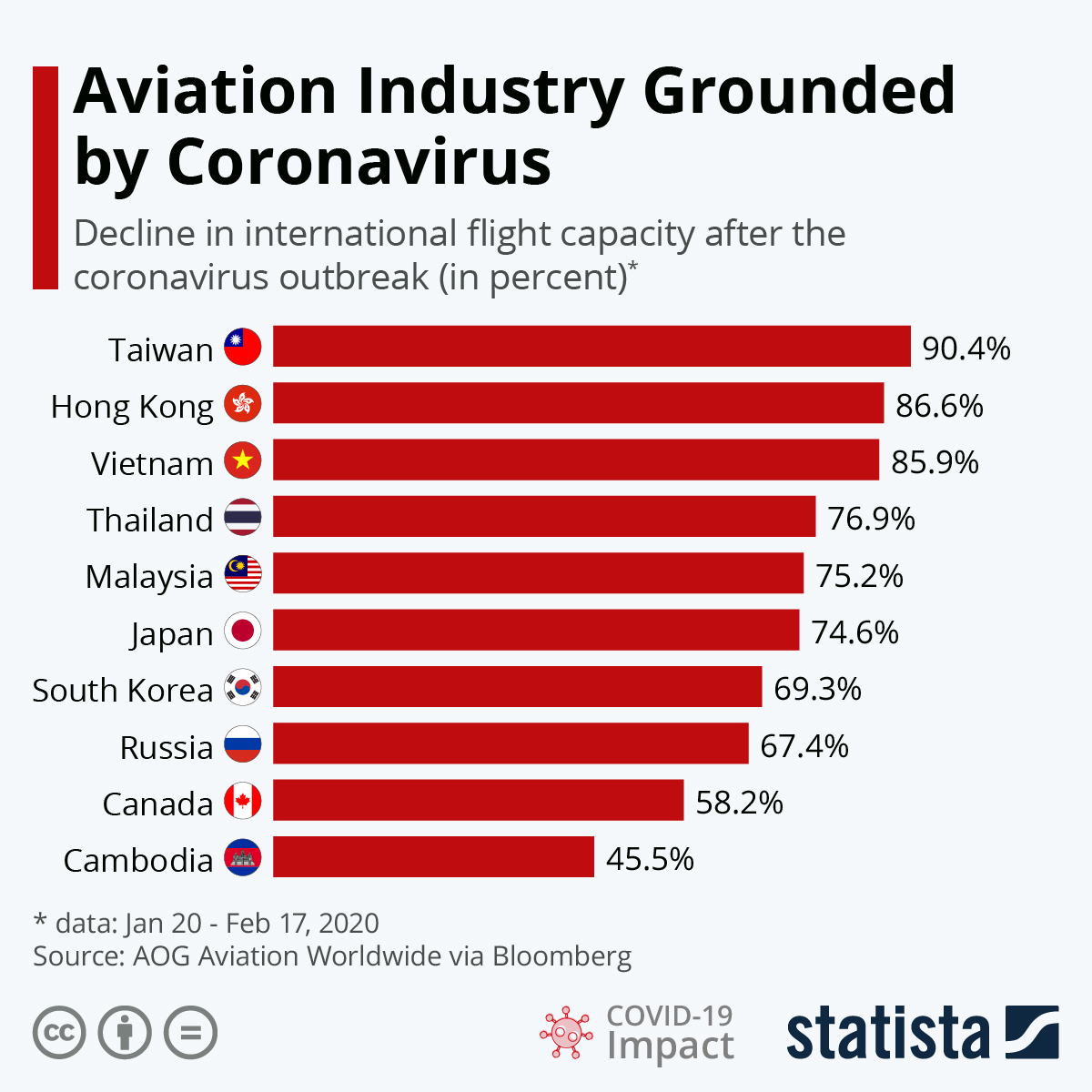
Air travel around the Pacific Rim is down by about half a nine to 1 nine [0]. Worldwide, airlines are taking beatings of about half a nine [1], which isn't that much, one would think, but airlines famously have supposedly tight margins of about 1% [2][3], and so even a minor system shock is impactful.

Sure, 99% reduction, 2 nines, is a bold statement. I'm merely imagining what would happen if both Boeing and Airbus went under. Without their facilities and engineering knowledge, it could take decades for a competitor to ramp up. Airbus themselves took decades to ramp up against Boeing, and they were purposely assembled for that task [6].

Most Boeings in the air are a little dated in terms of design, which has led to scandals (read: "crashes and loss of life") in the past few years. Specifically, the 737s and 747s account for 77% what Boeing's got in the air [4]. Similar numbers for Airbus, with again 77% of those planes being the A320s [5]. That's a lot of planes that rely on the duopoly for not just continued production, but also maintenance; aircraft are continuously costly and require expertise and care.

[0] https://cdn.statcdn.com/Infographic/images/normal/21027.jpeg

[1] https://www.nationalgeographic.com/travel/2020/04/charts-sho... Apologies, but JS will be required to render the graphs. Ugh.

[2] https://www.economist.com/the-economist-explains/2014/02/23/...

[3] https://i.insider.com/4fdb8a20ecad04051f000016

[4] https://en.wikipedia.org/wiki/Boeing_Commercial_Airplanes#Ai...

[5] https://www.statista.com/statistics/263394/airbus-aircraft-i... More JS, sorry again.

[6] https://en.wikipedia.org/wiki/History_of_Airbus