This way of living, with that many people on the planet is not sustainable. We are on a runaway train to extinction and we want it to go faster. The economy!
When people talk about climate, resources, ecology etc. people are typically quite optimistic until you bring up the idea of "sustainability". The typical reply is something like "oh, we'll get there one day, it's certainly possible in the future.." but the idea of that sustainability is something we can put off is rather absurd, in the most technical sense.
Sustainability is the border between two ways of life. The side we're on, is by definition, unsustainable. It literally cannot be maintained. When you are in a state that no one on earth would argue can be maintained, pessimism and existential concern should be the default, predominate way of thinking.
If a subsistence farmer needed 1000 lbs of potatoes to feed his family each year, but was only capable of growing 700 this year, and was estimably 650 for next, you would be deeply concerned. Even if his estimate was 850 for next year, you would still bet that he was not going to survive. But this is how we live our lives, the sustainability is often talked about as some sort of moonshot goal.
The irony is that we do scream "the economy!" but when you think of the basic logic of sustainability there is the one side where you cannot survive on your current path, and the other where you produce a surplus of what you need. If our farmer expects to grow 1200 lbs of potatoes he can survive unexpected events, sell his potatoes to a neighbor, expand his family etc. Clearly the real economy only exists on the other side of sustainable.
If the economy is unsustainable, in any situation other than the world we live in, anyone would clearly state that such an economy is an illusion, since by living in an unsustainable way you have less than you need to survive, let alone enough to worry about what you want.
I agree. And the other thing too is nobody wants to hear about the prospect of overpopulation. In fact, I think most of our problems stem from this.
Bill Gates, for example, says we can "feed 12 billion people". Ok sure, but at what cost to the planet and our quality of life? Others say "the whole population could fit in an area the size of Texas". Or they look at Hong Kong density and say "it's possible". But I don't think that is sustainable or desirable.
When people think of picturesque countries like Norway, they often forget that those countries have low population densities, which allow them to leave parts of nature untouched.
Another issue that arises is that the global economy is built on a forever growth model. We're kind of stuck with an economic house of cards standing on the back of continued population growth.
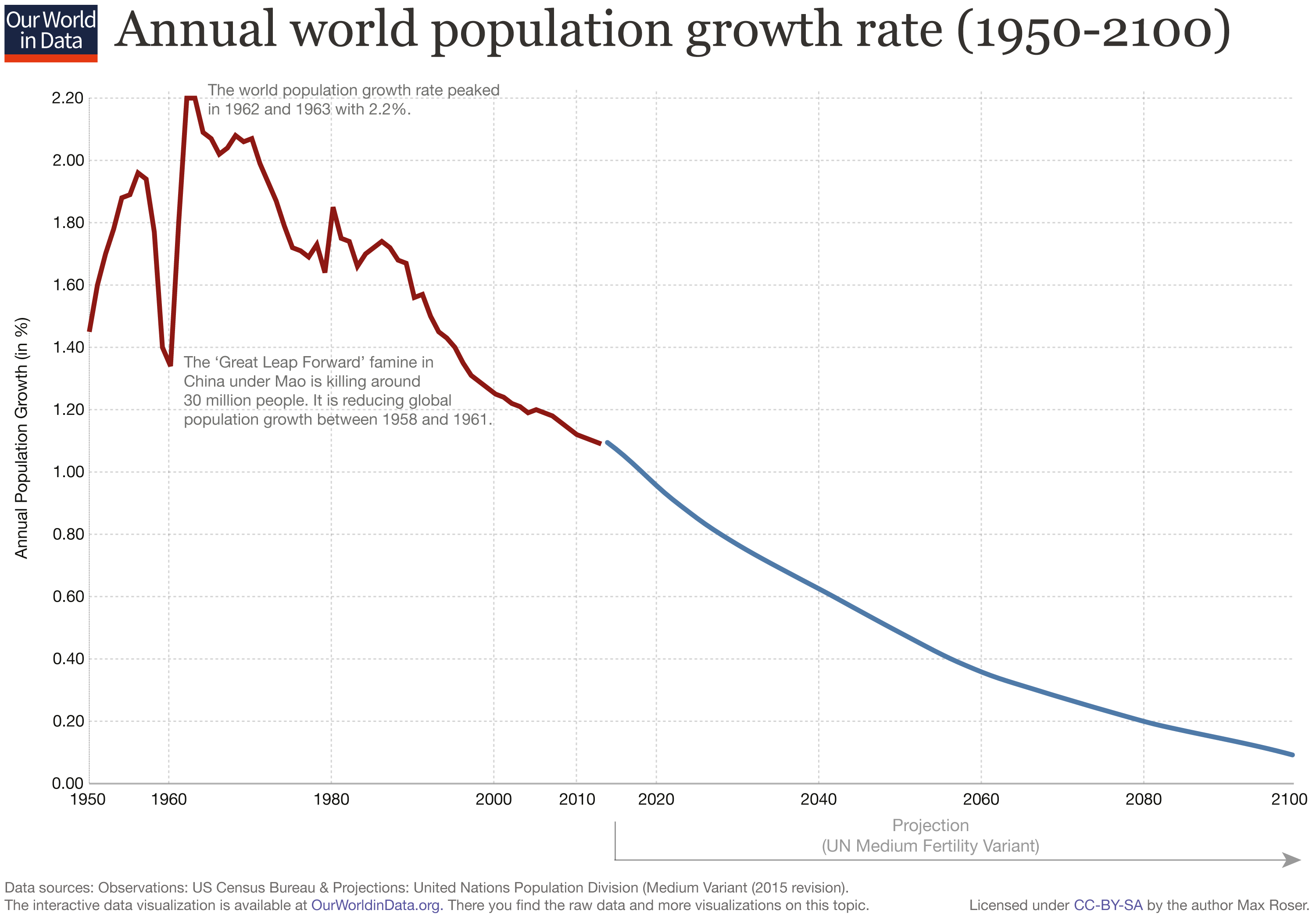
World population growth has plummeted. You should be pleased.
https://ourworldindata.org/uploads/2013/05/Updated-World-Pop.... That drop in growth was not achieved by impact of war, disease or starvation but by economic activity of the kind you think is an 'issue'. People want to trade and better themselves. When they do this, dramatic improvements can result at all levels. You're hardly able to take an interest in protecting and nurturing your environment when you're poor. Note how it's the middle and upper classes in the West who largely comprise the environmental action groups across the world. The poor are too busy just surviving. 19th century families in the UK (one of the richest countries in the world at the time) were large because 15% of babies under 1 year, died.
Growth in general has fallen, yes. The issue is momentum going in to 12bn people or so. I don’t think that things scale effectively at population levels like that. Not to mention the environmental impact.
We have more than enough resources on the planet to feed everyone(0)(1)(2)(3)(4), it is the distribution of it that is the problem.
Large amounts of food are wasted(5)(6)(7), that is a problem posed by our economic system and something that we can fix -- something we should try to fix, without going straight to Eugenics (as Malthus did, and many white nationalists do), or population control.
Yes but who’s willing to get off at the next station, not the passengers who’ve been on it from the start and not the passengers who just got on and are getting a taste.
With very few exceptions, any affordances technology brings are consumed by humanity's insatiable appetite before they can benefit the environment. If technology figures out how to make $X more energy efficient, we just run more $Xs such that the (trajectory of) energy consumption is constant.
Isn’t just counting the developed world missing the problem though? We also moved all of our manufacturing to the developing world at the same time and they saw a much greater increase.
Shipping stuff around the world and moving your pollution to Asia doesn’t do much good when we all share the same atmosphere.
This is really interesting; I wasn't aware. That said, "per capita" is the wrong metric since we're discussing humanity in aggregate. I might still be wrong about energy in general, however. In any case, I think the broader principle holds.
No. Political will is the only way out. Technology alone is not going to help when politics is geared to subsidize dirty fuel, permit polluting industry and avoid economic interventions that would help, like carbon taxes.
Over time, perhaps. But we don't have time. Where are the low-methane cows? The low-carbon flights? When will cement pollute less? Why are we still generating 61% of power with coal and gas [0]? Part of the answer to all of these things is that there is a lot invested in maintaining the status quo. Airlines getting away with tax-free fuel isn't a technology problem. How long, realistically, until any significant proportion of current meat eaters switch to lab-grown meat or other alternative? And how much political capital will alternatives need to accumulate to take on the meat industry?
Sure, technology can help with any of these problems but it'll take forever as long as governments only pay lip service to wanting to change things.
I think you're both right. I don't think we'll get much mileage by limiting consumption via legislation, but I do think subsidizing industries like renewables and green research (and phasing out dirty energy subsidies) combines policy and technology to get us there faster (in time?).
I think political technology is the way out. Right now we can't coordinate political will efficiently enough. Nations aren't powerful enough in a global capitalist world economy and even our best flavours of representational democracy doesn't have enough integrity to make the right decisions.
"It doesn't matter if I take the cost for changing my ways if I can't trust the others to not eat the benefit."
What happens to the economy when a significant portion of society wakes up to the reality of the biosphere collapsing? Will it happen soon or when the oceans are dead or the pollinating insects extinct?
There's a risk that not much will happen (from this realization alone). Most people don't have much power to do anything about it other than joining political movements. And for the individual life goes on. Once it starts to affect society itself we will act but only to do something about the immediate concern.
The economy/society works like this, it can only be forced into action because there is yet no efficient way to coordinate action over the scale required.
If it happens gradually, we may never wake up to it. For all I know, our biosphere is an already collapsed version of yesterday's, yet we usually see it more as a better version of tomorrow's.
Are there any resources for determining which US politicians support environmentalism (specifically meaningful, evidence-based policies as opposed to vapid virtue signalling) and/or where the "battleground" states are? I guess in general I'm looking to get involved more in climate politics, but I don't know where to start.
First look at how their campaigns are funded. You will not find any meaningful action from politicians who are dependent on support from billionaires or powerful corporations. Then I would look at whether they are committed to supporting the Green New Deal and how their policies are rated by climate groups like the Sunrise Movement. This has helped me learn more about climate policy in general, and has made me more able to distinguish platitudes from serious proposals to address this crisis.
My favorite writer on the subject is Naomi Klein. I think her work is a good resource for learning more about the politics of the climate crisis.
Check out Citizens Climate Lobby. citizensclimatelobby.org
Non-partisan group attempting to get a carbon tax and dividend law passed, and they are making progress. They continue to get new co-sponsors on their bill, they do a lot of training on how to get involved, how you can speak to your Congressperson etc.
I'm not really sure how to break down "evidence-based" any more for you. It's pretty self-explanatory. Virtue signalling refers to actions that indicate you care about a topic (the environment in this case) but without any real commitment to the cause. For example, politicians who want to appear to care for the environment might promote a ban on plastic straws because it generates lots of good publicity, is only most mildly inconvenient, and is transparently negligible with respect to saving the planet ("better than nothing" unless one accounts for the squandered political will).
Sustainability is the border between two ways of life. The side we're on, is by definition, unsustainable. It literally cannot be maintained. When you are in a state that no one on earth would argue can be maintained, pessimism and existential concern should be the default, predominate way of thinking.
If a subsistence farmer needed 1000 lbs of potatoes to feed his family each year, but was only capable of growing 700 this year, and was estimably 650 for next, you would be deeply concerned. Even if his estimate was 850 for next year, you would still bet that he was not going to survive. But this is how we live our lives, the sustainability is often talked about as some sort of moonshot goal.
The irony is that we do scream "the economy!" but when you think of the basic logic of sustainability there is the one side where you cannot survive on your current path, and the other where you produce a surplus of what you need. If our farmer expects to grow 1200 lbs of potatoes he can survive unexpected events, sell his potatoes to a neighbor, expand his family etc. Clearly the real economy only exists on the other side of sustainable.
If the economy is unsustainable, in any situation other than the world we live in, anyone would clearly state that such an economy is an illusion, since by living in an unsustainable way you have less than you need to survive, let alone enough to worry about what you want.