|
When people talk about climate, resources, ecology etc. people are typically quite optimistic until you bring up the idea of "sustainability". The typical reply is something like "oh, we'll get there one day, it's certainly possible in the future.." but the idea of that sustainability is something we can put off is rather absurd, in the most technical sense. Sustainability is the border between two ways of life. The side we're on, is by definition, unsustainable. It literally cannot be maintained. When you are in a state that no one on earth would argue can be maintained, pessimism and existential concern should be the default, predominate way of thinking. If a subsistence farmer needed 1000 lbs of potatoes to feed his family each year, but was only capable of growing 700 this year, and was estimably 650 for next, you would be deeply concerned. Even if his estimate was 850 for next year, you would still bet that he was not going to survive. But this is how we live our lives, the sustainability is often talked about as some sort of moonshot goal. The irony is that we do scream "the economy!" but when you think of the basic logic of sustainability there is the one side where you cannot survive on your current path, and the other where you produce a surplus of what you need. If our farmer expects to grow 1200 lbs of potatoes he can survive unexpected events, sell his potatoes to a neighbor, expand his family etc. Clearly the real economy only exists on the other side of sustainable. If the economy is unsustainable, in any situation other than the world we live in, anyone would clearly state that such an economy is an illusion, since by living in an unsustainable way you have less than you need to survive, let alone enough to worry about what you want. |
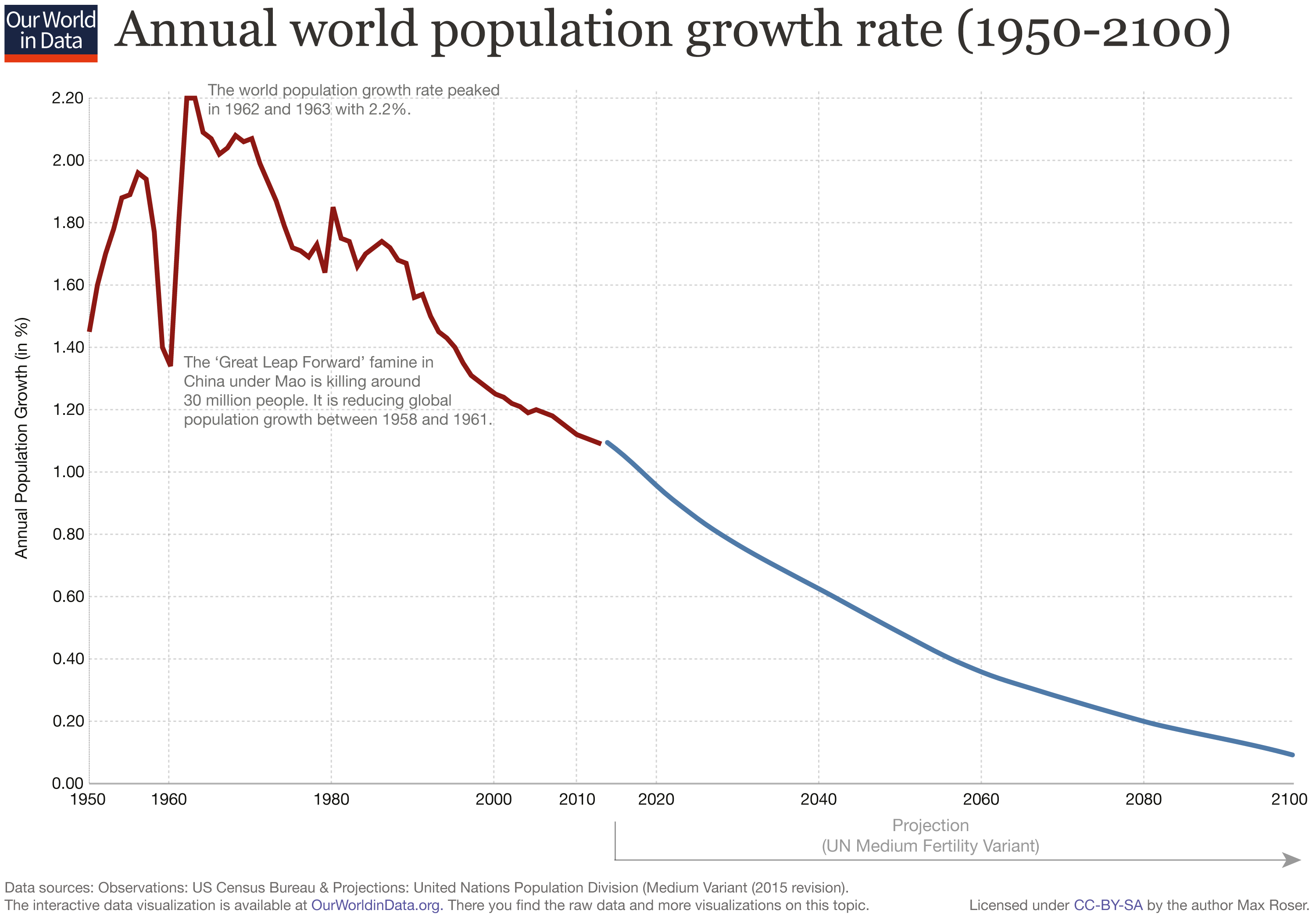
Bill Gates, for example, says we can "feed 12 billion people". Ok sure, but at what cost to the planet and our quality of life? Others say "the whole population could fit in an area the size of Texas". Or they look at Hong Kong density and say "it's possible". But I don't think that is sustainable or desirable.
When people think of picturesque countries like Norway, they often forget that those countries have low population densities, which allow them to leave parts of nature untouched.
Another issue that arises is that the global economy is built on a forever growth model. We're kind of stuck with an economic house of cards standing on the back of continued population growth.
/Bit of rambling here.