Hacker News new | ask | show | jobs
by dmytroi 2265 days ago
While the core product is LGPLv3+Commercial, most of their extensions are GPLv3+Commercial which makes them not suitable for a lot of apps.

Hence I find it's a bit confusing to say "to be committed to open source" where in practice the only way to use their extension is either to release your apps code (given you distribute the app) or pay for commercial license. IMHO "to be committed to free software" would represent extensions situation a bit better.

7 comments

> GPLv3+Commercial which makes them not suitable for a lot of apps.

In other words, the license is not suitable for users who are not committed to open source themselves but are not willing to pay either.

Dual licensing with GPL is IMHO the best and often only viable method from the business point of view for small and medium sized companies who sell product and not just service.

QT Company has large customers that are much bigger than it is. Many of them in software business. Turning into yet another software as a service producer for Autodesk or car manufacturers is not in their interests.

> While the core product is LGPLv3+Commercial, most of their extensions are GPLv3+Commercial which makes them not suitable for a lot of apps.

this is FUD - the immense majority of Qt is under LGPL. You can build literally entire OSes out of the LGPL parts.

The only strictly GPL parts are (from this page https://doc.qt.io/qt-5/qtmodules.html) : - Qt Charts - Qt Data Visualization - Qt Network Authorization - Qt Virtual Keyboard - Qt for WebAssembly - Qt Quick WebGL

All the widgets, qt quick, etc... stuff is available under LGPL.

Yeah, can't find another cross-platform UI library with Qt's selection of (permissive license-compatible) widgets. Other UI libraries tend to look like crap (at least on macOS), too.
> most of their extensions are GPLv3 [...] in practice the only way to use their extension is either to release your apps code

Which is exactly what improves and helps grow the open-source world?

GPL makes a product's code, and by infection/extension, other people's code, to be all released under a GPL license. GPL guarantees that users of open-source code won't act as leeches and will themselves contribute more open-source code. Isn't the act of choosing that license, in itself, "a huge commitment" to open-source?

Then they say: OK, seems you want to keep your code private, in order to preserve your IP and leverage over other competitors, and protect your lucrative interests... well that's fine too! You don't want our open-source license forcing you to contribute your code? Fine, we'll waive that requirement. Just pay up.

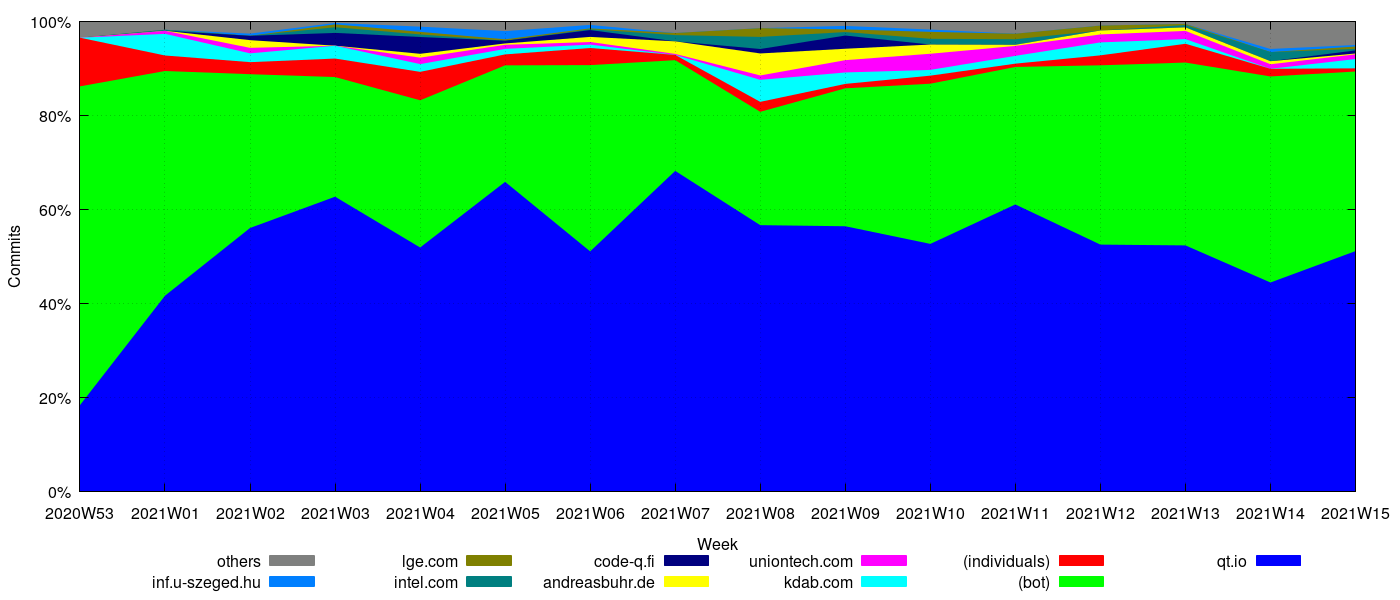
I think most developers get along pretty well with only the parts available under LGPL; that's not the issue. It's more of an issue that the The Company only represents a fraction of the commit log but even though sells commercial licences of work done by other companies. I'm sure more companies would contribute to Qt if there wasn't this dual licence nuisance and they weren't forec to sign a contributor licence agreement which puts The Company in charge of their work.
Ok, a bit more than last year. One should also analyze what parts were commited. There is a significant difference in the commits by company to the core framework and the new 3D tools and other parts that The Company wants to make money with.
The stats for qtbase are pretty similar. I suppose I might as well link the full page for folks: https://macieira.org/~thiago/qt-stats/current/
Thanks. It was quite different when I looked at it a year ago. Maybe the new activity is because of Qt 6.
The biggest problem of Qt is the FUD just like you're spreading.

No. All is LGPL except for some niche libraries.

How so? Promoting Open Source is the very point of the GPL.
You won't get any support of the "big money" unless the library is at least LGPL so it can be used in closed source applications. GPL is primarily for the idealists, not for business.
Qt has a commercial license. So what is the issue with big money again? They don't want to pay up?
Just look at other essetial, widely used frameworks like OpenCV, Skia, Chromium, LibreOffice, just to name a few. In each such open source project a couple of companies are involved who can affort to dedicate a couple of developers to work on the open source frameworks they're using but which are not their income. This is a "coopetition" among companies and everyone benefits from it. In the case of Qt it's restricted because The Company sells licences of work which was done by others (companies and private people) for free.
> In the case of Qt it's restricted because The Company sells licences of work done by others for free

No, using the LGPL code done by third party is still free of charge.

> This is a "coopetition" among companies and everyone benefits from it.

And we also have seen many times developers who released their code as MIT never seeing a dime from these big companies (such as Corejs developer).

LGPL is the way to go to ensure that big corps who make money out of an open source project do pay up. You don't want to release your source code? Then pay for a commercial license, end of story.

You just got my arguments all wrong. We're talking at cross purposes.
> You won't get any support of the "big money" unless the library is at least LGPL so it can be used in closed source applications. GPL is primarily for the idealists, not for business.

Right, of course; hence the failure of Linux and the dominance of the BSD family. /s

Haven't you heard? Sony's Playstation and Nintendo's Switch use FreeBSD, which somehow is good - especially for the consumers buying those products.
I wouldn't say that game consoles use FreeBSD so much as that they use chunks of code from BSD; I mean, the Switch is apparently using a microkernel, so I doubt that it's all that close.

But yes, using permissively-licensed components absolutely is* a good thing, including for the users, who get higher-quality software with less dev time and lower cost of development. Obviously I'd prefer that it was all GPLv3, but given that the alternative in practice is probably fully-proprietary software from scratch, I think BSD is better than nothing.

Using the product while making a closed source application and contributing nothing (money or patches) back can hardly be construed as promoting open source. The "big money" that won't play ball is why they instead have the commercial licensing options.
Nobody claims that. The problem today is that The Company only contributes a fraction to the maintenance and sells licences which includes work done by others. That's a pain point, isn't it?
I don't believe that is the real pain point. The Company could resolve it easily by paying contributors in exchange for signing the CLA. What is more likely is that they can't afford to do this.
That would be much too complicated. Just imagine such a model with OpenCV or some of the other big C++ frameworks. Selling framework licenses is just an outdated business model. It would make more sense to release the Qt framework under BSD and make money with add-on services (as other companies actually do successfully).
Considering the quality and capabilities of Qt, I really think they should just sell commercial licences. Considering the fact that the engineers at Qt need to pay to eat and pay their bills just like me, I find it absurd to expect something like this for free. In that sense, I think the current situation is very gracious.
It's not gracious. They have binding contract with KDE to release the code as open source within 12 months.

They can't change that without negotiating new contract. That would require giving something to get something in return. Only thing they can do is to do just the minimum. This is the current issue. They are moving towards the bare minimum.

What about all the people not working at Qt Company that wrote most of the code? Qt company immensely benefits from the work done by others under the condition it remains also available under open source licenses.
This is a good point but I'm not going to be too quick to comment on those developers. Because they may be working on paid products and they contribute to the upstream project when they find certain features missing.

I like opensource, I myself am a Linux user. I just like a world where perhaps individual devs can build nifty useful software that we pay a small fee for and use. This way the small guys can benefit. Unfortunately, the current state of OSS (which has changes since the early days) are concentrating more power in the hands of a few organizations.

Take Sublime Text for example. I like it that an engineer builds something useful, ask a one time fee for it and we pay something really affordable for it (while there was also a free version available). This way, talented software engineers could actually make a decent living without everyone has to build crappy software for an advert-based economy. So, IMHO, opensourcing the software is an act of grace and would be at the discretion of those engineers. To expect everything to be FOSS or perhaps even demand that, I find is detrimental for individual software engineers/small players.

Many contributors aren't. And even if they are, there is a clear open license they rely on, and Qt company is in the unique position to be allowed to sell exceptions to that. Companies actually contributing to open-source they use is a good thing.

Qt Company is also a 300+ employee company with 8-digit revenue. They are not some small shop trying to survive, they are a corporation that over-promised growth to their shareholders and now is trying to squeeze rules that have existed for 20 years to turn some part of the open-source ecosystem into paying customers, threatening to risk the entire open ecosystem around it for this, which includes many small shops and individuals.

I see, thanks for the clarification and it makes sense.
One problem is reluctance to buy closed-source from a one man business, it could even be regarded as negligent. Actually, having said that, Delphi had a thriving third party component ecosystem where developers commonly purchased the source code for an additional fee.
I fully agree it would be great for Qt as a company to have a great business model. That being said, it's not that obvious if making Qt as a product commercial-only would be effective, as there are other options on a market that don't cost anything (or much). Maybe Qt should pivot into services instead?