With respect to all the elders for whom all of this computer technology stuff came up pretty late in their lifetime - when and where do we draw the line about basic computer competency?
maybe someone will come along and explain why this is insensitive, but I think if a person has access to a computer (which is not a given) and a naive search query returns (relatively short/simple) step-by-step instructions on the first page of results, it's not unreasonable to expect the person to be able to do that thing.
Have you seen people doing basic internet searches? Open "the internet" by clicking the 'e' button, search Bing for Google, go to Google, type in the web address of an email someone sent you that you printed out ... I'm not even kidding.
But yes, most people can send an image on Facebook (with some coaching), so they can learn to send an image to a fax service.
What often confused these things is that people will type "send a fax" on Google, and then install the first thing recommended - those recommendations are based on 'making most profit for $company & Google' and so are often not the best system and often charge a lot c for basic services (with all the usual dark patterns).
yes, I often have to watch my father do these things. sometimes I can't handle the frustration and give step-by-step instructions, but I try to act like a TA and have him come up with the next step. usually he can figure it out himself if given enough time, he just doesn't really believe he can.
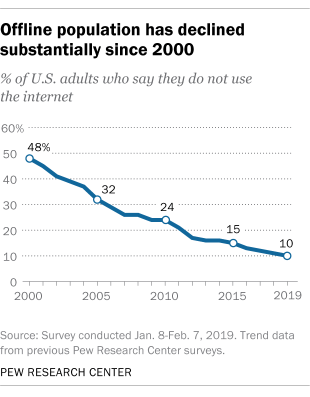
We will probably have a better idea of where that line might be when the number of Americans who don't use the internet isn't measured in the millions. That number is about 25 million adults now.
I would bet cash money that a substantial fraction of people who claim they "don't use the Internet" actually do but don't know they are using "the Internet".
Also, many of the people who don't use the internet also don't have access to fax machines or mailbox service either (homeless, very rural), so they aren't harmed by internet replacement for those.
I’m not sure about that. The 65+ demographic is huge and very over represented in the survey.
From the full pew survey, the strongest correlations were education and age... and only 19% of those who didn’t have the internet said it was because they couldn’t afford it.
Given that the demographics of people who don’t have the internet overlap very significantly with those who need benefits the most, I can’t help but think that moving public services to online-only might be a bit of an out-of-touch solution.
where do we draw the line about basic computer competency?
I think the question is why should there be a line about basic computer competency?
Why can't many methods be available to people, instead of restricting ourselves to certain methods?
Not everyone went to college. Heck, not everyone goes to high school. Those are very often the people who need government and medical services the most.
When computing interfaces stop being, generally, awful and arcane and requiring learning all kinds of voodoo rituals and tea-leaf reading to use (which becomes knowledge of how the systems are put together if you go into programming, of course—"oh that button's probably disappearing then re-appearing when you click it because [implementation detail]")
I'm a pretty cynical guy but in this case I disagree, the vast majority of UIs are simple enough that you just don't notice them working. Having tried occasionally to bake a UI myself, We take good UI for granted.
Yeah there's a learning curve but by and large even across operating system there are consistencies and even technically illiterate users can get up to speed quickly.
Do you remember the first time you discovered you could swipe in from the right in windows, or down from the top in android to access hidden functionality? Or the magic swipe to go back in the browser? Have you tried accessing the internet from small rural town USA? If you leave the coasts there are places you can't get cell service, much less blazing fast cell based internet from a rural provider. Those coverage maps the providers show in their advertisements are huge lies. Modern web UI's don't tend to run great on HugesNet, or single bar 3G.
That is just the tip, UI's have majorly regressed from the time period of the original iphone. Go to the local senior citizens home and give a bunch of them modern android/iphones and see how many can figure out how to add a contact, or send an email. Worse companies like consumer cellular have a section for flip phones. Not that it is really bad. My mother has one and likes it more than any smart phone, but its limits her.
Before you criticise computers or the internet as an access path to government, remember that bar it needs to beat is the DMV/MVA office, which is uniformly awful across this country.
This is a good point. We take a lot of skills for granted that required to successfully use a DMV/MVA office. If the truly compare the processes, which is actually worse?