Hacker News new | ask | show | jobs
by PappaPatat 2312 days ago
My first sale of my selfwritten software (about 35 years ago) was for a car driving instructor. The initial sales conversations where difficult. I thought they did not see the advantages of having their planning & bookkeeping in a computer...

How wrong I was. It was their "creative bookkeeping" that worried them. When I offered to make that all possible ('zapping' as it is called now), they loved it. Based on their referrals I sold it many times over.

Come next customer / market: bookshops. Guess what the most important selling argument was, besides easy cataloging, inventory, searching, website publishing and reporting? Right: zapping.

Thought me an important rule: do not underestimate what your customer is NOT telling you.

4 comments

I know that taxes ultimately don’t result in lost schools and hospitals, as it’s never that 1:1, but do you ever think you could have cost your country a hospital, a new road, or a new warhead or whatever?
> or a new warhead

Perhaps they thought they were saving the lives of innocents from collateral damage in wars of aggression?

They probably were!
Well given that they were already doing this before software, probably not?
Taxes are pretty much theft at gunpoint, so I imagine nobody losing sleep over dealing with it in an appropriate way.
On point. Tax is extortion. If you don't pay, they'll send the thugs after you. Try to stand your ground and they escalate the violence up to murder.
Taxes are dues for being part of a club. Any club will send security if you stay there, without paying, and refuse to leave.
Clubs are opt-in, taxes aren't.
No, a club will not imprison you in the club. They will just kick you out.
That's always an option in this case too. Just move to a somewhere without an extradition treaty.
Depends on the club.
> Taxes are pretty much theft at gunpoint,

It's odd how the people that think this are generally the same ones most likely to argue that “positive rights” that impose a cost on others are an incoherent concept, and positive entitlement can at most be a limited privilege granted by others based on available resources and expected utility of the grant. But they fail to recognize that the “right” to wall off goods from the commons and exclude others by force—i.e., property—is very much a positive right that has a cost for others.

Property is not a positive right. Property ownership is derived from the self-ownership of the person who created the property by combining their own labor with unowned land. The exclusive right to decide how the property is consumed is a negative right; others have no obligation to provide anything to the property owner, only to leave the owner (including their property) alone. Homesteading imposes no cost on others for the simple reason that these others have no claim to the unowned land being homesteaded.

Your error is starting from the assumption that land is owned in common by everyone, rather than unowned. If land were actually owned in common then you would need to obtain permission from every single person on the planet before using any of it. You would starve to death long before you obtained even a small fraction of the necessary consent. And no, the government cannot grant that consent on behalf of others who never deliberately and voluntarily agreed to permit the government to represent them. You would need the consent of each and every individual.

You're using some words that I do not know if I understand them correctly, but let me just say that I personally think of rights as something that is either given to you by someone or taken by force and the only rights you truly have are the ones you can personally defend with your own force, since the other ones can be taken from you at any time. If you think you should have rights that you cannot take with your own force, that is the definition of entitlement.
> It's odd how the people that think this are generally the same ones most likely to argue

Don’t attack strawmen, it’s boring.

Taxes are dues for being part of a club. You're free to move to somewhere else if you don't want to be part of that club but you don't get to freeload.
If it were just a "club" (as opposed to a protection racket) then joining would involve consent and you wouldn't have to move to quit. Also, it's not as if there's anywhere you could move to that hasn't been infested with its own "club".

Merely wanting to be left in peace in the place where you were born without being compelled to pay for things you never asked for is not "freeloading".

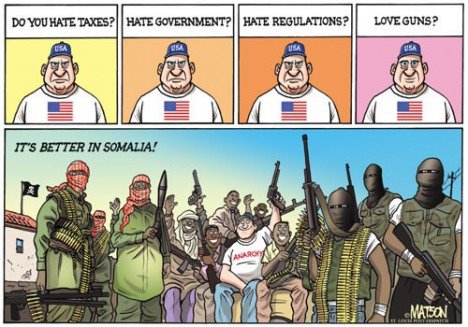
How about Somalia :). I reckon you can live without to many taxes there.

https://1.bp.blogspot.com/-sfVbXjODdRQ/T9-dLQR5yUI/AAAAAAAAM...

Taxes are not theft, they are an agreed-upon payment for being a member of a society.

Your parents, as guardians of a newborn, made your initial decision for you to bring you into the society.

You maintained your consent by retaining your citizenship when you reached an age of majority.

Taxes are the price you pay for retaining the benefits of your citizenship.

Not theft.

this is sort of like the "wage slavery is consensual because both sides agreed" argument. what realistic alternative does someone who doesn't consent to taxation have? renouncing US citizenship triggers a large tax on the total value of your assets if you are wealthy. even if you're not wealthy, the US charges a flat fee of about $2000 for the process. you might literally be unable to afford renouncing your citizenship.

even after that, the IRS can come back and harass you at any time if they suspect you of tax fraud, and most foreign countries will cooperate with them.

If you're looking to leave the country over taxes, why the hell would them trying to tax your assets bother you? You're leaving. You are welcome to leave, no one is forcing you. It's the same argument with bringing jobs to dead small towns. No one ever promised everyone could get any job anywhere, sometimes you have to move. No one ever promised you could live in any country without help paying for the upkeep.
I think you may be missing the point of my post.

pragmatically, I don't object to the idea of taxation. the government provides some useful services and it needs a way of funding them. I'm also not actually interested in renouncing my citizenship, as I personally find US citizenship to be worth the tax obligations.

what I do object to is the common "social contract" argument for why taxes are legitimate. in particular, I strongly object to the idea that I "consent" to taxation merely by having been born here. I haven't consented to anything; I submit because an overwhelmingly powerful entity compels me.

They are a forced payment. To add insult to injury they are wasted on stupid things in a very inefficient way all the time.
Did it bother you that you were facilitating crimes?
Tax evasion is a fairly soft crime, it’s shouldn’t be surprising there are people okay with facilitating it.

It’s not difficult to find people who believe, rightly or wrongly, the tax system is unfair.

It's a funny one because it's potentially one of the most serious crimes. You're stealing from everybody, undermining the basis of trust in the entire system in which we live and probably in the long term eroding the basis of democracy. You're creating a non-level playing field.

On the other hand, black and grey market activity are also I think quite an important counter-balance to the possibility of totalitarian government. It creates "gaps" let's say for more diverse human and economic outcomes. Which is also potentially good.

I think it's one of those indefensible things that we should tolerate a tiny amount of. Kind of like a vaccine in the body.

> It's a funny one because [Tax Evasion is] potentially one of the most serious crimes. You're stealing from everybody, undermining the basis of trust in the entire system in which we live and probably in the long term eroding the basis of democracy. You're creating a non-level playing field.

This is true, and in addition, it's a very unequal crime. To properly evade taxes and get away with it, you need professional help. Most standard W-2 employees can't afford it, i.e., for most, the cost to hire professional help evading taxes is larger than the taxes they could save.

However, if you're very wealthy, then the calculus changes: saving 20% taxes on $50M/yr income is a lot more attractive than saving 20% on $200k/yr income. Effectively, the wealthier you are, the easier it is to evade taxes, further exacerbating at least the perception (and quite likely the reality) of inequality.

>Most standard W-2 employees can't afford it, i.e., for most, the cost to hire professional help evading taxes is larger than the taxes they could save.

.

>than saving 20% on $200k/yr income

Erm, that's not a standard W2 employee's income. Not even close. The median U.S. household income was $63,179 in 2017.

In lieu of the accuracy, you missed the essence.
Tax evasion is not even a real crime. Tax is stealing from someone. Tax evasion and avoidance are great for society and we would be poorer if people didn't do it. Virtually all tax money usually goes to wars, warmongers, and the pockets of politicians and bureaucrats. Virtually nothing returns to society as services.

When people find a way to pay fewer taxes, it means money is not only not going to wars, but also being able to be used for better things for everyone.

http://bastiat.org/en/twisatwins.html

In theory, sure, but reality is a bit of a prisoner's dilemma.

Consider:

Person A is evading Taxes.

Person B is not evading taxes.

Government says 'Well, we aren't getting enough money', So they raise taxes on those who can't realistically evade. By a second order effect, Person A is causing Person B to get 'stolen from' twice instead of once.

> black and grey market activity are also I think quite an important counter-balance to the possibility of totalitarian government.

I don't really buy this: plenty of totalitarian regimes have illegal black markets, that governments often tolerate because they don't see a threat to their power.

A better way to counter a totalitarian government is via open communication and coordination of the government's subjects. Government's are far more afraid of this, which is why strict censorship and propaganda are the "go-to" tools for any totalitarian regime.

> governments often tolerate because they don't see a threat to their power

I would say it is often even opposite of it - black/grey markets help to stay in power. When everybody is breaking some law, buying something [almost] illegally, everybody wants to stay quiet.

And it helps [totalitarian] government a lot.

> that governments often tolerate because they don't see a threat to their power.

You think for example the North Korean government happily tolerates the black markets there? No way. If it would be easy for them to control them they would close them down. The black/grey markets happening in totalitarian countries are more like compromises - it would be too difficult to stop the activity without murdering half of the population or so.

> You think for example the North Korean government happily tolerates the black markets there? No way.

They most certainly do. There are tons of articles based on satellite based cameras that track the rise and fall of small black markets in North Korea. Some markets lasted years, before being abruptly shut down for unknown reasons.

You'll find that when an authoritarian government has a black market, the (brothers, cousins, etc of the) authoritarians are the ones running it. Police raids happen under the same kind of circumstances as corruption charges: you annoyed the wrong authoritarian, or they needed to make an example.
The point was happily. North Korean regime is at the point where they don't have any other sensible option than to tolerate the black markets.
Psychologically it's hard to see the victim, so people don't count it. It's a terrible thing about human nature, but it is what it is. The person you're replying to will never see themselves on the same level as someone who mugs someone or robs a liquor store, not because the damage they've done isn't worse, but because it doesn't feel wrong. We invent all sorts of ways and reasoning that allow us to do awful things without feeling guilt. It's just a sad fact about us.
> It's a funny one because it's potentially one of the most serious crimes.

No. How about serial killers, real theft etc.

> You're stealing from everybody

No, tax evasion is not theft. It is primarily your earned income where you pay taxes from. Tax evasion is tax evasion, no reason to confuse it with other crimes.

Think about it this way: easiest way to avoid taxes is not to work at all. Are all those who are slacking off with government benefits, or living off from savings or inheritance stealing from us? No, they are just not working.

> You're creating a non-level playing field.

The playing field will always be non-level, you gotta deal with it. What about those who have a job at the government and are not doing any work? Are those also stealing?

Trust in society is a complicated issue. Often the industries where tax evasion happens are low-income jobs. I'm not saying it is right thing to do, but I don't think it is as serious crime as many others.

> It is primarily your earned income where you pay taxes from.

Income you were able to earn because infrastructure allows businesses to operate, police forces protect their property, physical safety and the shipment of goods, a court system allows peaceful resolution of conflicts, armed forces protect you from invasion, fire departments prevent entire cities from burning down by putting fires out early etc.

Taking the benefits without paying the democratically set price for a wide array of services is not that different from stealing.

The "benefits" were forced upon you without your consent, though. And some of those are blatantly misleading. For instance, most of the defense budget isn't spent on protecting the US from invasion. Most companies protect their property by hiring security guards, not calling the police.
> [tax evasion is] potentially one of the most serious crimes.

This reminds me of a joke I heard on Jerry Seinfeld's Comedians in Cars Getting Coffee series: https://www.youtube.com/watch?v=ljaP2etvDc4

The reality is that pretty much everyone these days facilitates some kind of crime or unethical conduct in one way or another. Either intentionally or unintentionally and either actively through collaboration or passively through inaction. Aaron Swartz was spot on when he wrote about "The intentionality of Evil" - http://www.aaronsw.com/weblog/intentionalevil - This has become the biggest problem of our age.

Even a lot of the things that are legal these days are extremely unethical. The system is a mess. Capitalism is destroying society, rewarding bad behavior and punishing good behavior.

All the good companies/projects I worked on over the years (e.g. education) are struggling in this economy while all the evil ones (gambling, finance) are thriving.

Communism is looking better with each passing day. Especially with the level of automation we have today.

Every day, automation is getting better but people are getting worse. The systemic inefficiencies caused by fraud and other unethical behaviors under capitalism has outpaced the inefficiencies of a communist society whereby everyone gets paid the same and each person does as little work as possible.

Ethics. Where were yours?
I’m not saying what OP did is right, however, is creating tools that could possibly bypass a governments’ laws always an ethical issue?

Would the creators of VPN software need to consider ethics since it could break government censorship? Or if the government requested I create a backdoor for them, would that also be an ethical issue?

Creating a tool that can theoretically be abused to break laws? No.

Selling a tool with a law-breaking feature, in full knowledge that its main selling point is that feature, that your customers are buying it specifically to break the law? That ought to raise some ethical concerns. You can say that it depends on the particular laws being broken - but here we're not talking about ethical minutiae of censorship or surveillance. We're talking the usual defrauding of the commons through tax evasion.

Creators of VPN software definitely need to consider ethics when deciding who to sell to, what uses to tolerate, what information to store, and how to navigate local laws. Such a business has to deal directly with conflicting needs of citizens, criminals and governments, and thus whatever it does, it's making an ethics choice one way or another.

> We're talking the usual defrauding of the commons through tax evasion.

Giving ‘The Government’ less money is seen by some as a moral duty.

Governments do a whole lot of giving other people other people’s money. I’m sure there’s people who would argue this can be problematic.

There's plenty of such people. Most that I met are simultaneously unhappy about giving their government the money, and very happy to use all the services provided by the government from that money[0]. I would appreciate their views more if their argument involved pointing out that nobody asked them to sign the social contract, and that they have no meaningful way to opt out. But very few of such people I talked to raised that point. The argument seems to always boil down to "me getting service good, me paying for it bad".

(I've also seen people argue that they pay for more than they're using, but somehow the concept of derisking and variance reduction doesn't escape these people when it comes to buying insurance.)

--

[0] - Ranging from healthcare and schooling to laws, defense and ensuring a safe and stable environment in which everyone can conduct their business.

If you do pay (even if unhappily), it makes sense to use the service that you had to pay for.

It'd be kinda dumb to pay up and refuse service on principle.

On the other hand there are lots of people happily receiving all their money from government, and also using all the public services as well. For example those having a job* at government or receiving benefits from government.

Note that it is still pretty much impossible to run a business without paying any taxes, in the end you have to pay some but you might be able to evade some. In the end it is just endless debate about what level of taxes is felt fair. Changes from individual to other. When people don't feel their taxes are fair, they start to evade those. They might be also just greedy bastards, but I don't think that's necessarily commonly the case.

(* Having a job doesn't necessarily mean doing beneficial work, just receiving the salary.)

> Giving ‘The Government’ less money is seen by some as a moral duty.

Right, but when you add a feature that does that and has no other major use, you move beyond 'seen by some' on to 'seen by me'

Yeah, look, ethics is great and all but when you risk being homeless or hungry, it quickly goes out the window. Especially for "victimless" (i.e. no one is directly affected) illegal activity.
If you are at risk of being homeless or hungry you are probably below the threshold for paying taxes in most countries.
Assuming this is the truth, I think that's fair enough tbh. IMO your ethics have to change depending on your safety. I apologize for the initial assumption of your well being. I hope (given the context of the website) it is evident why I jumped to that assumption!
I would be very curious to be presented with a single case of tax evasion chiefly decided to avoid becoming homeless or hungry.

Also, ethics include one own integrity, it is not about sacrificing everything to others - at least not all ethical inquiries will conclude that.

I would guess a lot of cash paid manual work anywhere in the world is done by poor and vulnerable people, avoiding taxes or any regulations.
seems like you were and are helping your customers commit tax fraud and should stop