Also as an American, my medical record mostly just consists of how many days since the last time I went to the doctor. For those without insurance, less is more when it comes to number of visits.
Yes, and par would be like needing a doctor about once every three months. Keep it less frequent than that, and you're winning the game.
A friend of mine without insurance skateboards at a skate park. And I'm like "dude, that's pretty risky for not having insurance."
He explained the math to me, as long as he doesn't break a bone or need stitches more than once every few months, then not paying for insurance saves him money even if he has to pay $300-500 out of pocket at a walk-in clinic.
For young people in America, it seems that the only time that insurance isn't a net negative is when: 1) you have a chronic illness that requires regular treatments, 2) you have been diagnosed with cancer, and 3) pregnancy.
> For young people in America, it seems that the only time that insurance isn't a net negative
Insurance inherently is on average a net negative, but it constrains the risk that your needed costs unexpectedly are significantly above average, which can be catastrophic otherwise, especially in a system where care beyond immediate stabilization is gated by ability to pay. so that not having resources doesn't just mean a debt dischargeable in bankruptcy but potential denial of care.
Insurance is a net negative for anybody paying for regular, routine care. Insurance and the massive rats nest of middle men and perverse incentives it creates is why a physical, stitches and every other boring service provided thousands of times per day costs hundreds of dollars.
The question can make sense in any country really. Even if you are some place like Spain say which I gather has a sane electronic records system you still have issues if you get treated by someone outside the system, say in another country.
The UK's system, where I'm from is famously a mess. I think we hit a record with "£12bn NHS computer system is scrapped..." My aunts doctor has a GP system and the local hospital has another and when she collapsed and was treated in the hospital the doctor can't see the records as different systems. I guess unless they print it out and shlep it over somehow.
The quality of any given countries healthcare system is mostly tangential to which parties of the system are responsible for getting patient data where it needs to be. It doesn't really matter in the grand scheme of things whether the patient, patient's physician or some central 3rd party is the record holder.
In Germany, for example, medical records are scattered across medical practitioners, hospitals and health insurance providers. There's no central, distributed or federated EMR system. Each practice or hospital basically runs its own system, sometimes dating from the 1980s. MS-DOS is still widely used in surgeries.
Data transfer (i.e. lab results, consultation results) happens mostly on paper, that is the patient usually gets handed a letter with the results to present to their GP.
Lots of information is lost this way. Examinations and analyses often are duplicated or done repeatedly.
Which is also a privacy feature. Your dentist has your records, if a body is found and they think it might be you, they will ask your dentist for the records. If the mandatory storage period has passed, they are gone. To steal the records, an attacker would have to know, who your dentist is and then get them from there.
The same kind of system could be implemented with a distributed or federated EMR.
The data would still be stored with the practitioner where it originated but it could be shared with third parties (i.e. other practitioners) if the patient consents.
I really don't see how using the patient as messenger for medical data on paper could be seen as a privacy feature. Quite to the contrary, actually: Paper documents are easily misplaced or lost and then suddenly someone has access to your medical data.
How great for the patient. Everywhere you have built in second opinions. With digital, one lazy or bad doctor can more or less permanently alter the course of subsequent medical care with inaccurate information or a bad diagnoses.
It is easier for you as a patient to control your paper record. You can just throw out an opinion that doesn't seem right. If your record is being managed for you, it is much harder to get things corrected.
This is simply a question of ownership and control. If you own and control your medical data you can simply share it with medical practitioners when required.
With the current system on the other hand I have very limited control over my medical data, if at all.
Sure, when receiving results on paper I could throw away anything I "don't like".
However, I have no control over what records my GP, a hospital, or my health insurance provider keep about me. I can't see them. I can't have them amended or deleted.
Every time my local medical cartel upgrades their EMR, my personal history gets amended to include false information that could have impacts on my career, and lead a provider to make a bad decision.
Ah come on, it's not that bad anymore. My mother recently had some x-rays done because of a broken knee and all the files were sent digitally to the doctor and he forwarded them to a specialist. So, it's not that bad...
The last time I got a PET scan (about 3 years ago) they handed me a CD with the images and an accompanying piece of paper with a summary of the results. At least that CD included a DICOM viewer for macOS as well so I could have a look at the images myself.
It's the same with other medical imaging procedures. They have machines literally costing millions but they can't afford to have a secure system for keeping and exchanging medical data.
Up until a few years ago (according to my knowledge, perhaps this is still happening) paramedics routinely used WhatsApp for sending information to A&E while en route because there simply is no proper system in place to do so.
Hm, not sure, maybe this differs from doctor to doctor. To be honest, I was also suprised when she told me that as she lives in a rather rural area and not some big town. But at least that hospital/doctors seem to be really up to date with their tech.
In my area (Northwest Spain) medical info is recorded in the public health system, which is universally free. I can go to any public medical center and they can access to all my history, no need to carry anything with me apart from my card.
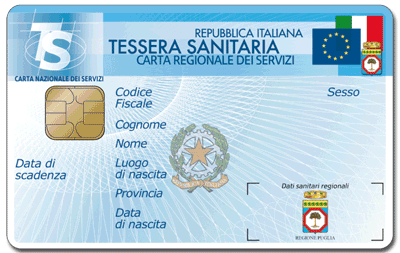
Every medical interaction is recorded on a nationwide network - at least here in Italy. Every time I go to my doctor and they prescribe me something / they give me a shot / vaccine, it gets recorded and every other doctor can access the same data when I present my "health smart card"
well, to be honest, this sounds like kind of overselling reality.
There is a system in place that tracks and records some things, like days off prescribed by base doctors, prescriptions for which national care pays and few other stuff, but most of everything else, including charts from when you are admitted in most hospitals and of course whatever you do outside of the public care (which kind of sucks and has insane waiting times, which means you most often do) is not included in that.
It sounds like a great system assuming the smart card is a like a credit card with the chip in it, and you needed that to view medial records. Unfortunately I seriously doubt that's the case.