Hacker News new | ask | show | jobs
by maxharris 2394 days ago
I searched for 'nuclear' on that page, and found no mention of the word at all. Whatever you might think of nuclear energy, I don't think such a drastic energy cut is even possible to implement without it. (After all, I see little point in cutting CO2 emissions in the US if people in other countries emit an amount equivalent to whatever gets cut here.)
7 comments

The time for nuclear has passed (at least fission. Fusion may still be a good future energy source).

I say this because the cost of building a new nuclear plant is more expensive than wind and solar.

Nuclear might still be a good solution for northern and southern habitats. But, at this point, where most pollution is produced, solar and wind are viable.

https://en.wikipedia.org/wiki/Cost_of_electricity_by_source

With all that said, the real viability of renewables is partially going to be determined by storage costs. Nuclear doesn't really solve the storage problem though (it is a base load only power source). Eventually in order to hit a 7.6% reduction goal we'll have to phase out natural gas peaker plants. To do that, we need storage.

We certainly shouldn't be decommissioning nuclear plants in favor of renewables. I just don't think the time to build new nuclear is here. The cheaper and faster solution is new renewables.

The cheapest option is probably to build nuclear to the level that meets minimum demand at night, and solar for everything on top of that, with just enough storage to even out the remaining discrepancies.

Storage is quite a bit more expensive than nuclear, and while the cost is dropping it has a long way to go. At the same time, new nuclear technologies like molten salt reactors could well drop the price of nuclear. For that to be a factor, we'd likely have to get more aggressive with licensing new nuclear technologies; i.e. we'd have to treat climate change with the urgency it deserves.

Here's a Lazard report on levelized cost of storage: https://www.lazard.com/perspective/lcoe2019

Besides the cost problem, deployment is also a huge issue with nuclear. It takes 10->20 years before a new nuclear plant produces it's first watt hour.

I can get behind the idea of pushing for nuclear in the case of baseload and even in the case of high population density areas where wind/solar are simply not practical. But, if there is anywhere to dump a bunch of money, it is wind and solar. We can have those producing electricity within a year, easily. Even if you want to talk about manufacturing costs, those are payed back within 1->5 years. Still shorter than the timeframe to getting a new nuclear plant online.

I'm not saying this to be anti-nuclear. I think it was a great solution. I just think that solar and wind have become the better solutions (at least for the shorter term).

I agree nuclear is more of a long-term solution. Solar is the way to go right now, with nuclear coming online as solar gets to such high market penetration that storage is a serious issue. Until then, we can back solar with the remaining fossil on the grid.

The deployment time is a solvable problem though. We've built nuclear faster in the past, and some places still do today. France converted to 80% nuclear in 20 years, South Korea has recently built modern reactors in about five years [1], and some new designs can be mass-produced in factories. Thorcon is working on building molten salt reactors in shipyards, at massive scale [2].

[1] https://www.forbes.com/sites/michaelshellenberger/2018/06/21...

[2] http://thorconpower.com/production/

Guess I don't disagree :)

I do thing there is some peak amount of producible renewables that we aren't really anywhere near. New nuclear would work well to decrease the amount of new renewable build-out required year over year.

Particularly, I think nuclear is a great option for islands (Hawaii, for example) where land is at a premium anyways.

This is a great point - solar/wind and nuclear are, as the grid currently works, not drop-in replacements to each other, but complements. Nuclear provides base load (because it's difficult and slow to ramp a nuclear plant up or down), Wind/solar provides as much daytime load as practical, and meeting any remaining demand (especially peak evening demand) will require a peaking source that can dynamically be ramped up or down to meet demand.

The optimist in me believes that we'll eventually get good enough at solving the unit commitment problem in the energy grid that we'll reduce the need for carbon-intensive peaking sources and eventually even eliminate nuclear power. But we're not there today.

Nuclear ramps just fine. French nuclear plants reportedly ramp routinely between about 50-100% capacity, so this isn't just theoretical. Going from full power to less than about 40% tends to run you into a Xenon pit, which causes a two day shutdown, but fortunately nighttime load is roughly half of daytime load, so this point is moot.
They all suffer from the same problem, none of them are ramping sources. You need a peaker plant for all of them (though, you'll need more for solar and wind).

Storage is a problem that simply needs to be solved for any green solution. Nuclear and wind included.

A big issue is that solar, wind, and nuclear simply don't play well together. Nuclear wants to be a base load, solar and wind push down the maximum base load feasible.

Without storage to smooth out the demand curve, you can't efficiently operate either.

The question isn't whether you'll need storage at all. It's whether it's cheaper to build enough storage for windless nights, or baseload nuclear and enough storage for remaining demand discrepancies.

I think the latter is more feasible without too much wind, since solar predictably goes to zero when demand is lowest. I don't think it's at all clear that a grid with high amounts of wind instead of nuclear would be cheaper.

Yeah, hard to tell given the dramatic drop in storage costs.

Today, I agree that if we could make the switch overnight that solar + storage would probably be a lot more expensive than nuclear + storage.

However, who knows in 10 years. I could see liquid metal batteries becoming extremely economical.

What's always bothered me about this argument is: how much of that cost stems from the nuclear industry being misregulated into a pulp over the last 50 years??

Regulatory decisions seem to be made on the basis of hysteria moreso than scientific merit. For instance, that in the US secondary waste is treated equally as dangerous as primary waste, leading to ludicrous disposal costs. And nuclear 'waste' isn't even an issue with many modern reactor designs.

It shouldn't surprise anyone that the _current_ cost of bringing a new nuclear plant online is astronomical, but that doesn't mean that the cost can't be brought down tremendously with sane regulation and modern designs. In many ways, the nuclear industry is still in its infancy (how many of the reactors operating worldwide right now are boiling water reactors, literally the oldest and most dangerous design??). No one expects nascent technologies to be cheap, you look to the future.

And beyond that, nuclear and solar/wind are not directly comparable. Solar/wind cannot provide the base load that nuclear is so apt at. What you really need to be comparing is a nuclear plant vs renewable PLUS energy storage. And last time I checked, grid-level energy storage is still extremely expensive.

I don't think you can dismiss nuclear so easily. Not by a longshot.

It still blows my mind that we found an almost magical solution to use of fossil fuels over 60 years ago and fumbled it so hard. Shame on big oil, shame on our regulatory agencies and politicians.

> What's always bothered me about this argument is: how much of that cost stems from the nuclear industry being misregulated into a pulp over the last 50 years??

Agreed! Nuclear could be much cheaper were there not so much fear mongering and red tape in the path. Chernobyl and TMI taught us the wrong lesions as a society. However, fat chance getting those policies, politics, and activists minds changed to decrease those regulatory costs.

> And beyond that, nuclear and solar/wind are not directly comparable. Solar/wind cannot provide the base load that nuclear is so apt at. What you really need to be comparing is a nuclear plant vs renewable PLUS energy storage. And last time I checked, grid-level energy storage is still extremely expensive.

I don't discreet per say. However, for the US, most power grids simply aren't at the point where storage needs to be considered. A large portion of power is coming from fossil fuels (more than the tipping point where storage needs to be considered).

In those cases, the clear path forward that will cut carbon emissions the fastest is deployment of renewable tech. You can bring online new solar and wind plants in less than a year. Nuclear requires at least 10->20 years of time before it can be brought online (mostly due to all the regulations surrounding it).

Storage will enter the equation when a large percentage of the grid is renewable (30->50% someone cited). We simply aren't even near that point yet. However, even before we hit that point, natural gas can provide a stop gap to allow us to have even higher mixes of renewable generation.

Nuclear doesn't solve the storage problem. You still need a peaker plant with nuclear.

> It still blows my mind that we found an almost magical solution to use of fossil fuels over 60 years ago and fumbled it so hard. Shame on big oil, shame on our regulatory agencies and politicians.

Agreed. We SHOULD have been ramping up on nuclear usage. I would MUCH rather have to deal with localized nuclear waste problems vs our current issues with climate change. It was simply a societal failure that we didn't go nuclear for everything from the 1960 onward.

It was the best solution to climate change for nearly a half century and the very people that should have supported (environmentalist) killed it with fear mongering.

Here is what you get some days with solar and wind: https://i.imgur.com/m2snJgg.png . Germany using a lot of standard gas and coal generators.
That doesn't really answer the point, which was that new solar and wind tend to be cheaper than new nuclear as of 2019.
It doesn't matter how cheap it is. No sun and no wind means no power, which means using coal and other fossil fuels. Increasing use of natural gas has reduced emissions more than switching to renewables.
There's a thought provoking web site out there, Low Tech Magazine. Their basic idea is that electricity 100% of the time isn't as important for everyone and everyting as we think. The need for base capacity is still there of course, but if we allow unnecessary things to shut down when there's less supply we can get away with less.

(Yes, of course we need to have electricity in hospitals and for heating 100% of the time - but if the newspapers are unavailable three days per year, or if some non-essential TV channels turn off when it's really cold - maybe not as bad.)

https://solar.lowtechmagazine.com/about.html

Increased natural gas usage has been primarily pushed because of the rise renewables.

Natural gas is currently the peaker plant solution to renewables. The fact that more of these plants exist is primarily driven by the fact that larger portions of the grid are being pushed towards renewables.

I think it's more because gas is cheap because of fracking. And the timing between the rise in gas use and the rise in renewable deployments is mostly coincidental. If gas were expensive it wouldn't be used. As it is, gas is cheap and has 1/4 the emissions of coal (IIRC).
The thing is, storage is unsolved. Battery isn't going to cut it. Pumped hydro isn't realistic for much, and we're using intermittent hydro about as well as we can. Thermal solar is unproven economically, but getting closer. Power->gas->power is marginal.

A little bit of nuclear in the mix, plus storing biogas, and aggressively pursuing thermal solar is very important, IMO. It just isn't possible to overprovision wind enough to meet 99th percentile supply/demand mismatch, but having a few percent of nuclear base load really helps.

If we want people to stop burning natural gas and heating oil for their homes, and more to move to electric cars, we'll need a ton more base load, too.

Yes, nuclear can't compete with natural gas base load, but we want to stop burning so much natural gas, so...

Natural gas isn't a base load power source, it is a peaker power source.

Even with a pure nuclear grid, you'd still need a peaking source. That would be provided, probably, by natural gas or hydro if available.

A storage solution is simply required regardless of where the grid goes. I think that Liquid metal batteries look to be the best solution for grid level storage. (relatively cheap, super long life, if massively adopted would likely become a lot cheaper).

> Natural gas isn't a base load power source, it is a peaker power source.

Gee, what are all these combined cycle gas plants that take 12-24 hours to start/shutdown, and require high duty cycle use to be economically competitive, if they're not base generation?

(Yes, I know we're starting to get faster combined cycle plants, but they're still not fast, and they still require to be producing power most of the time to be viable).

> Even with a pure nuclear grid, you'd still need a peaking source. That would be provided, probably, by natural gas or hydro if available.

I suggested use of biogas and hydro in the comment you replied to! Did you not read it, or just talked past it?

> A storage solution is simply required regardless of where the grid goes.

Sufficient overprovisioning of renewables and smart grid greatly reduces the amount of storage/peaking needed. A bit of reliable, carbon-neutral base load greatly reduces the amount of overprovisioning needed.

The point is, we don't really see a path to enough wind + appropriate storage in order to have a carbon neutral grid... but France performed the transition to a nearly-carbon neutral grid decades ago with nuclear, and the fully-amortized cost of French electricity isn't that bad.
France got there by exporting their excess power to other nations.

If everyone does it, then there would be no place to export excess, what do you do then?

Neither nuclear power nor wind/solar is readily ramped up/down economically, but at least nuclear power is consistently available and can be dispatched to some extent.

You can always turn off renewables during periods of overproduction. Whether you build nuclear+renewables or just renewables, you need to overprovision the renewables and be willing to turn them off. You just have to do this more with only renewables.

(Of course, you'd want to use all available strategies to reduce required overprovisioning-- including maximizing use of dispatchable hydroelectric and biogas, some storage, and agreements with utility users to reduce usage during times of critical supply shortages).

In, ahem, "fairness" to Germany, they operate some of the dirtiest lignite coal power plants in all of Europe. [0] Despite their self-promotion as a leader in green energy transition with the Energiewende, they seem unwilling to shut down these very carbon-intensive operations. Even replacing these plants with hard/anthracite coal or natural gas would be a major improvement, but alas.

[0] https://en.wikipedia.org/wiki/Garzweiler_surface_mine

You can't just look at cost/kwh. You have to look at the cost of meeting total instantaneous energy demands. Sure, solar and wind are cheaper in many places, but they all depend on a reliable fallback like natural gas. I really don't see how we can avoid fission power for the time being. Its the only current technology that is 100% compatible with our existing grid.
For now in the US, you can.

We simply aren't at the point where there are enough renewables on the grid that adding more would ultimately cause more natural gas emissions. Until the renewable profile starts pushing into base load generation (particularly eating into green base loads like hydro and nuclear) then it is pretty much a pure win to add solar and wind. The natural gas peakers ultimately produce less CO2 with renewables than with base load fossil fuels.

However, there is a time where storage becomes the main issue. We aren't there yet. Until we hit that point, deploying as much solar and wind as possible is going to be the fastest, most efficient, and cheapest way to decrease our carbon footprint.

We can’t afford to wait around, especially in the US. As it stands today, nuclear is part of the solution to climate change. The time to build new plants is now.
We can push out new solar and wind today, right now. The lead time for new renewables is months.

The lead time for new nuclear is 10->20 years. It is, frankly, too late for nuclear (at least without serious regulations overhaul). It might make sense to start building plants, but if we want to curb climate change then the only path is renewables.

My point isn’t that we shouldn’t deploy more solar/wind. Of course we should. We will need more nuclear power plants as well. The time for all of these is now. We can’t afford to wait until we hit the limit of what current renewables can provide before we build up our nuclear infrastructure.
Storage and grid stability problems are still largely unsolved. When wind and solar starts to be 30-50% of the capacity, this problems will get serious. If you factor the cost of storage solutions, the cost of wind and solar against nuclear is not that lucrative any more
I'm not sure why the parent comment is being downvoted, it seems like a compelling argument backed up by data.
Greenpeace and the environmental movement have a lot to answer for,

thanks to their knee jerk reaction to nuclear one of the technologies (note that I say "one of", there is a range of choices, not an either/or black/white choice, as is so often case on internet discussions nowadays)

we ended up with more coal/oil power plants contributing towards climate change

nuclear could have been the bridging technology buying us decades to build up real renewables (and/or fusion) and provide base load, but no cant have that, ideology trumps pragmatism

We are where we are now. Turn your effort towards the future -- how do we get to where we want to go from where we are today.

The same attitude applies in engineering -- post-mortems aren't about assigning blame, they are about understanding the current state and how you'll address or mitigate any failures so they don't happen again.

If you want to be backwards looking, at least focus on what the lesson is and how you will turn that lesson into concrete actions that prevent the same failure case in the future.

In the future, there are 450 nuclear power plants that will need to replaced as they are retired.

There are about 100 nuclear plants in the United States generating 20% of the power.

Unfortunately, pragmatism like yours sounds unconvincing compared to the more passionate positions of somebody against nuclear fission power. It doesn't mix well with an expensive project with a long development time that risks being cancelled in a temporary shift of public opinion.
Greenpeace is a farce for sure, but surely some blame lies with big oil's lobbying efforts?
Are you saying these are two different things?
Touché.
Greenpeace isn't that influential, the reality is that the economics of nuclear never added up.

Also, there really is something off-putting about leaving behind waste that lasts longer than civilisation has.

France is a shining counter-example to your claim.
That isn't that clear-cut. France has lots of nuclear power, but most of the power plants are getting quite old and eventually have to be dismantled and replaced. We will see how affordable the nuclear electricity is, after all costs have been paid. I don't think they will be replacing nuclear power plants with new ones, at current costs.

Still, currently electricity is way cheaper and much cleaner than in Germany. I certainly disagree with the amount of coal used in Germany.

That's a very strange way of saying "it brought them cheap, abundant, safe, eco-friendly electricity for nearly 60 years."

Yes, the infrastructure is aging. Yes, it needs to be replaced ... with more nuclear power.

It has a proven track-record. It works well with the existing grid architecture (which avoids massive costs). It's eco-friendly.

The thing that prevents nuclear plants from being built is not nuclear technology, but rather public opinion. Revisionist comments like yours, are doing humanity a disservice.

Please claim that nuclear is cheap only after all bills have been paid. Dismantling a reactor can cost a billion or more, the radioactive waste needs to be stored for millenia.

And France will show, that you can't just replace nuclear reactors. They are certainly trying, but modern reactors are increadibly espensive. So they are currently building... one.

Enough to impress college kids and stay at home moms to protest and oppose construction of new plants.
> Greenpeace and the environmental movement have a lot to answer for

Gut instinct is that they were sponsored by shell corporations / charities to go after nuclear et. al. and leave other vested interests alone.

I've heard rumors that their budget dropped precipitously after the fall of the Berlin Wall...
Just to add to the two very insightful replies you've already got, yes, nuclear power could have been a great contributor on the fight against Global Warming, 30 years ago. And yes, it is a shame that "environmentalist" movements made so much noise that they ensured we took the most harmful possible path. Those movements should be shamed, and very loudly so because they still didn't give up on fighting improvements and waste the popular focus on useless feel-nice ideas.

But, well, today is not 30 years ago, and the same way that nuclear power never could be the complete solution to carbon based fuels, today it is too late for them to even be a large component of it. So, today pushing for nuclear does more harm than good.

I mostly agree with you (with the caveat that pushing for nuclear has different cost/benefit ratios in different parts of the world, the U.S. is merely one extreme), but this is exactly why I pay very little attention to public debate regarding energy policy and emissions control.

Outside of IPCC reports (which for all their process issues are generally fairly comprehensive and well written) and a small number of other scientific publications, there are few serious attempts to conduct objective cost/benefit analysis, rank order policy measures, etc. Instead, we have people who pretend science doesn't exist on one side and many of the same "environmentalists" who are, by virtue of their ideological stupidity, just as culpable for this mess as their opponents on the other. Given this state of affairs, I see no reasonable prospect of prevention. Instead, we will simply have more or less local mitigation solutions, which will work fairly well in the rich parts of the world and probably fail miserably in many of the poorer parts. The only silver lining here is that localized measures are far easier to implement as they require cooperation on a much smaller scale and, for the most part, will happen to avert dangers that will by then have become obvious to all.

>So, today pushing for nuclear does more harm than good.

You made the case for why you don't think nuclear can do any good (because it's too late), but what's the case for harm?

Every dollar invested into nuclear is a dollar not invested into solar/wind/etc.

Building new nuclear just usn't the most effective use of limited capital to reduce emmisions at this point.

Every dollar in solar/wind/etc is wasted since it can't support the population without falling back to coal and gas. Renewable are a crapshoot relying on new storage technology that doesn't exist to make then viable. Why not focus on something we can 100% guarantee will fix the issues instead of leaving it to chance?
It is not only a distraction, but pushing a non-viable technology reduces the credibility of everybody that is trying to solve the problem with technology.
Nuclear power seems to be considered too powerful to trust in the hands of many nations, making it kind of a non starter globally.

My understanding is that with any type of nuclear plant, in a non trustworthy country, it would still be dependent on importing the fuel from a nuclear state, making it quite unappealing and a security risk for the purchasing state.

I kinda wish there was a NASA equivalent for nuclear that would be given 10s of billions of dollars per year to R&D safer, next gen nuclear power plants. The organization could build/run those plants around the world in order to provide less developed countries with power while preventing proliferation.
An international version of this was Oppenheimer's vision (both for peaceful nuclear applications and weapons) which he expressed in his personal writings and in the Acheson–Lilienthal report. It was not looked favorably on by most of the US government and was the first step to the eventual revocation of his security clearance and removal from any position of influence.
Funny, one of the most often heard argument of those, who try to fight against reducing CO2 in Germany is, that other countries, e.g. the US, are not reducing theirs and we should wait until they do.

That sounds to me, that every country should do its best to cut CO2 and not wait for others to lead first.

That's funny because the US actually has reduced per capita CO2 emissions by about 20% back down to levels not seen since 1960.

Edit: I suppose I should include a source. From the Carbon Dioxide Information Analysis Center at Oak Ridge National Laboratory.

https://data.worldbank.org/indicator/EN.ATM.CO2E.PC?location...

Kyoto Protocol and Paris Agreement sought to do that. Unfortunately the time span between the launch of such talks and the agreement of terms is around the time in office for 1 US Democratic president.
If you break ground today on a nuclear generator, you will not see your first kwh generated for at least a decade, and that kwh will not be cost competitive with anything else on the spot market.

At the same time, you could replace all nuclear in the US currently operating in around three years (even compensating for capacity factor), solely from PV manufacturing capacity in the US. It is plainly obvious why nuclear is not included when renewables and at grid parity and the cost of utility scale storage is rapidly declining. Even if the cost decline of storage takes longer than expected, you can compensate with overbuilding, curtailment, transmission and demand response.

You ask why nuclear isn't being talked about. I can't fathom anyone thinking it's a real option compared to solar, wind, and battery storage, all of which are cheaper unsubsidized than nuclear today, can be manufactured and shipped where ever needed, and scaling up production is trivial (in comparison).

https://www.lazard.com/perspective/lcoe2019 (Lazard Levelized Cost of Energy and Levelized Cost of Storage 2019)

> If you break ground today on a nuclear generator, you will not see your first kwh generated for at least a decade.

If Climate Change is so important, declare a total war against it like during WW2 against the Axis. With most production geared toward nuclear energy, you should have generator up and running a lot faster.

The list of things I don't want built in a rush definitely includes nuclear reactors!
And yet a ten year timeline is obviously nonsense. When these reactors were built in the 1970s, groundbreaking to power production was often 5 years.

Why is the process much worse now?

https://en.wikipedia.org/wiki/Zion_Nuclear_Power_Station

Yes, but it's also possible to go a lot slower than necessary. France converted their grid to 80% nuclear in 20 years and it seems to have worked out ok.
Cant you do the same thing in regards to renewables?
From that Lazard report, PV with four hours storage costs 10 to 13 cents/kWh. That's "in front of the meter" which is the wholesale cost. For retail cost, commercial/industrial pays 22 to 38 cents/kWh, and residential pays 45 to 66 cents/kWh.

That's with only four hours storage. That's a convenient amount since it's the excess typically generated by solar installations during the day, but to actually get through a windless night we might need more storage. Lazard's retail cost for storage alone is 48 to 104 cents/kWh. Plus you'll need extra solar dedicated to charging it.

At this point people often bring up long-distance transmission. The report happens to include that too, with a cost starting at $2.35/kWh wholesale and going way up from there.

None of this includes the overcapacity we'd need, to get through cloudy winter weeks.

Lazard puts nuclear's cost at 12 to 19 cents/kWh but it's unclear whether that's retail cost; I suspect so since I only pay 12 cents/kWh on a grid that's heavy on nuclear.

Wind/solar is very cheap when the grid is still mostly fossil, but to run a reliable carbon-free grid in areas without abundant hydro, nuclear is still cheaper. The cheapest combination is probably nuclear to the level of minimum nighttime load, and renewables for everything beyond that, without just enough storage to even out remaining discrepancies with demand.

What night base consumption is absolutely vital ? I understand that some of the consumption is necessary to function and that some other is made possible by the fact that fossil energy is as expensive to generate at night and that it's cheaper to function 24/7. But sometimes it can be cheaper to shut down widget X factory at night not to double storage capacity. Maybe this effect will be important, I don't know.
If we have to build twice as many widget factories to make up for shutting them down at night, that's another cost to society that we should take into account. I've seen a lot of renewables advocates talk about "demand management" but not any estimate of this cost.

There's also heating, air conditioning, street lights, etc. Aluminum plants, which can't shut down more than 4-5 hours without major damage from the metal solidifying.

Before long, electric vehicles charging in people's garages at night; it'd be nice if we used them to supply the grid at night but that would require parking lots full of charging stations where everybody works, plus new infrastructure in people's houses, and some kind of incentive to get people to bother. All that costs money too.

At the same time, you could replace all nuclear in the US currently operating in around three years (even compensating for capacity factor), solely from PV manufacturing capacity in the US.

I think that you may have confused PV manufacturing capacity in the US with global PV manufacturing capacity.

The US generated 807 TWh from nuclear power in 2018 [1]. If solar farms achieve a good-but-realistic capacity factor of 25%, you need 368 gigawatts of modules [2] to produce 807 TWh per year. That's about 3 years' worth of global module production at 2019 production rates. US domestic module production is currently below 10 GW per year.

[1] https://www.world-nuclear.org/information-library/country-pr...

[2] (807000 / (24*365)) / 0.25 = 368. Actually you need a bit more because most solar farms report capacity factor on an AC basis, and the inverter loading ratio is greater than 1.0. But close enough for a quick estimate.

You are correct. Thank you for pointing out my mistake.

https://www.solarpowerworldonline.com/u-s-solar-panel-manufa...

Nuclear power is 20% of electricity in the United States.

If you could replace it all in 3 years, wouldn’t we be better off replacing 20% of coal power over 3 years and wait a little longer on the nuclear power?

If your math is right, half the grid would be zero carbon in 5 years.

Yes, you would absolutely want to stave off nuclear generator retirements as long as (safely) possible to displace carbon producing generators. I use the example only to demonstrate the ease of renewable deployments versus nuclear. You could go do a green bond offer (or PPA contract), bid out the construction project, and build a solar generation facility next to a nuclear power plant to replace its capacity. You cannot do this to build a new nuclear plant.

Coal power is going away, full stop, due to the cheap cost of natural gas and renewables. It is not cost competitive. Natural gas throttles fast; it's why California can have such a steep Duck Curve [1] and support GWs of solar generation capacity. It is a great stop gap until batteries catch up.

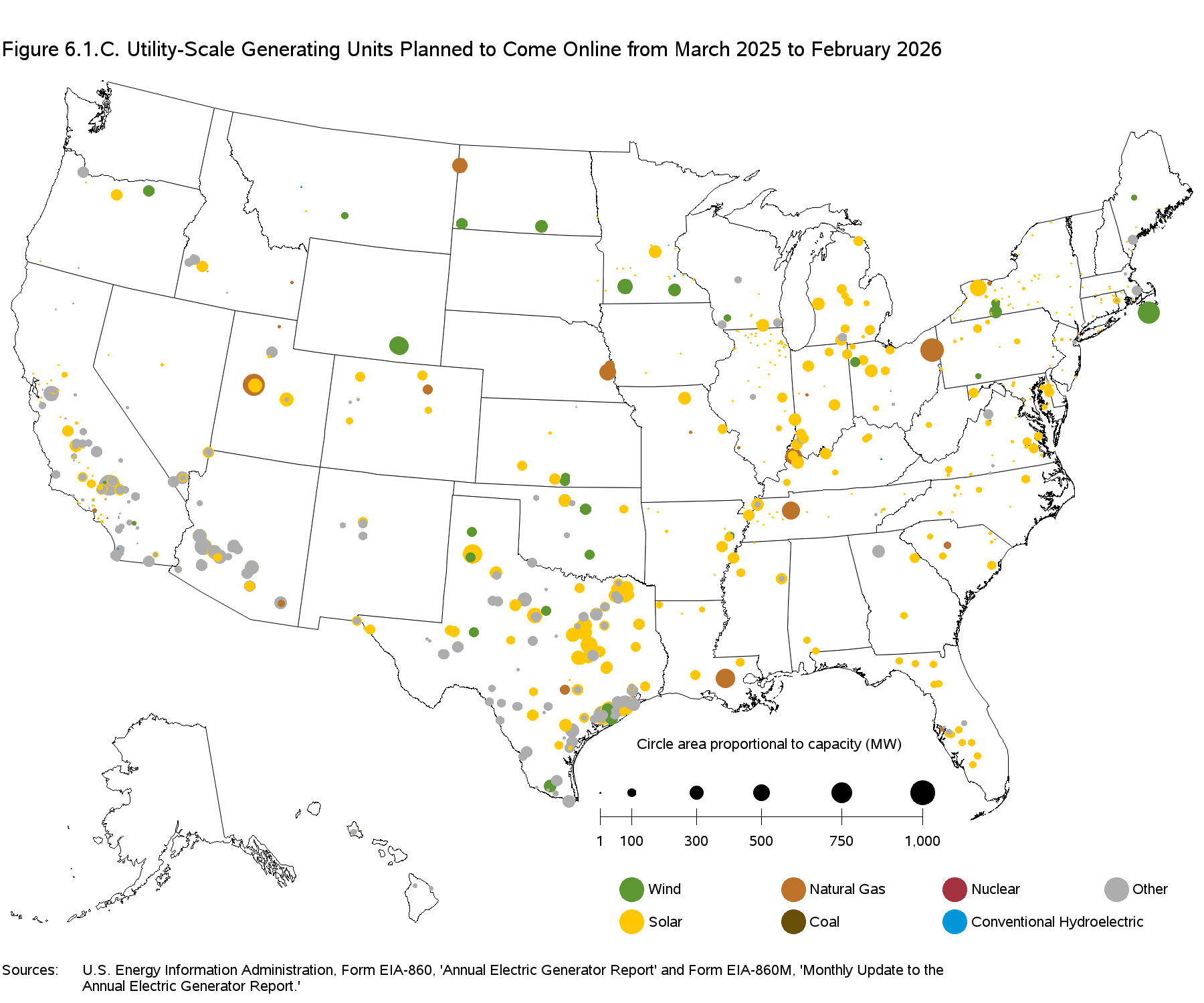
Utility scale generating plants coming online over the next year (green = wind, yellow = solar) https://www.eia.gov/electricity/monthly/images/figure_6_01_c...

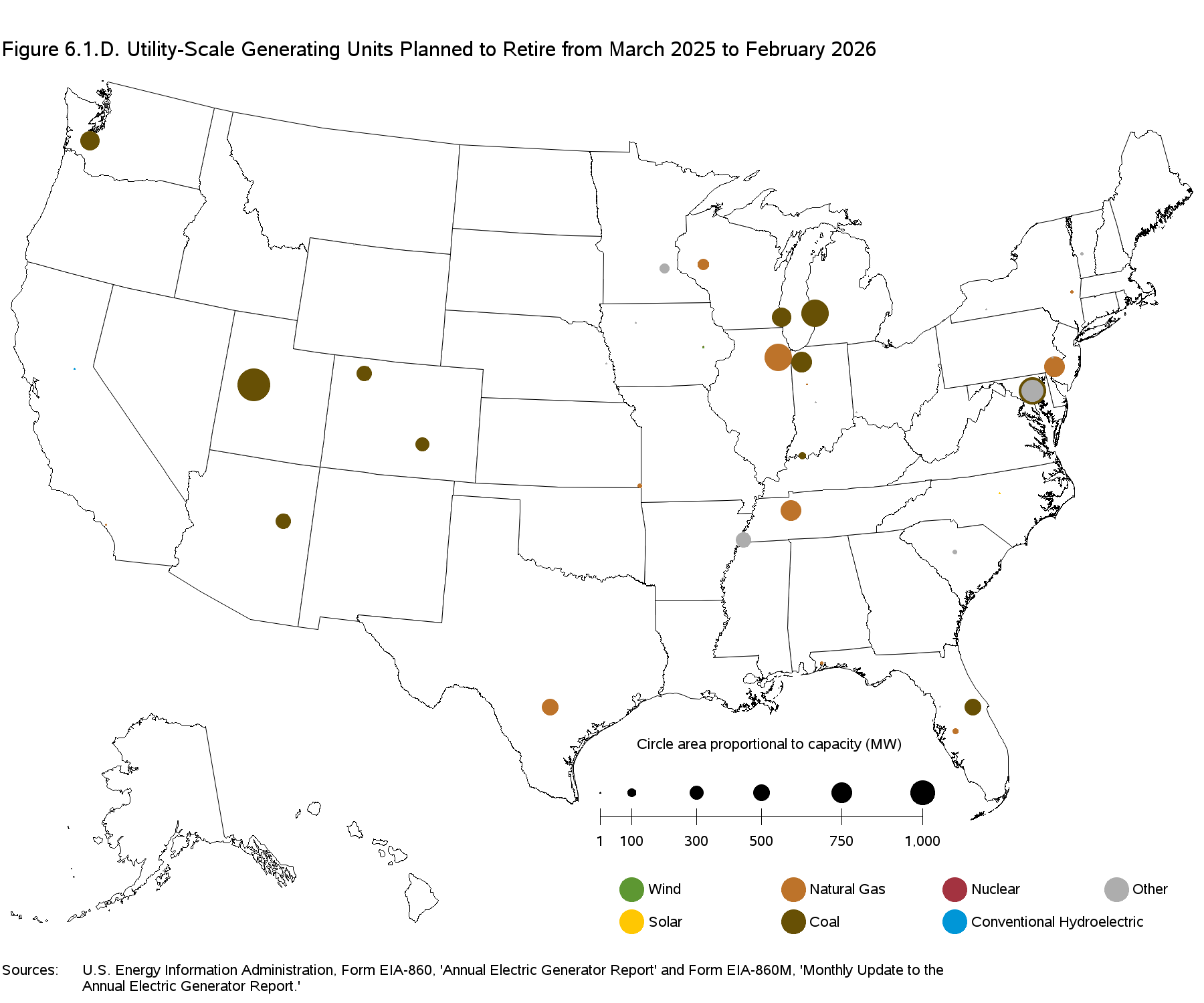
Utility scale generating retirements over the next year (gray = coal) https://www.eia.gov/electricity/monthly/images/figure_6_01_d...

[1] https://www.nrel.gov/news/program/2018/10-years-duck-curve.h... (Ten Years of Analyzing the Duck Chart: How an NREL Discovery in 2008 Is Helping Enable More Solar on the Grid Today)

China started building coal again, and global coal production is rising.

https://www.washingtonpost.com/world/asia-pacific/years-afte...

Use economic sanctions if necessary to encourage better behavior from participants in the world economy. There will be some bumps on the energy transition journey. We fixed the Ozone hole [1], this is no different.

[1] https://en.wikipedia.org/wiki/Ozone_depletion#Public_policy

This seems weird to me. Would that be on the roofs or are you forgetting to count for all that land? But I am European and land is way more valuable here, so that might be the case, I don't know - perhaps you do?
There is a lot of worthless land where utility solar can be installed in the US, not to mention folks who want it on their roof (rooftop solar is cost competitive in most states over 25 years).

Europe has enough wind potential to power the world [1].

"Taking into consideration socio-technical constraints, which restricts 54% of the combined land area in Europe, the study reveals a nameplate capacity of 52.5 TW of untapped onshore wind power potential in Europe - equivalent to 1 MW per 16 European citizens – a supply that would be sufficient to cover the global all-sector energy demand from now through to 2050."

[1] https://www.sciencedirect.com/science/article/pii/S030142151...

What about the opposition because of worsened living standard of people around and because of the environmental impact, also hazardous maintenance etc? There is a wind farm being blocked in Germany over these concerns now. Same applies for solar and water (river/nature based) power plants in Europe.
> that kwh will not be cost competitive with anything else on the spot market

Maybe capitalism isn't the right model for energy? Or, if you are a die hard capitalist, maybe we aren't costing externalities correctly and we should get some folks in power who will ensure that the right options are also the cost competitive options?

Even assuming you're not a die hard capitalist, why champion an outdated energy technology when there are superior options. We aren't costing CO2 properly, but then we're also not costing decommissioning of nuclear generators or the waste disposal either.
We're not? https://www.nrc.gov/waste/decommissioning/finan-assur.html We also have a nuclear waste fund that previously received $750M in fees per year and sits at a balance of $44B, but that's been paused since there has been no effort to actually use the funds to dispose of waste.
Accumulating funds for an activity you can't or won't undertake isn't properly accounting, it's aspirational accounting. Talk is cheap.

https://www.politico.com/story/2013/11/nuclear-waste-fiasco-...

"Doing nothing often has a cost — and when it comes to storing the nation’s nuclear waste, the price is $38 billion and rising.

That’s just the lowball estimate for how much taxpayers will wind up spending because of the government’s decades of dithering about how to handle the radioactive leftovers sitting at dozens of sites in 38 states. The final price will be higher unless the government starts collecting the waste by 2020, which almost nobody who tracks the issue expects.

The first $15 billion is what the government spent on a controversial nuclear waste repository at Nevada’s Yucca Mountain until the Obama administration scrapped the project. The other $23 billion is the Energy Department’s estimate of the damages the government will have to pay to nuclear power utilities, which for the past 30 years have paid a fee to DOE on the promise that the feds would begin collecting their waste in 1998.

Industry argues that the damages are closer to $50 billion — which raises the bottom line to $65 billion including the money spent on Yucca."

So we're going to build more reactors you say? Where will that waste go? This is not an issue with renewables and batteries.

Moving goalposts to advance a different broken argument.

Your original assertion:

> but then we're also not costing decommissioning of nuclear generators or the waste disposal either.

But we are costing and accumulating funds for that purpose.

> the final price will be higher unless the government starts collecting the waste by 2020, which almost nobody who tracks the issue expects.

You're now complaining that costs are accruing to utilities because the other money we've collected isn't being spent. This means we're effectively double costing the storage/disposal.

I disagree with that precise statement, BTW. The final price in current dollars for final disposal will decrease the more time the waste has sit in spent fuel pools and cooled. Not that this is a great thing to be doing.

Nuclear would be good but here in California nuclear waste is stored on the beach making it less enticing. Most people would prefer home solar.
> nuclear waste is stored on the beach

What?

San Onofre Nuclear Generating Station
It is pretty crazy. The government swears up and down that it is completely safe but yet the concrete bunkers are already wearing away now after just a few years.