Hacker News new | ask | show | jobs
by toomuchtodo 2393 days ago
If you break ground today on a nuclear generator, you will not see your first kwh generated for at least a decade, and that kwh will not be cost competitive with anything else on the spot market.

At the same time, you could replace all nuclear in the US currently operating in around three years (even compensating for capacity factor), solely from PV manufacturing capacity in the US. It is plainly obvious why nuclear is not included when renewables and at grid parity and the cost of utility scale storage is rapidly declining. Even if the cost decline of storage takes longer than expected, you can compensate with overbuilding, curtailment, transmission and demand response.

You ask why nuclear isn't being talked about. I can't fathom anyone thinking it's a real option compared to solar, wind, and battery storage, all of which are cheaper unsubsidized than nuclear today, can be manufactured and shipped where ever needed, and scaling up production is trivial (in comparison).

https://www.lazard.com/perspective/lcoe2019 (Lazard Levelized Cost of Energy and Levelized Cost of Storage 2019)

6 comments

> If you break ground today on a nuclear generator, you will not see your first kwh generated for at least a decade.

If Climate Change is so important, declare a total war against it like during WW2 against the Axis. With most production geared toward nuclear energy, you should have generator up and running a lot faster.

The list of things I don't want built in a rush definitely includes nuclear reactors!
And yet a ten year timeline is obviously nonsense. When these reactors were built in the 1970s, groundbreaking to power production was often 5 years.

Why is the process much worse now?

https://en.wikipedia.org/wiki/Zion_Nuclear_Power_Station

Yes, but it's also possible to go a lot slower than necessary. France converted their grid to 80% nuclear in 20 years and it seems to have worked out ok.
Cant you do the same thing in regards to renewables?
From that Lazard report, PV with four hours storage costs 10 to 13 cents/kWh. That's "in front of the meter" which is the wholesale cost. For retail cost, commercial/industrial pays 22 to 38 cents/kWh, and residential pays 45 to 66 cents/kWh.

That's with only four hours storage. That's a convenient amount since it's the excess typically generated by solar installations during the day, but to actually get through a windless night we might need more storage. Lazard's retail cost for storage alone is 48 to 104 cents/kWh. Plus you'll need extra solar dedicated to charging it.

At this point people often bring up long-distance transmission. The report happens to include that too, with a cost starting at $2.35/kWh wholesale and going way up from there.

None of this includes the overcapacity we'd need, to get through cloudy winter weeks.

Lazard puts nuclear's cost at 12 to 19 cents/kWh but it's unclear whether that's retail cost; I suspect so since I only pay 12 cents/kWh on a grid that's heavy on nuclear.

Wind/solar is very cheap when the grid is still mostly fossil, but to run a reliable carbon-free grid in areas without abundant hydro, nuclear is still cheaper. The cheapest combination is probably nuclear to the level of minimum nighttime load, and renewables for everything beyond that, without just enough storage to even out remaining discrepancies with demand.

What night base consumption is absolutely vital ? I understand that some of the consumption is necessary to function and that some other is made possible by the fact that fossil energy is as expensive to generate at night and that it's cheaper to function 24/7. But sometimes it can be cheaper to shut down widget X factory at night not to double storage capacity. Maybe this effect will be important, I don't know.
If we have to build twice as many widget factories to make up for shutting them down at night, that's another cost to society that we should take into account. I've seen a lot of renewables advocates talk about "demand management" but not any estimate of this cost.

There's also heating, air conditioning, street lights, etc. Aluminum plants, which can't shut down more than 4-5 hours without major damage from the metal solidifying.

Before long, electric vehicles charging in people's garages at night; it'd be nice if we used them to supply the grid at night but that would require parking lots full of charging stations where everybody works, plus new infrastructure in people's houses, and some kind of incentive to get people to bother. All that costs money too.

At the same time, you could replace all nuclear in the US currently operating in around three years (even compensating for capacity factor), solely from PV manufacturing capacity in the US.

I think that you may have confused PV manufacturing capacity in the US with global PV manufacturing capacity.

The US generated 807 TWh from nuclear power in 2018 [1]. If solar farms achieve a good-but-realistic capacity factor of 25%, you need 368 gigawatts of modules [2] to produce 807 TWh per year. That's about 3 years' worth of global module production at 2019 production rates. US domestic module production is currently below 10 GW per year.

[1] https://www.world-nuclear.org/information-library/country-pr...

[2] (807000 / (24*365)) / 0.25 = 368. Actually you need a bit more because most solar farms report capacity factor on an AC basis, and the inverter loading ratio is greater than 1.0. But close enough for a quick estimate.

You are correct. Thank you for pointing out my mistake.

https://www.solarpowerworldonline.com/u-s-solar-panel-manufa...

Nuclear power is 20% of electricity in the United States.

If you could replace it all in 3 years, wouldn’t we be better off replacing 20% of coal power over 3 years and wait a little longer on the nuclear power?

If your math is right, half the grid would be zero carbon in 5 years.

Yes, you would absolutely want to stave off nuclear generator retirements as long as (safely) possible to displace carbon producing generators. I use the example only to demonstrate the ease of renewable deployments versus nuclear. You could go do a green bond offer (or PPA contract), bid out the construction project, and build a solar generation facility next to a nuclear power plant to replace its capacity. You cannot do this to build a new nuclear plant.

Coal power is going away, full stop, due to the cheap cost of natural gas and renewables. It is not cost competitive. Natural gas throttles fast; it's why California can have such a steep Duck Curve [1] and support GWs of solar generation capacity. It is a great stop gap until batteries catch up.

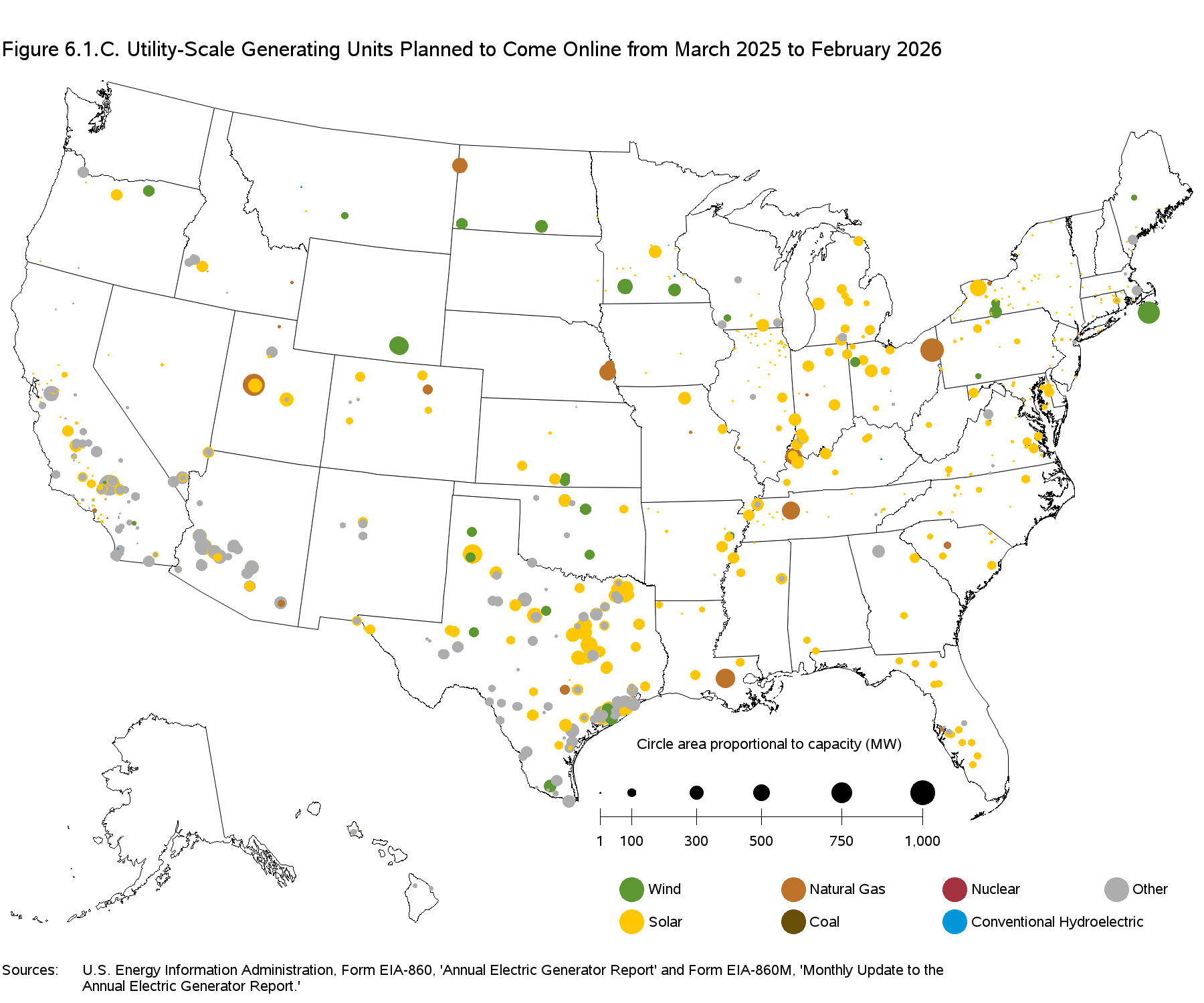
Utility scale generating plants coming online over the next year (green = wind, yellow = solar) https://www.eia.gov/electricity/monthly/images/figure_6_01_c...

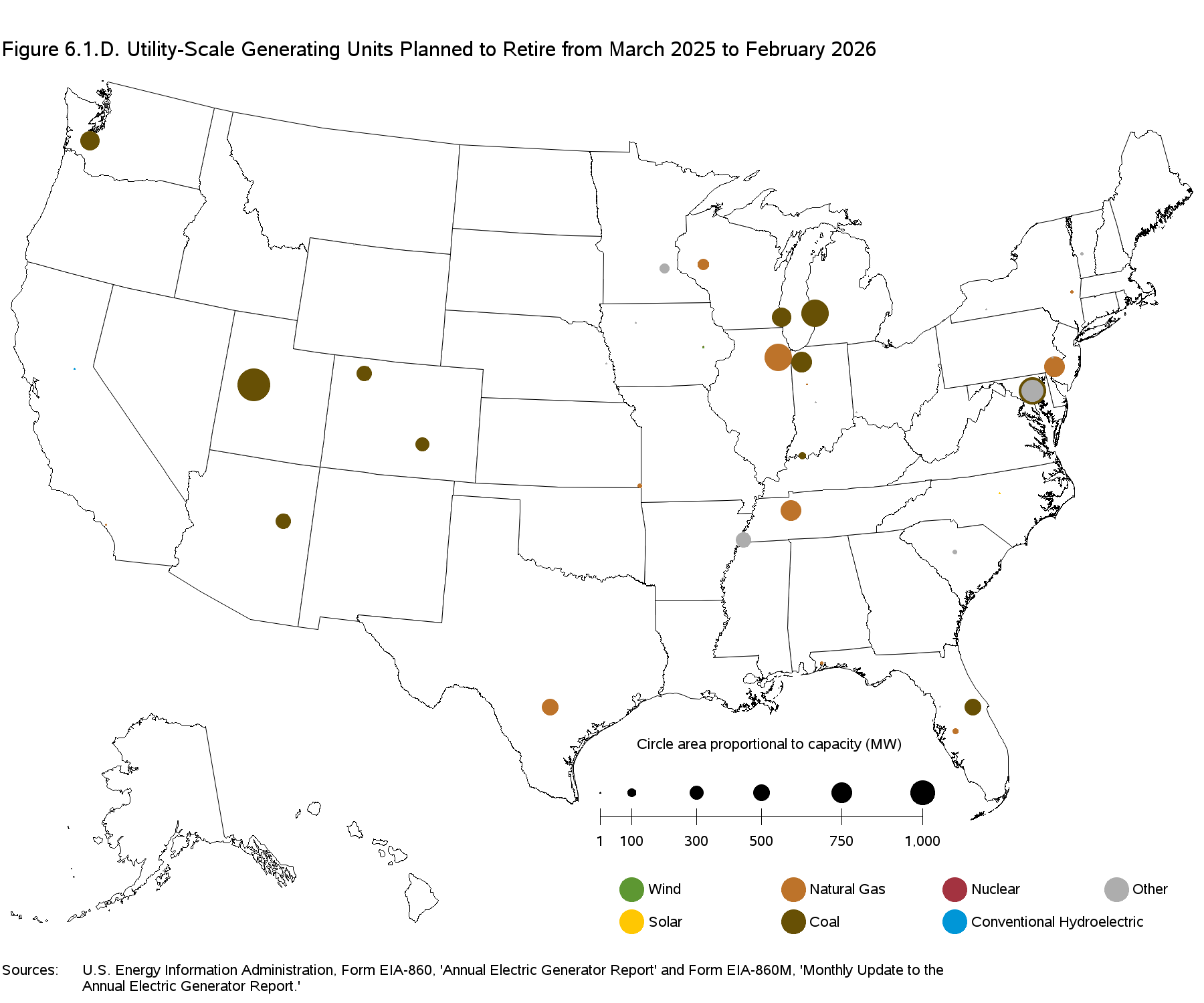
Utility scale generating retirements over the next year (gray = coal) https://www.eia.gov/electricity/monthly/images/figure_6_01_d...

[1] https://www.nrel.gov/news/program/2018/10-years-duck-curve.h... (Ten Years of Analyzing the Duck Chart: How an NREL Discovery in 2008 Is Helping Enable More Solar on the Grid Today)

China started building coal again, and global coal production is rising.

https://www.washingtonpost.com/world/asia-pacific/years-afte...

Use economic sanctions if necessary to encourage better behavior from participants in the world economy. There will be some bumps on the energy transition journey. We fixed the Ozone hole [1], this is no different.

[1] https://en.wikipedia.org/wiki/Ozone_depletion#Public_policy

This seems weird to me. Would that be on the roofs or are you forgetting to count for all that land? But I am European and land is way more valuable here, so that might be the case, I don't know - perhaps you do?
There is a lot of worthless land where utility solar can be installed in the US, not to mention folks who want it on their roof (rooftop solar is cost competitive in most states over 25 years).

Europe has enough wind potential to power the world [1].

"Taking into consideration socio-technical constraints, which restricts 54% of the combined land area in Europe, the study reveals a nameplate capacity of 52.5 TW of untapped onshore wind power potential in Europe - equivalent to 1 MW per 16 European citizens – a supply that would be sufficient to cover the global all-sector energy demand from now through to 2050."

[1] https://www.sciencedirect.com/science/article/pii/S030142151...

What about the opposition because of worsened living standard of people around and because of the environmental impact, also hazardous maintenance etc? There is a wind farm being blocked in Germany over these concerns now. Same applies for solar and water (river/nature based) power plants in Europe.
> that kwh will not be cost competitive with anything else on the spot market

Maybe capitalism isn't the right model for energy? Or, if you are a die hard capitalist, maybe we aren't costing externalities correctly and we should get some folks in power who will ensure that the right options are also the cost competitive options?

Even assuming you're not a die hard capitalist, why champion an outdated energy technology when there are superior options. We aren't costing CO2 properly, but then we're also not costing decommissioning of nuclear generators or the waste disposal either.
We're not? https://www.nrc.gov/waste/decommissioning/finan-assur.html We also have a nuclear waste fund that previously received $750M in fees per year and sits at a balance of $44B, but that's been paused since there has been no effort to actually use the funds to dispose of waste.
Accumulating funds for an activity you can't or won't undertake isn't properly accounting, it's aspirational accounting. Talk is cheap.

https://www.politico.com/story/2013/11/nuclear-waste-fiasco-...

"Doing nothing often has a cost — and when it comes to storing the nation’s nuclear waste, the price is $38 billion and rising.

That’s just the lowball estimate for how much taxpayers will wind up spending because of the government’s decades of dithering about how to handle the radioactive leftovers sitting at dozens of sites in 38 states. The final price will be higher unless the government starts collecting the waste by 2020, which almost nobody who tracks the issue expects.

The first $15 billion is what the government spent on a controversial nuclear waste repository at Nevada’s Yucca Mountain until the Obama administration scrapped the project. The other $23 billion is the Energy Department’s estimate of the damages the government will have to pay to nuclear power utilities, which for the past 30 years have paid a fee to DOE on the promise that the feds would begin collecting their waste in 1998.

Industry argues that the damages are closer to $50 billion — which raises the bottom line to $65 billion including the money spent on Yucca."

So we're going to build more reactors you say? Where will that waste go? This is not an issue with renewables and batteries.

Moving goalposts to advance a different broken argument.

Your original assertion:

> but then we're also not costing decommissioning of nuclear generators or the waste disposal either.

But we are costing and accumulating funds for that purpose.

> the final price will be higher unless the government starts collecting the waste by 2020, which almost nobody who tracks the issue expects.

You're now complaining that costs are accruing to utilities because the other money we've collected isn't being spent. This means we're effectively double costing the storage/disposal.

I disagree with that precise statement, BTW. The final price in current dollars for final disposal will decrease the more time the waste has sit in spent fuel pools and cooled. Not that this is a great thing to be doing.