Hacker News new | ask | show | jobs
by yumario 2418 days ago
From the game theorist point of view I think its better if one company is the underdog. Think about it, if one company is the underdog, one company has a lot to gain by competing, while the other has a lot to lose if they don't compete. Therefore we get competition. Now, the more equal the market share of the companies the grater the risk and less the reward for competition... A better strategy would be not to undercut your competitor and instead divide the market share. Which leads to stagnation.

Do people here think it sound reasonable?

Edit: Mathematically the argument would be as follows:

Consider two company A and B. A has market share 'a' and B has b. n is the total market. Then a + b = n.

A's reward for competing will be n - a = b.

A's risk for competing will be a, (it's remaining market share).

A's will compete as long as the reward is greater than risk.

This will reach an equilibrium at a = b.

8 comments

Take it for what you will, but an Intel engineer relayed to me (many years ago, in the aftermath of the Microsoft antitrust trial), that they attempt to ensure that AMD maintains a certain level of competitiveness as a hedge against antitrust. Sometimes that involves actually helping AMD via partnerships or technology sharing, if they are struggling too much - other times it means giving them a swift kick to the crotch if they are gaining to much ground. It may have been BS, it may not have - and much has certainly changed over the years... but...

AMD has always been nipping at Intel's heels, for 20+ years now, never really losing or gaining too much to pose a real threat. Yet we've seen how ruthlessly Intel will snuff out potential contenders (such as Transmeta, RIP), it does kind of make you think there's something to it.

This was the reason for me to still buy AMD shares when they were deep underwater. I considered them basically immortal, because if the company ever was in existential danger, Intel would have a huge incentive to stage some kind of indirect rescue operation (not outright buying, that would kill the goose, but something else that surely would prop up AMD share value), because the monetary value of AMD as an antitrust insurance was easily much higher than AMDs market cap.

Sold those shares way too early in hindsight, but still got a good return out of that thinking, and if AMD ever gets into trouble again, I won't hesitate to apply the same logic.

This actually would mesh pretty well with that one Kaby Lake G NUC, released in 2017 and probably had roots in 2016 when AMD's stock was at $3, that had Radeon graphics inside https://www.tomshardware.com/news/intel-discontinue-kaby-lak...
There's a simpler explanation for why Intel used AMD GPUs for a while: Intel's new integrated GPU design couldn't ship until they sorted out their 10nm issues, and their older design wasn't competitive. When Intel went shopping for GPUs on the open market, they could get them cheaper from AMD than Nvidia (though the HBM2 requirement was a clear downside). They actually paired AMD GPUs with both 14nm Kaby Lake and their failed 10nm Cannon Lake processors that had broken integrated GPUs. The short-lived Intel/AMD GPU partnership came to an end because Nvidia's lead over AMD got too big, but it was doomed to be cancelled as soon as Intel gets 10nm working.
What is Nvidia's lead over AMD? Intel's non-AMD gpus are Intel gpus

Do Nvidia integrated gpu (mpgu) exist?

Nnvidia claims they exist but all their weblinks to details are dead. https://www.nvidia.com/object/main_mobo_gpus.html

Nvidia and AMD both make discrete mobile GPUs, and those are the only two options for offering better GPU performance on an Intel laptop when Intel's own GPU is inadequate. Nvidia's GPUs have for years generally had a substantial power efficiency over AMD's.
That's what everyone does now. Microsoft Teams versus Slack, Facebook versus Snap. Nobody wants to be hit as hard as Microsoft was
it's been said enough for me to remember yeah, not killing AMD was a benefit, but keeping their head under the water too
If it turned out to be actually true... I wonder sometimes if it makes a better example of antitrust policy actually working to some degree... or failing.
yeah, it's working but within its limits ..
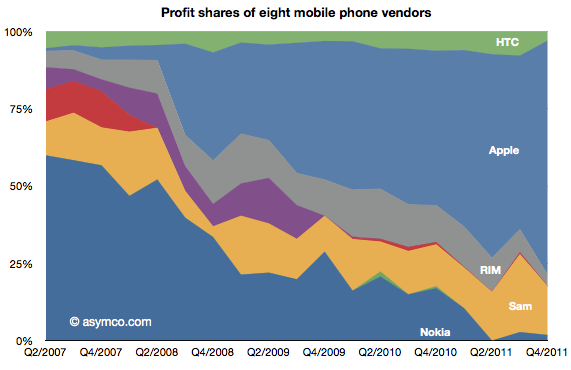
Ease of entry into the market is much more important than the present market structure. An underdog can become the market leader in a year or two [0]. The issue with Intel/AMD is that there are only something like 4 legal entities out of >7 billion legal entities on earth who are licensed to produce x86 chips. 4 is better than 1, but it is still a low number.

It is nearly impossible to maintain an oligopoly in a market that is easy to enter and questions of underdog/overdog become irrelevant. All companies have to offer a reasonable (value/$) proposition to customers of they go broke.

[0] Poor Nokia - http://www.asymco.com/wp-content/uploads/2012/02/Screen-Shot...

Is there a time in the future that x86 related patents will expire?
Sure! For actual x86, they already have. You can make a perfectly good 32-bit chip with SSE2.

The patents on the core of x86_64 will expire in a couple years. Even if you can't have the more recent vector instructions, that's pretty good for a lot of use cases.

each of those 4 entities has whole teams devoted to building up the warchest of patents + colluding on standards to keep the balls in the air indefinitely.
This basically describes the argument for antitrust regulation
Possibly some kind of tacit collusion is more likely with relatively similarly sized competitors. But to me a giant vs underdog situation is usually worse because in the real world I don’t think the underdog usually comes from behind and wins. In fact I’m amazed by the number of times AMD seems to have accomplished this with a fraction of Intel’s resources.
It feels backwards... the closer the companies are, the more there is to lose from not competing... but you do get commoditization. I wonder what a world with AMD being the leader and Intel being the underdog would look like.
Consider two company A and B. A has market share 'a' and B has b. n is the total market. Then a + b = n.

A's reward for competing will be n - a = b.

A's risk for competing will be a, (it's remaining market share).

A's will compete as long as the reward is greater than risk.

This will reach an equilibrium at a = b.

I understand this is an armchair discussion about economics, but this is wildly oversimplified. What does it even mean to "compete" in this case? Obviously if either intel or AMD stopped researching entirely then they would quickly fall by the wayside, as long as either intel or AMD pose a credible threat to being able to innovate.

I would say that your a and b could be like, levels of investment into researching. They'll research at some level, or risk falling too far behind, but can't spend too much as then they'll have to divert funds from other things like marketing or production, or just run out of money. They'll both likely choose to invest at a pace where they think they'll be able to match the other's innovation, but not so much as to overspend.

Yes it oversimplified. Suppose that a = b, i.e both companies has the same market share. Also suppose that when both companies has equal market share their innovations rates are the same, same price etc. The model has two equilibrium both companies compete in which their market share fluctuates around a = b. and we get a sort of predator-pray model[1]. Both companies do not compete their market share stays the same.

What does it means to compete? It could mean many things like not putting lower prices, delaying innovations until competitor has release their own etc.

[1] http://ccnmtl.columbia.edu/projects/seeu/dr/restrict/modules...

The issue with this is the scenario where either company deviates from the status quo. For example, company A decides to make a tradeoff: invest more into R&D at the expense of sales and marketing. If Company B remains the same, company A may suffer a temporary dip in sales, but in exchange, their product becomes better over time and they are able to take more than the original 50% of the market due to having a superior product.

What you're talking about really only works if both companies agree to stay stagnant and collude to keep the status quo as-is. To be fair to your point, this has happened a few times historically, but it is usually considered price fixing and is very illegal[0].

[0]: https://en.wikipedia.org/wiki/Price_fixing#United_States

I think a clearer is example would be with telecom companies. Say A and B, are telecom with equal market share. A, could "compete" in an attempt to gain market share and install a gigabit bandwidth, but this will only cause cause company B to retaliate and instant gigabit bandwidth as well. Therefore the market share and revenue will fluctuate back to equal. But both companies would have lose the money involved in installing the higher bandwidth. Therefore if the market share is equal the best strategy would be "tic for tac" i.e wait until you opponent does something. Which has two equilibrium either constant tic for tact. Or waiting for the opponent does a move.

In the case when one company's market share is smaller than the other it is always better to "invest" or compete.

This is gibberish.
Regardless, AMD would have to two by an order of magnitude to be "on Intels level". They have a long way to go to stop being an underdog.
This is as simplified as saying "racism needs to exist because every other race is trying to take over my genes".