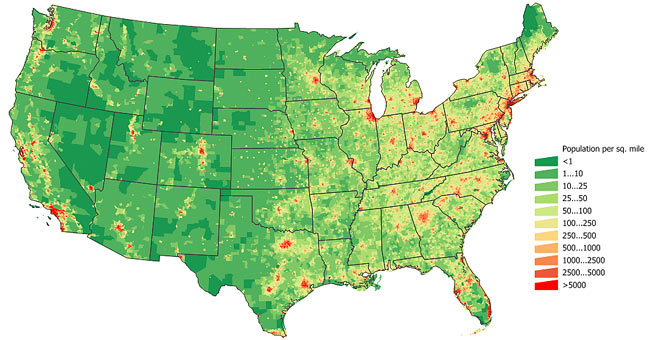
| The eastern US has numerous major metro regions within an hour or two's travel from one another, where "major" is 1-2 million or more in population. The west coast largely doesn't, and the intermountain and west plains region is far less populated still. See: http://modernsurvivalblog.com/wp-content/uploads/2017/06/pop... https://en.wikipedia.org/wiki/List_of_metropolitan_statistic... Dense population centres as vertical relief: https://i.imgur.com/a8tsVUP_d.jpg?maxwidth=1024&shape=thumb&... The "whys" of this are interesting, though I suspect much of this revolves around water and transport. How much it affects homeless populations is an interesting question as well. The climactic factors Doreen mentions are undoubtedly a factor, though I suspect the ease/difficulty in finding nontraditional means of support (odd jobs, busking, panhandling, gig work) likely matter. The options for other than traditional single-family and long-term apartment dwelling, and the relative costs of mortgages and rent also undoubtedly matter, as does the ability to get too and from residence, work, and/or services. My experiences travelling through the US are: 1. The changes in density are hugely apparent, with the almost wholly unpopulated region between California's central valley and the eastern front of the Rockies being most pronounced. There are marked transitions at, say, SF, the 9 bay counties region, Sacramento, Reno, excepting Salt Lake / Wasastch next Denver / Front Range, Omaha, Chicago, and then points east. The density of development along the East Coast, from Boston well into Virginia is hard to appreciate for those who are only familiar with California. And even more rural regions east of the Mississippi and well through the South are far more developed than most of California is. The stretch of CA-99 from Roseville to Bakersfield being only slighly comparable -- it's a linear belt whereas through the Eastern US you'll find comparable or higher densities in all directions. From San Francisco, for two hours' travel, you have ... more or less two destinations: Sacramento or Stockton. Going north or south, there's nothing until Portland, OR, or Los Angeles. And once you pass Sacramento, there's very slim pickings until you cross the Rockies, or better, the Missouri or Mississippi rivers, which is at best days travel by car or bus. And once you arrive, options may be few and attitudes not particularly welcoming. 2. Density alone isn't vitality. There are relatively habited regions which offer little economic opportunity. That's pointedly obvious as you travel through the Mississippi Delta region, much of Arkansas, and old rust-belt regions of Indiana, Ohio, and Pennsylvania. Even with density and clement weather, and despite low costs, support is scarce. The feel of regions that do have some level of wealth or at least money flows is palpable. Aspen, CO, Seattle, WA, and Menlo Park, CA have tremendously different feels than Clinton, IA, St. Louis, MO, or Gallup, NM. Even attractive tourist-based regions often seem to have an edge of concern based on a mix of past indigenous sources of wealth (often mining and timber) now gone and a fear for what happens when the travel fad fades. What passes for generally vibrant in most of the US would be considered strongly depressed in much of California, where the distinctions between even thriving core and outlying regions of the SF Bay Area are severe. 3. Local attitudes matter. Homeless, housing-challenged, car- or van-dwellers, and the like, are more evident where support and services exist, all else being equal. Over the past few decades, I'd say they're more evident generally, and aren't strictly limited to the west or even coastal regions generally. 4. Much of coastal California, as well as the central valley, has and has long had its homeless or transient populations. I strongly recommend Steinbeck's Grapes of Wrath as a backgrounder. The question of why homelessness suddenly emerged in the late 1970s / early 1980s is one that's interested me. I've had an occasional correspondence with Doreen since replying to a comment of hers on HN about a year ago based on some research I'd done on the question at the time. How much of the phenomenon is simply nomenclature and semantics, and how much is an increase in the number / visibility of the unhoused, is something I still don't have a good handle on myself, though I do strongly suspect the problem is getting worse. Failing to offer options other than detached single-family dwellings or rabbit-hutch apartments or housing tower blocks seems another. There really ought be a sensible middle range. There isn't. Doreen has been advocating for SROs as at least a partial solution. She may be right on this, though I see it as at best only a partial element. Co-housing, intentional communities, boarding, and other options may also be useful. As well as a widely implemented land value tax. Treating housing and real estate as financial assets rather than essential societal services seems to me a very strong component. https://news.ycombinator.com/item?id=18499697 That last element turns up in another item I've found fascinating, a 1937 analysis of resistances to technological innovations which includes among other sectors housing, by Berhnard J. Stern: https://archive.org/details/technologicaltre1937unitrich/pag... (Markdown copy: https://pastebin.com/raw/Bapu75is) My attention had been first brought to that by Stern's research assistant for the project, a young Columbia University graduate student named Isaac Asimov. There are a whole slew of valuable lessons from that piece. I've submitted it a few times to HN though discussion's been light to date. https://news.ycombinator.com/item?id=20532443 All told, though, this is a problem that's proved stubbornly resistant to technological (or any other) solutions attempted to date, and for which awareness and understanding are at best limited. Doreen has direct experience (I really don't), and her criticism of what I'd seen as a generally sensible and surprisingly sympathetic White House white paper is cogent. |

My understanding is that deinstitutionalization plays a large role here. The US institutionalized about 500k people nationwide until 1965, when that number cratered to about 100k by 1980 [1]. Not everyone who is released this way ends up homeless, but a recent study in Massachusetts in Ohio found that about a third of people released from mental institutions have no known address within six months [2].
You seem to have thought a lot about this topic, what is your take on the role of deinstitutionalization? Institutionalization seems cruel, but our current system pushes many people with severe mental illnesses onto the streets or into prisons, which seems worse.
[1] http://bpr.berkeley.edu/wp-content/uploads/2017/10/Mental-Ho...
[2] https://www.treatmentadvocacycenter.org/fixing-the-system/fe...