Hacker News new | ask | show | jobs
by majos 2440 days ago
> The question of why homelessness suddenly emerged in the late 1970s / early 1980s is one that's interested me.

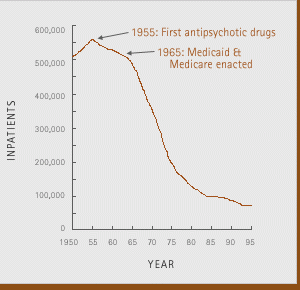
My understanding is that deinstitutionalization plays a large role here. The US institutionalized about 500k people nationwide until 1965, when that number cratered to about 100k by 1980 [1]. Not everyone who is released this way ends up homeless, but a recent study in Massachusetts in Ohio found that about a third of people released from mental institutions have no known address within six months [2].

You seem to have thought a lot about this topic, what is your take on the role of deinstitutionalization? Institutionalization seems cruel, but our current system pushes many people with severe mental illnesses onto the streets or into prisons, which seems worse.

[1] http://bpr.berkeley.edu/wp-content/uploads/2017/10/Mental-Ho...

[2] https://www.treatmentadvocacycenter.org/fixing-the-system/fe...

2 comments

Denstitutionalization had a significant impact on the demographic composition of the homeless population. But urban renewal in the years following the Second World War reduced the stock of cheap housing. Single room occupancy and boarding houses became rare. In many places they became extinct.

The quality of housing at the left of a price histogram became higher. But so did its minimum cost. There's less transient and temporary housing. The overall population is larger. Hope VI continued the removal of the least expensive housing under the rubric of urban renewal policy right up to the twenty-first century.

This is a huge part of the problem. I've been researching the history of US housing for at least two decades at this point and I feel clear that this is a consequence of WW2, post-war prosperity and the existence of the Baby Boom generation that mostly grew up with unprecedented wealth, didn't need cheap housing and essentially imposed it's ideas of "minimal, acceptable housing" on the nation as a whole.

Then demographic and economic reality changed, but we've been both reluctant to rebuild the cheaper accommodations that got demolished and we face serious logistical barriers to recreating such. Cheap housing tends to be older housing. New construction is generally built for the middle class or the wealthy. Poor people don't finance new construction.

So we currently have a huge shortage of housing that works for lower income people. It's not just a factor of rent price per se. We also have created a situation where most Americans cannot live without a car, which is de facto another substantial financial burden and logistical barrier for anyone with physical barriers to being able to drive. On top of that, we just straight up do not have a lot of decent housing options for anyone who prefers a smaller home for some reason.

I'm still trying to figure out out how to document and communicate the shape and extent of the housing problem. Using the term "affordable housing" fails to be helpful in talking about the issue. In fact, it's counterproductive.

But the huge loss of entry-level housing is a large part of this problem space and the period of its active destruction coincides with the findings by dredmorbius that at some point our terminology changed in a way that suggests the issue of homelessness fundamentally changed such that it is inherently more serious, problematic, chronic and long term.

The stigmatization of poverty is an Anglo-American tradition going back at least as far as the 1536 English Poor Laws.[1] Among it's intellectual benefits is a convenient absence of necessary inconvenience upon the wealthy.

Stigmatization of poverty is not the only tradition at play in America. San Francisco's namesake advocated poverty and homelessness. The city was literally established by homeless men who lived in poverty.

The "affordable housing" problem limits solutions to those meeting some criterion for "economically deserving." It precludes pursuit of universal shelter security free of relative political disability. Affordable housing allows eviction from public housing when a family member is criminally charged. Affordable housing allows assistance disqualification for past drug offenses fully paid. Affordable housing is premised on scarcity not abundance.

At the macro-economic scale affordable housing has the delusional premise that there's a housing market that exists in an independent way. The delusion that there's a housing market that can reach equilibrium. Housing is not just one among many alternatives for achieving returns on real-estate investment.

It's one of the worst because conversion of real-estate to housing is sticky. Conversion of housing to more productive commercial, industrial, and agricultural uses ranges from hard (rental trailer parks) to near impossible (multiple single family fee simple lots). Politically, housing houses voters. Economically, homeowners have an incentive to hold out during aggregation.

Real-estate investment is primarily a vehicle for preserving wealth. It's long term. Cashing out is only rational when the returns are high. Cashing out into housing only makes sense when the cash value of the housing at time of delivery exceeds the potential long term value of other uses minus the increased risk from liquidating a perpetual real property title into goods, chattels, and/or financial instruments.

[1]: https://en.wikipedia.org/wiki/Poor_laws

Your use of the term "affordable housing" suggests you are talking about government run poverty relief programs, aka The Projects. I am not. This is one of the reasons it isn't useful terminology for my purposes.

I see our current homeless crisis as a crisis that emerged out of the success of past generations, much like London burned to the ground because as big cities finally emerged from a growing population, it wasn't obvious beforehand that thatched roofs and the like would be a disastrous detail when building a lot of housing under conditions of population density that had not been previously seen.

I am aware that classism and other evils exist. I experienced classism first-hand while homeless.

But I don't find it constructive to focus overly much on that and I don't feel that framing is particularly accurate. I think the majority of the problem is due to factors like blind spots on the part of the privileged.

In a case where you have a mix of root causes, it's generally better to focus your effort on the more readily resolved pieces of the problem. When one of those pieces is prejudice, addressing other pieces of the problem is an effective means to combat prejudice.

Condemning people for their prejudice tends to entrench the problem, not remedy it. Casting light on the fact that their assumptions are incorrect is far more productive.

I believe that this problem exists not because most people in power actively desire to be abusive assholes punishing the lower classes for existing but because they don't have good answers. I think the best thing I can do is do the research, figure out how to effectively communicate it and make it freely available on the internet for anyone interested in the topic.

That still leaves me with an unresolved question of how to pay my own bills. I'm off the street, but I still struggle to make ends meet. I'm currently nearly broke and facing a week where I am likely to go hungry for a few days.

This is an all too common occurrence in my life. Ads are "dead" so to speak and I don't know how to get enough tips and/or Patreon supporters to turn my writing into a middle class income for me.

But other than the detail that it isn't paying enough, I feel pretty confident that this model of 1. Do the research and 2. Put out good info for free is our best hope for finding a viable path forward on some of our current hard problems.

Thank you for your participation in this discussion. Your comments have been enormously helpful for me.

Sorry for not being clear. I agree that "affordable housing" is not a particularly useful starting point for addressing housing insecurity in a meaningful way. I agree that it is a way of maintaining wealth and power.

I think in the context of homelessness, "affordable housing" is used to muddy the waters. "Affordable housing" gets people off on the tangent of home ownership and the American Dream expectations of FAANG engineers. And when that connotation starts to gain traction, "affordable housing" can be used to derail that conversation by bringing homelessness into the mix. No matter what I mean, "affordable housing" has another meaning that can be used to derail my point.

I am really glad you are writing what you are writing and sharing it on HN. It makes Hacker News a better place.

My perspective on housing has developed over the thirty years since I studied architectural drafting at vo-tech and later an MArch. I worked nearly exclusively in housing from 2001 until just a few years ago. With and for developers and homebuilders plus some time in government as a planner and building plans examiner. I watched Hope VI go down in grad school. I worked on some Tax Credit housing projects when I had an independent practice.

Anyway, if I can help, my email is in my profile. Thanks for making HN better.

Anyway, if I can help, my email is in my profile.

Thanks.

I did write you about my latest project. If you don't see an email from me, check your spam folder.

I've seriously suggested that the oil crisis may well play a factor.

The connection is complicated, but plausible.

As the US increased its share of oil imports, starting in 1950, its balance of trade shifted from net exporter to importer (debtor). Before the OPEC crisis of 1973-4, Nixon took the US dollar off the gold standard. I see this not so much as a problem as a response to one: it's not possible to maintain a stable currency against a consistent spending outflow.

The '73 crisis itself not only cut off oil supplies but created a huge spike in cost, again exacerbating the BoT problem. One of the critical events in resolving the crisis appears to have been a meeting in December 1973 between Henry Kissenger and the Saudi finance minister, on which I've as yet found little as to substance. A consequence of this was the "dollarisation" of the US-Saudi oil trade, later extended to the entire international oil market.

From a currency perspective, this solved two problems. The US saw a huge new demand for dollars (absorbing much of the inflationary consequence of increasing the money supply, and both government and private spending), and the Saudis weren't saddled with an ever-appreciating (deflating) riyal.

But the US and the Federal Reserve still had the problem of how to manage the money supply, and fixed on fractional reserve banking and open market operations to do so. This meant that banks and bank assets played a huge role in managing the money supply, where bank assets are loans, largely business and real estate. (Stocks and other equities play a relatively minor role.)

Appreciating real estate valuations, already attractive to banks, became even more so.

A second whammy came with the Iran embargo in 1979, by some measures more severe than the 1973-74 crisis. Meantime, increased energy costs and political shifts were undermining both manufacturing and union jobs, with them, pensions. Appreciating housing also became the household asset and retirement plan for homeowners. Toss in environmental regulations (not a bad thing of themselves) and tax revolts such as California's Proposition 13 in 1978 (a bad thing of itself), and you'd pretty much put all the ingredients together for a fatal brew.

Stew over a sputtering GDP for 50 years, and voila!

The first major reporting on homelessness came in 1980, during the US presidential election campaign, from CBS. The Doonesbury comic strip began an item at about that time, and many homeless organisations date from 1980 or shortly afterward.

There's the question of why this hadn't happened earlier. I'd largely chalk this up to the post-WWII urban exodus and suburban housing boom, throughout the US, but in particular in California, which until 1970 had never seen a subdivision or freeway it didn't love at first glance. OK, slight exaggeration -- the San Francisco freeway revolts began in about 1956, and numerous planned routes in SF were cancelled in 1959, but the movement continued to pick up steam statewide through the 1960s:

https://en.wikipedia.org/wiki/Highway_revolts_in_the_United_...

By the mid-1970s, the idea of simply rolling out massive new tract home and automobile-centred transport projects within California had largely ended. Projects could move, but took far longer and cost much more. Urban centres were already unpopular (the reverse migration into SF began in the 1980s), and there were considerable resistances to densification. What effect events such as the Loma Prieta Earthquake (1989) and Oakland Hills Fire (1991) I'm not sure.

By the mid 1990s, housing prices were taking off again, new dense construction was at best difficult, and at the same time, employment was fairly ill-defined -- California was in the process of shrugging off much defence-related activity (base closings, shifts from defence-related industry), but hadn't yet discovered high-tech. "Multimedia Gulch" (South Park, SF) was A Thing briefly in the mid-1990s, biotech was generating far more hype. There were military base closings across the state (San Diego, Los Angeles, Santa Barbara/San Luis Obispo, Sacramento, Stockton, Vallejo, Alameda, Mountain View, Concord, Fairfield/Vacaville, and more).

Then Netscape appeared and Dot Com 1.0 took off, August, 1995.

I think you are on the right track here. Energy, energy efficiency, Distribution in a system. The more centralised, the more uneven the distribution. Decentralised localism might be solution.