Hacker News new | ask | show | jobs
by siruncledrew 2445 days ago
Watching acquaintances raise funding around metrics like “viewership”, “engagement”, “reach”, and “accounts” has made me especially weary of companies espousing some kind of Golden Metric (big red flag if they don’t mention earnings/money) as a means to justify they are an awesome business.

It’s just too easy to “fudge the numbers” and give the very-best-case estimates that don’t incorporate uncertainty or sensitivity (or reflect reality). It just takes some non-half-assed due diligence to do a sanity check.

> ”We had 100k new users signup in January”

> “How many were still active a month later?”

> ”... 17k”

...

> ”Our users read an average of 12 stories per day”

> “What counts as a ‘read’?”

> ”Spending at least 3 seconds on a page”

It never gets old the stretches people will make to try to pitch something that is in desperate need of legs to stand on, so whatever metric that looks the best is the one pulled out of the hat.

2 comments

Ideally you want to correlate the metric with the dollar ROI. I have yet to see extensive reports on that about google & FB. It's crazy to think the amount of money being thrown at them willy-nilly
John Wanamaker (1838-1922) was a very successful United States merchant, religious leader and political figure, considered by some to be a "pioneer in marketing”. He opened one of the first and most successful department stores in the United States, which grew to 16 stores and eventually became part of Macy’s.

He is credited with coining the phrase “Half the money I spend on advertising is wasted; the trouble is I don't know which half”.

src : https://www.b2bmarketing.net/en-gb/resources/blog/half-money...

my 2 cts : there was never a culture of performance in marketing. Its very hard, especially in a phygital scenario (digital ad, real world spending)

That's a great excuse for 1830 but today i would expect to see tens of precise , large scale studies from an industry that spends billions every year. The fact that I don't, makes me suspicious
These studies exist, but tend not to be published. Essentially there's little to no commercial benefit from publishing, so people tend not to.

Like, I would argue that 80-90% of Goog/FB revenue is correlated with sales. This may be done badly (often), but it is done.

So how do advertisers find out who has the most effective ad system if they re not getting published? They choose in the dark?
Even ROI can't be counted separately, as both companies can count the same conversion as theirs (up to 30 or 90 days layer if I recall correctly). You really need to use 3rd party for validation.
And then you can't do viewthrough (especially on mobile). It's a mess, to be honest.
There's nothing I hate more than a viewthrough - media agency telling me they're responsible for hundreds of conversions when all they've done is put a banner on a webpage (usually combined with retargeting) that's in the viewport for a second.

Basically saying a non-guaranteed second of eyeball time in a banner-blind spot from someone they're retargeting who's already visited our site who converted 60 days later is their acquisition. [0]

I'm a marketer and I despise some of the crap these ad companies are selling.

[0] Conversely, this makes my personal KPIs look amazing, since I can take credit for other people's work and attribute it as my own. Obviously not doing that has caused me twice as much work to get proper attribution set up. If you want an easy life, push the BS metrics they give you.

I dunno, I like view-throughs. I can definitely remember viewing an ad and then converting many, many times so I regard it as pretty normal. I totally get where you're coming from with providers and attributions though :)
Yeah, on a more technical level, the issue I put to the agency was that they had the same weighting in their conversion reporting for a retargeted viewthrough as they did for a click through conversion from a source that was the only channel in a linear attribution.

The former is some nice data on steps to convert, the latter is a conversion driver - the problem is, the latter is hard and the former is easy, so ad tech agencies try and spin them as being equal since they want to push the easy "wins".

Willy-nilly is a bit of stretch. There's quite a bit happening in the space. It's just a hard problem.
I'll be playing the devil's advocate because there is a marketing department down the corridor and we get along (mostly) fine:

>> ”We had 100k new users signup in January”

>> “How many were still active a month later?”

>> ”... 17k”

> ...

Well, that's a retention rate and it's a useful measure (like engagement and reach are).

>> ”Our users read an average of 12 stories per day”

>> “What counts as a ‘read’?”

>> ”Spending at least 3 seconds on a page”

3 seconds might be more than you need to get your message on your audience's mind though. I am thinking of the catchy headline, the picture of the celebrity of the month (with that particular brand of headphones or handbag), the coke ad, etc. That 45second of vid. that isn't played ? The first still is the message.

Now from that, how do you go to prove that your conversion rate is tied to those measures ? I don't know. The consensus seems to be "we can't really pinpoint it but when we don't do it our conversion rate tanks and we get less sales/booking". Yeah, marketing isn't as clear cut as quadratic equation. In a way, it's not that easy.

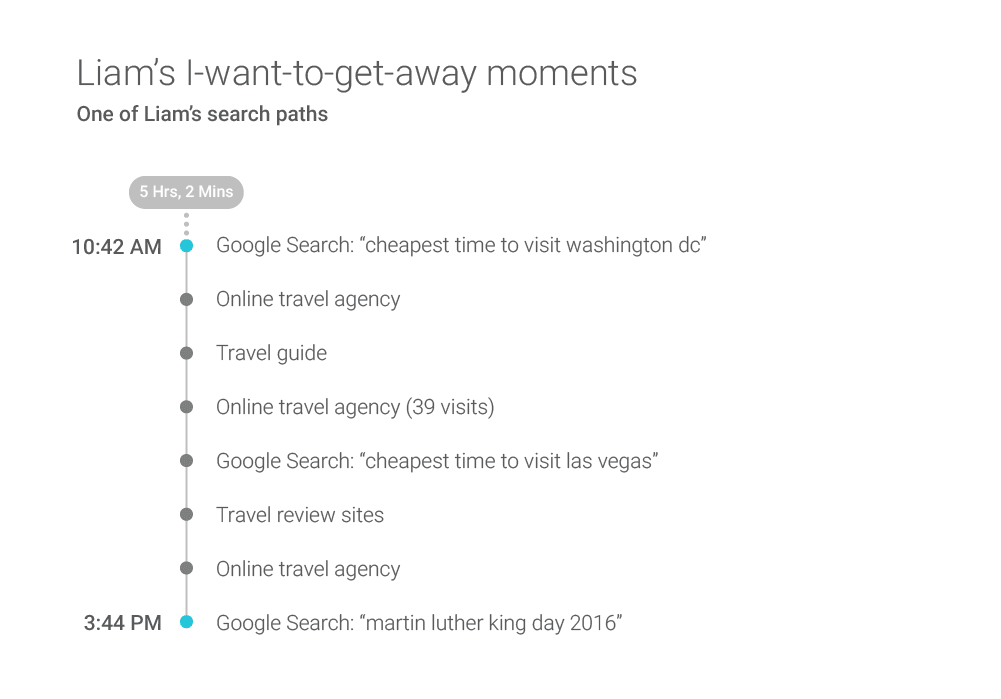
edit: I was reading this article the other day https://www.thinkwithgoogle.com/marketing-resources/micro-mo... and it mentions steps taken by a traveler https://storage.googleapis.com/twg-content/original_images/l... before an hypothetical conversion. Few agencies have the horse power to analyze and prove those steps are taken for the products they help their clients to sell. But I am convinced it's doable, not in the price range of cheap agencies that boast only facebook likes though. /edit

> It never gets old the stretches people will make to try to pitch something that is in desperate need of legs to stand on, so whatever metric that looks the best is the one pulled out of the hat.

Which is fair game. Contract, commercial endeavor, etc. Information is always asymmetrical.

Now, in my 9 to 5, I have had that advice since day one: your $50 FB/GA campaign for a year or a month isn't going to fix a bad business plan :/. If your product is flawed, get out before losing any more money.

> [be] especially weary of companies espousing some kind of Golden Metric (big red flag if they don’t mention earnings/money) as a means to justify they are an awesome business

Solid, sound and gold advice. Most agencies are working on the basis of "best efforts" but it pays to ask them for success stories and check them out.

Now, what facebook did ? Pure, evil scam but I wouldn't hold my breath to see if anything changes in "the industry" (it hasn't when it was revealed and yet tomorrow I am attending a video festival dedicated to the tourism industry).

> "3 seconds might be more than you need to get your message on your audience's mind though. I am thinking of the catchy headline, the picture of the celebrity of the month (with that particular brand of headphones or handbag), the coke ad, etc. That 45second of vid. that isn't played ? The first still is the message."

This can be justified only circumstantially; not everybody structures their social media material to be digestible in three seconds, and as such the term 'read' is misleading. If the criteria for what constitutes a read is not transparent and exact, then how do I know what exactly I'm paying for? Can I adjust it so that I only pay for reads that are at least 30 seconds long?

If not, then this cannot be justified.