Hacker News new | ask | show | jobs
by GhostVII 2559 days ago
The suicide rates by ethnicity are very interesting as well - white people have a significantly higher suicide rate (2x) than most other ethnicity, despite presumably facing fewer problems overall.

My theory is that they can't attribute issues in their life to things like racism/discrimination, so they perceive failures in their own life as their own fault rather than the fault of a racist society. That also seems to fit with suicides dropping during the world wars, when there is something else which you can blame for your problems, suicide rates are lower. I have nothing to back this up though so idk but it makes sense to me, blaming someone else for your situation is a common way to make yourself feel better about it (and is reasonable in many cases I think, there are lots of things you can't control which contribute to failures in your life).

5 comments

Maybe, another theory I've heard from Chris Hedges is that minorities never believed in the myth of the American Dream.

White americans have been told as kids that if you go to college, and then work hard, you'll be rewarded with a good life. This generation of people are finding this to be a con. Look at the lack of wage increases since the 70s even though productivity has increased a lot or look at the student debt crisis for some proof that it was.

Minorities, on the otherhand, were never taught to believe in the American dream, because they haven't really had it in the past.

Now that white people are figuring out it was a myth, and that they are going to likely end up with a worse life then their parents they are commiting suicide, commiting mass shootings, etc.

Here's the article. There's some stuff in there I'm not so sure about it, but I think the general idea has some merit. https://www.truthdig.com/articles/american-anomie/

This rings true to me. They told me that if I worked hard, then I'd be successful by default. At some point in my early 20s, I realized that it wasn't true at all, and it hit me like a ton of bricks. I was severely depressed and felt like a failure, right up until the point where I accidentally stumbled into being a programmer and turned out to be good at it.
I know this feeling very well, made considerably worse by the fact that I happened to be friends with some people who for various reasons did end up being very, very successful. It took me a very long time to realise that they were the outliers rather than me being a failure, and I still doubt myself.
theres a tweet thats been blowing up among us kids/post grads

https://twitter.com/yaboyjaeb/status/1142137347456344064

I think a lot of it is also due to minorities becoming better educated and being treated more fairly in the job market (both domestically and due to globalization), there is more competition for jobs now, so you can't just be successful by default because you are an educated white person who shows up on time. And a lot of people are probably seeing their standard of living decrease from childhood->mid adulthood as they are affected by this transition to a work environment where race plays less of a factor. Another factor is that the percentage of people getting bachelor's degrees over time keeps going up, so degrees are also getting more common and are ending up to be a less competitive advantage.

> White americans have been told as kids that if you go to college, and then work hard, you'll be rewarded with a good life.

People should add an addendum that you need to think about what kind of job you are going to get after you graduate, and it's still kind of true. I know people who thought like this, not at all exclusively white people, and those people are at this stage of their lives (early-mid 20s) seemingly a lot less happy than people who actually thought about their potential careers before they turned 22.

Freakanomics did an interesting podcast about the same theory, what they called the "no oney left to blame" hypothesis.

>DUBNER: The most compelling explanation of suicide I’ve ever heard about — discussed with the fellow who promulgates it — because we don’t really know that much about suicide, because it’s taboo, the research is very distant and so on. But he calls it the “no-one-left-to-blame” theory. Which is that if you have problems in life, but you’ve got a toxic environment or a nasty government, you can always imagine that life will get a lot better. But if you’re surrounded by happy, shiny people and you’re not happy and shiny, it can be — so can you talk about that notion in a place that’s so happy?

WIKING: Yeah. So there is a term, “the happiness-suicide paradox,” that talks about exactly that — that it might be more difficult to be unhappy in an otherwise happy society. If everybody around you feels that life is great, that are oh-so-happy, and you yourself feel unhappy, then that could create a stronger contrast and maybe you start to blame yourself. And more developed countries have reduced the reasons why we should be unhappy. You know, eliminate poverty, have eliminated lack of education — then if I have all these opportunities, why am I still unhappy? We start to internalize that cause and blame ourselves.

http://freakonomics.com/podcast/happiness/

Those rates to not appear to be normalized to account for the proportional differences across ethnicities. Based on the 2010 census, ~75% of the population identifies as white[1]. Based on that, the white suicide rate appears to be lower than their minority counterparts. From the link in the GP, based on 2017 numbers:

  White: 38%
  Native American: 31%
  Asian/Pacific Islander: 16%
  Black/African American: 15%
The Native American number is the most striking to me because, again, from the 2010 census, only 0.9% of respondents identified as Native American[1]. Perhaps that number is also including Latinos?

[1]: https://en.wikipedia.org/wiki/Race_and_ethnicity_in_the_Unit...

That chart is already in Deaths per 100,000 people, so it does indeed show the white and Native American suicide rates to be significantly higher than black and Asian rates.
More precisely, it is deaths per 100,000 people from the target group. I think the parent is interpreting it as "suicides by white people per 100,000 people in the general population", when it is actually "suicides per 100,000 white people."
Correct, but it is not normalized to account for population differences. The white suicide rate is ~2.5x higher than the black suicide rate, but there are ~5.75x more white people than black people in the US. Therefore, normalizing for population proportion, the black suicide rate is more than twice that of their white counterparts.
> The white suicide rate is ~2.5x higher than the black suicide rate, but there are ~5.75x more white people than black people in the US. Therefore, normalizing for population proportion, the black suicide rate is more than twice that of their white counterparts.

No, the population share has already been taken into account. You may have mistaken those numbers to be percentages of total suicides and then compared them to percentages of the population. They aren't, they are deaths by suicide per 100,000 people. You don't need to know anything about the sizes of the groups involved to compare those numbers, and the rate doesn't change. 100 suicides per million people is 10/100,000, just as 1000 per ten million or 10000 per one hundred million.

There are many confounding variables here that make it difficult to draw a convincing conclusion. The ethnic disparity can partially be explained by the fact that white men have higher handgun ownership rates than other demographics (my guess is this is because white men also have higher incomes, not because white men inherently like guns), and such access to guns is associated with increased suicide risk.

I'm sure that's not the whole story though. And statistics on suicides are notoriously unreliable, as many communities consider it shameful and are incentivized to rationalize the person's death with another explanation.

Naw, we're pretty depressed by the structural racism thing. https://www.nimhd.nih.gov/docs/byomm_factsheet02.pdf
What part of that fact sheet contradicts something I said? The "what are some of the barriers" section actually demonstrates my point - it provides external reasons for depression and mental health issues, which only apply to minorities. If you are not a minority, you can't really use these to explain why you are depressed or in a bad situation.
> My theory is that they can't attribute issues in their life to things like racism/discrimination, so they perceive failures in their own life as their own fault rather than the fault of a racist society.

Maybe your saying that the perception of who caused the failure plays into the response to it. I would say that depression in the Black community has been normalized -- that is, no one is really talking about it, but the large part of folk that I've grown up with, the large number of ancestors that I've heard stories about, the ladies in my church who would start crying for no apparent reason, the people that I've known in several decades of being Black, these people are fighting through depression. We need to normalize the healing.

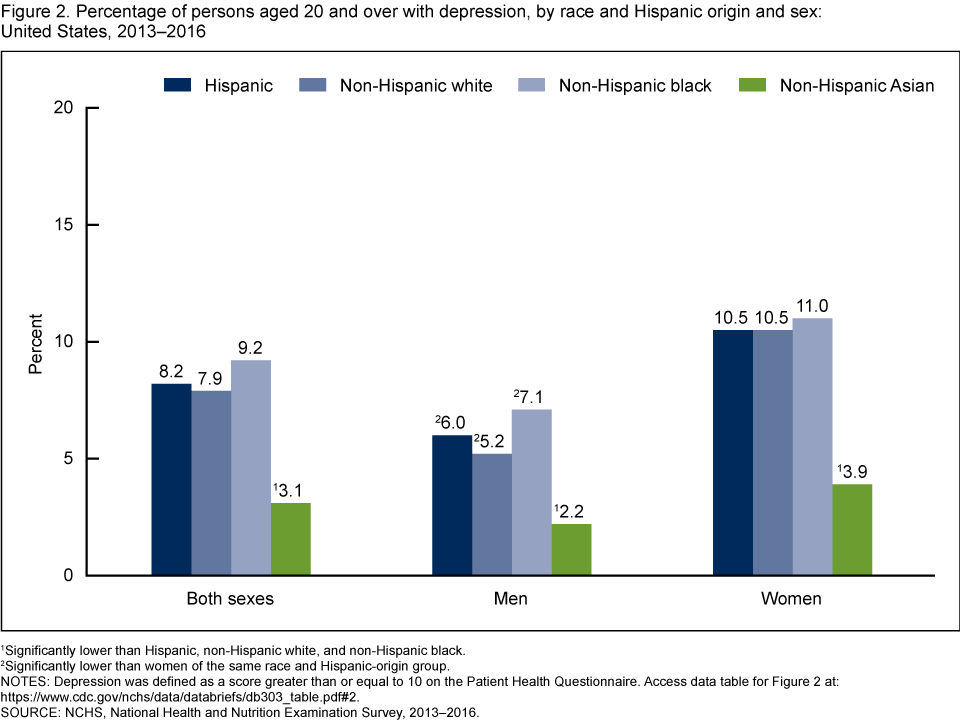
The numbers are here

https://www.cdc.gov/nchs/images/databriefs/301-350/db303_fig...

The most poignant story I know of is that of Rosa Parks

https://www.shondaland.com/inspire/a16022001/rosa-parks-was-...

In other words, even though you may know the difficulties you're against are caused be a racist system (typically knowing that racism is really at play takes months, years, even a century to piece together), taking it on does not guarantee that you will be supported by the community, you are likely to be cast into the same conditions and isolation that exacerbate mental health crises.

I don't know of a more poignant indicator of "depression as a state of being" than our creation of Blues

https://en.wikipedia.org/wiki/Blues

"In lyrics the phrase is often used to describe a depressed mood."

The "work songs" were the songs of men re-enslaved in the mass incarceration programs of the early 20th century

http://newjimcrow.com/

The numbers also tell us that the leading cause of death of Black male teens is homicide.

https://www.cdc.gov/healthequity/lcod/men/2015/black/index.h...

How many of these deaths are being wrongly reported -- young men and boys seeking out the right combination of circumstances to be on the wrong side of a gun barrel? My personal experience and theory is that probing these deaths you would find the majority to be set in motion by a mental health crisis.

As I talked to older relatives and thought through the stories I'd hear as a child, they run rife with of undiagnosed mental health issues. Relatives who succumbed to suicide, people who simply decided to leave/disappear, people who suddenly went completely silent forever. The recurring theme you hear in those stories -- elaborate plans to defeat a segregated housing covenant that fell apart, a grown man being too many times being called "boy" -- people take this pain on themselves and the torment lasts generations.