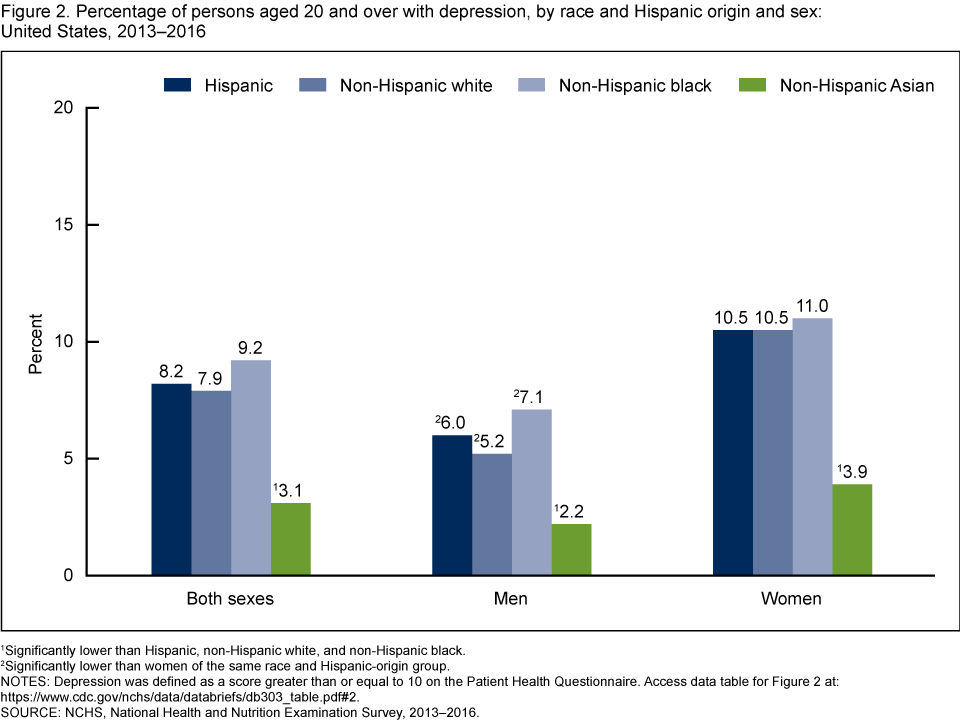
| > My theory is that they can't attribute issues in their life to things like racism/discrimination, so they perceive failures in their own life as their own fault rather than the fault of a racist society. Maybe your saying that the perception of who caused the failure plays into the response to it. I would say that depression in the Black community has been normalized -- that is, no one is really talking about it, but the large part of folk that I've grown up with, the large number of ancestors that I've heard stories about, the ladies in my church who would start crying for no apparent reason, the people that I've known in several decades of being Black, these people are fighting through depression. We need to normalize the healing. The numbers are here https://www.cdc.gov/nchs/images/databriefs/301-350/db303_fig... The most poignant story I know of is that of Rosa Parks https://www.shondaland.com/inspire/a16022001/rosa-parks-was-... In other words, even though you may know the difficulties you're against are caused be a racist system (typically knowing that racism is really at play takes months, years, even a century to piece together), taking it on does not guarantee that you will be supported by the community, you are likely to be cast into the same conditions and isolation that exacerbate mental health crises. I don't know of a more poignant indicator of "depression as a state of being" than our creation of Blues https://en.wikipedia.org/wiki/Blues "In lyrics the phrase is often used to describe a depressed mood." The "work songs" were the songs of men re-enslaved in the mass incarceration programs of the early 20th century http://newjimcrow.com/ The numbers also tell us that the leading cause of death of Black male teens is homicide. https://www.cdc.gov/healthequity/lcod/men/2015/black/index.h... How many of these deaths are being wrongly reported -- young men and boys seeking out the right combination of circumstances to be on the wrong side of a gun barrel? My personal experience and theory is that probing these deaths you would find the majority to be set in motion by a mental health crisis. As I talked to older relatives and thought through the stories I'd hear as a child, they run rife with of undiagnosed mental health issues. Relatives who succumbed to suicide, people who simply decided to leave/disappear, people who suddenly went completely silent forever. The recurring theme you hear in those stories -- elaborate plans to defeat a segregated housing covenant that fell apart, a grown man being too many times being called "boy" -- people take this pain on themselves and the torment lasts generations. |