Hacker News new | ask | show | jobs
by mrpopo 2605 days ago
Another reason for the "country’s shrinking appetite for nuclear" that I can cite is the North Korean terrorist threat.

Rationally, there is little reason for the North Korean state to cause long term damage to a soil that they claim belongs to them, and also the number of such attacks is now close to zero, but as we all know this kind of fear will not go away.

Renewables could work as a replacement, but this may only further weaken South Korea's position in the energy sector in the 21st century. They have a large petroleum and natural gas refining sector, which as we know needs to be phased out. What will be their trajectory in this context?

1 comments

"Renewables could work as a replacement"

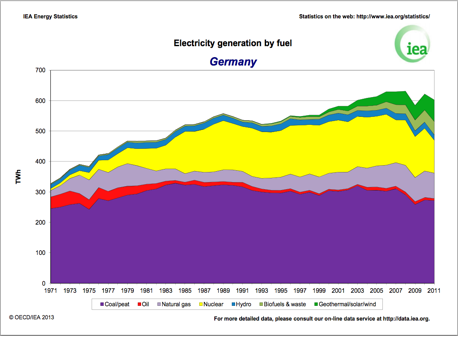
No. They can't as long as cheap energy storage on mass scales doesn't exist. Case in point: closing nuclear plants and replacing them with renewables is what Germany has been trying to do and has failed to do so far. They essentially replaced (and will continue to replace) nuclear by renewables paired with coal and gas plants running on standby. They can't cold start these plants fast enough to catch dips in energy production from renewables.

You simply can't replace a constant energy source (nuclear) by an intermittent one (most renewables).

I'm guessing South Korea will go the same route as "good example" Germany. Push renewables. Which translates to; close nuclear plants, invest heavily in solar and wind paired with gas and coal. End result: more CO2 emissions, higher consumer energy prices, but most importantly: a clean reputation through good intentions.

Renewables at this stage are more about politically correct marketing than about clean and safe energy.

> No. They can't as long as cheap energy storage on mass scales doesn't exist.

It does, Tesla's grid-scale Powerwall made 25% of its cost in profits in 6 months (per https://insideevs.com/news/340702/tesla-powerpack-in-austral...).

Aside from using Powerwalls, us Europeans have extensive experience with using hydro pump storage.

The Tesla grid scale system made that money by stabilizing the grid, essentially providing storage for time periods below 15 minutes. It in no way provides the kind of storage that is needed to use solar or wind power as baseline production.
They also chose Australia on purpose, because the energy market there is pretty messed up and the result is high energy prices, i.e. higher profits than the same system would see somewhere else.

For battery storage to be cost effective in general it has to be quite a bit cheaper than it currently is. The cost has been declining, but people who expect exponential curves to continue forever are generally disappointed. It may or may not hit a stable floor before the cost is low enough to actually replace baseload power generation. What it is likely to be good for is to get over the load hump between dusk and bedtime for solar -- but that requires a lot less storage than being able to carry the whole night. Especially in winter (when the nights are longer), and especially if we expect people to switch from carbon-based to electric heat.

The issue is we need to be building things to replace carbon right now. Even if batteries become cost effective in a decade or more, that's too late. And there is no guarantee of even that.

To be fair, nuclear power plants can also take a decade or more to build.
> To be fair, nuclear power plants can also take a decade or more to build.

That's kind of the point. Better to have it and not need it than need it and not have it.

And even if batteries become cost effective in a decade or more, that's when people start installing them at scale. It's not as if you could replace the entire grid with them overnight either.

So why did Germany go with gas and coal?
Germany has always had a lot of coal.

It's not like Germany just started building a lot of coal plants, to replace the closed nuclear plants.

Our coal infrastructure is on the way to be phased out, it won't be around for long-term any more - the Kohlekommission proposed 2035-2038 for the final shutdown, with 12.5 GW of 42.6 GW capacity going offline until 2022 (per https://www.zeit.de/wirtschaft/2019-01/kohlekommission-kohle...).

What's left will be gas and renewables.

It is planned to be phased out. Just like nuclear. That means that within 15 years Germany will have to replace roughly 70 % of its constant energy sources (nuclear and coals) by the only scalable constant energy source left: gas. Thereby becoming completely reliant on gas from Russia. Creating a massive geopolicital risk that didn't exist previously.

http://instituteforenergyresearch.org/wp-content/uploads/201...

I'll believe it when I see it. Also. What problem exactly is that supposed to solve?

I thought the whole energiewende stunt was about decreasing CO2 emissions. I'm not seeing this.

>by the only scalable constant energy source left: gas.

What makes you think coal and nuclear are scalable? Gas has been the only option from the start and simply switching from coal to gas already results in a 50-60% CO2 reduction.

> Thereby becoming completely reliant on gas from Russia.

While currently most imports are from Russia,there‘s an effort to start building LNG terminals to be able to import from the US.

https://www.reuters.com/article/germany-lng/update-1-germany...

Part of this is appeasement to the US but it is a good backup to have.

> Case in point: closing nuclear plants and replacing them with renewables is what Germany has been trying to do and has failed to do so far.

Germany was the global top electricity exporter, by dollar value, in 2017 [0]. If that's what "failing" looks like, then maybe more countries should start "failing" like that?

In that context, coal and gas are only stop-gap technologies until storage technology and deployment has caught up, and coal is mostly only around for the same reasons as in the US: To not piss off the miners/lose those jobs.

[0] http://www.worldstopexports.com/electricity-exports-country/

The talking point i usually hear against this is "germany exports the huge fluctuation in production caused by green energy to the eu grid, straining the entire system". I haven't come across a good argument against this. Import/Export does indeed seem to vary widely based on time of day [0]. But this doesn't mean there are negative effects. Net frequency might be a better indicator, but I haven't found good graphs, yet.

> coal is mostly only around for the same reasons as in the US: To not piss off the miners/lose those jobs.

Totally agree, especially lignite heavy regions don't have a lot of other industry.

[0] select "import, export" at https://energy-charts.de/power.htm?source=all-sources&year=2...