The Tesla grid scale system made that money by stabilizing the grid, essentially providing storage for time periods below 15 minutes. It in no way provides the kind of storage that is needed to use solar or wind power as baseline production.
They also chose Australia on purpose, because the energy market there is pretty messed up and the result is high energy prices, i.e. higher profits than the same system would see somewhere else.
For battery storage to be cost effective in general it has to be quite a bit cheaper than it currently is. The cost has been declining, but people who expect exponential curves to continue forever are generally disappointed. It may or may not hit a stable floor before the cost is low enough to actually replace baseload power generation. What it is likely to be good for is to get over the load hump between dusk and bedtime for solar -- but that requires a lot less storage than being able to carry the whole night. Especially in winter (when the nights are longer), and especially if we expect people to switch from carbon-based to electric heat.
The issue is we need to be building things to replace carbon right now. Even if batteries become cost effective in a decade or more, that's too late. And there is no guarantee of even that.
> To be fair, nuclear power plants can also take a decade or more to build.
That's kind of the point. Better to have it and not need it than need it and not have it.
And even if batteries become cost effective in a decade or more, that's when people start installing them at scale. It's not as if you could replace the entire grid with them overnight either.
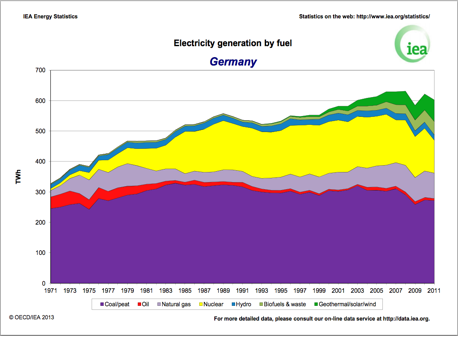
Our coal infrastructure is on the way to be phased out, it won't be around for long-term any more - the Kohlekommission proposed 2035-2038 for the final shutdown, with 12.5 GW of 42.6 GW capacity going offline until 2022 (per https://www.zeit.de/wirtschaft/2019-01/kohlekommission-kohle...).
It is planned to be phased out. Just like nuclear. That means that within 15 years Germany will have to replace roughly 70 % of its constant energy sources (nuclear and coals) by the only scalable constant energy source left: gas. Thereby becoming completely reliant on gas from Russia. Creating a massive geopolicital risk that didn't exist previously.
>by the only scalable constant energy source left: gas.
What makes you think coal and nuclear are scalable? Gas has been the only option from the start and simply switching from coal to gas already results in a 50-60% CO2 reduction.