China is fastracking to being a developed nation faster than anyone before, and missing out many of the developed world's mistakes. They'll have poisonous air for a shorter time than the US or Europe did. They'll have the least obsolete infrastructure of anyone. Making stuff in China isn't necessarily disastrous.
Making huge amounts of overly cheap shite that doesn't last, or do the job properly is especially disastrous as it encourages waste.
Shipping huge amounts of stuff around the globe is disastrous.
Making stuff in places that don't yet have mature and tight environmental protections is disastrous. (Probably a significant reason it moved there in the first place)
I'd pay more for a MBP or another Thinkpad made in Greenock (where IBM used to make them), or anywhere in the EU. I'm in a minority so small it may as well not exist in wanting locally made stuff. For most stuff, I try not to buy at all, but I can rarely choose local any more.
In the early days of Chinese manufacturing they would have been importing most.
Suppliers tend to cluster where manufacturers are, and import specialist parts. Of course as you just posted in the other comment, CO2 taxes reflecting the full environmental costs would tend to encourage more clustering, more local production, and generally buying less wastefully.
As popular as plague no doubt, but stuff needs to get expensive again. Perhaps better to say "expensive enough".
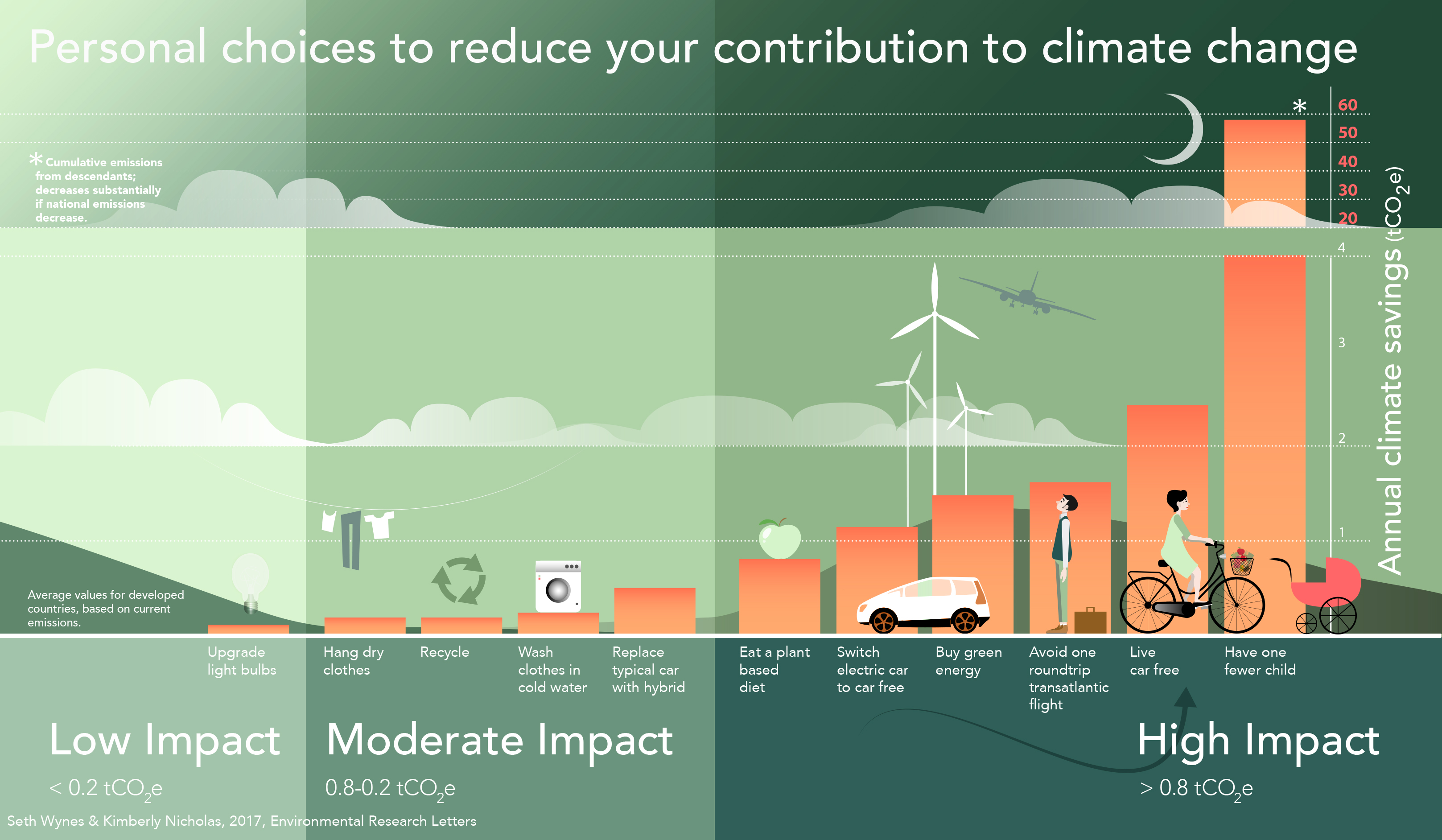
Eating less meat is pretty high on the list [1]. But I think that for many people it is easier to buy less crap they don't really need, or to fix things instead of replacing them. Buying used instead of new is also an option.
The worst culprit for many people I know is flying. You can eat a lot of meat for the emissions of just one long-haul flight. (Which is sad because flying is great.)
>> The worst culprit for many people I know is flying. You can eat a lot of meat for the emissions of just one long-haul flight. (Which is sad because flying is great.)
And yet the total CO2 contribution of the world-wide aviation industry is 'only' 2%.
Based on that chart I would say having (more) children is by far the worst culprit. By now I'm really 100% convinced that the only way to save the earth is if everyone everywhere around the globe stops getting more than 2 children per couple, preferably not more than 1, so the world's population can shrink down back to somewhere around 1/10th of what it is now.
I'm 100% serious about this, and it makes me sad and angry nobody is actually really talking about this. Nothing we can do like eating less meat or skipping a holiday will help if the world's population doesn't shrink by a significant factor. It's a very unpopular opinion to have, because everyone likes children, they are the future, they are god's gift, it's a human right to make babies, bla bla, etc. But reduced to cold hard facts, there are simply way.too.many.people.
Yes I know this would absolutely kill our debt-based economies and probably significantly reduce the standard of living in many places, at least in the short-to-medium term, but that's a different topic. Completely destroying the earth will have much worse effect on the economy and standard of living anyway.
> I'm 100% serious about this, and it makes me sad and angry nobody is actually really talking about this.
Well in some parts of the world people are already having less children. Even in Africa and Asia the birth rates are going down as people (women in particular) receive higher levels of education. So much so that in a few European nations the governments are actively encouraging couples to have more children. The most recent one I heard of is Hungary. I think the same is happening in some of the Scandinavian countries. In the far east (Korea if I'm not mistaken) there are even university courses on dating. In some of these places (Hungary in particular) the preferred approach is increase the birth rate as opposed to encouraging immigration to the country.
I'm not disputing that the sheer massive number of people on the planet is a major factor in the climate change.
However, the contribution of children in the chart we are referring is dubious. The number is so high that I once googled and found what I think to be the original source. (A couple of swedish researches IIRC.)
They counted the children's and their descendants contributions and assigned them to parents for ongoing year.
There are many problems there. For example if the birth rate would be calculated as 2, the contribution would be infinite.
Also counting multiple generations is problematic, because if climate change is not mitigated within one generation we could be in for Mad Max * Water World.
Another frustratingly neglected topic is fusion. Fusion is really the least painless way to get out of this mess. It should be one of the major investments for every developed country right now. Even if it doesn't work out, the benefits of it does are so big that we absolutely need to throw out full weight behind the research. Yet funding keeps getting cut because it's "nuclear" and no politician currently in power will get to claim the enormous win for themselves.
I find this difficult to believe! One transatlantic round trip flight is about 60% as bad as living car free? Assuming you do not travel at all - right? But you will travel. You will cycle to work, and you will burn more calories, and you will therefore eat more food, ending up contributing just as much too increasing emissions!
This part of your statement desperately requires citation and supporting logic.
Among other things to consider -
Compare moving a ~80kg person and a ~13kg bike at 18kph
vs
moving an 80 kg person in one-300th (ish) of a ~300,000 kg plane (call it 1000 kg of plane per person) at 960 kph. 777 GTOW is ~335,000 kg
Now considering that drag is roughly proportional to the cube of velocity, and compare 18kph on a bike to 960 kph on a plane. We'll call it ~50 times faster to keep the math simple. Drag is now 50^3 greater for the plane, or 125,000 times greater.
So you're moving about ten times as much weight and need to overcome 125,000 times as much air resistance while doing it. I think it's fair to say that you can got a lot more miles per burrito on bike than plane.
This is a shame, because I love traveling to faraway places. But it comes at enormous cost. A low-frills slow cruise ship (think cargo ship with beds, not the Queen Mary 2) might manage all right, but even that's not fantastic. Better electrified rail to replace overland flights would be a good starting point
This got me thinking: do the environmental cost calculations for food waste include calories consumed in excess of daily requirements?
What about alcohol consumption?
Is confectionary, eg. chocolate, lollies, ice cream, considers food waste for environmental purpose, given they are highly processed and completely uncessary from a nutritional perspective?
Manufacturing and maintaining a vehicle produced pollution itself, so not creating demand for one is less polluting than still creating a demand for a vehicle of any type.
> I was under the impression the easiest way for people, who live in developed nations, to reduce emissions is to eat less meat?
The most effective thing is probably less carbon intensive transport (that means first and foremost flying). But less meat (or better no meat) is still among the more impactful things.
They also don't drive several thousand or tens of thousand kilometers in one go once or more a year either in addition to the normal driving, so I'd say that argument is not helpful here.
That's not how it'll work though. Do vegans get more flight allowances? Do people with kids have to forgo meat as well as vacations?
Obviously no consumer choice driven solution is going to work. The costs have to be included in the goods and services if we want any actual reduction.
Per passenger. Therefore, a single passenger on a single 8000 mile flight produces as much CO2 as an average family car in a year (where I live - 13000 Km/year).
It would be a cheap food supplement since the methane inhibition required only about 2% seaweed in cattle food, which in turn implies a bromoform feed content of only about 35 parts per million. Though no doubt some farmers would prefer to be able to say that they add seaweed rather than a particular chemical to their cattle feed.
It's less beef, specifically. On a practical level cutting out meat entirely can actually increase emissions because you can raise farm animals off of human inedible parts of plants like stems and other marginal food (i.e. parts we don't get any nutrition from).
Beef however is one of the worst conversion methods in this regard, but animals like chickens and goats are quite efficient.
We have the same cultural reservations about shrimp. We do not normally eat the head, tail, exoskeleton, legs, gills, or poo-filled gut. It's pretty similar for chicken; nobody eats the feathers and beaks and poop.
Shrimp is nevertheless popular however. We simply remove the parts for which we have cultural reservations.
So, where can I get insects that have been properly prepared, just like shrimp?
Even in Western countries, this varies. For example, in many European countries, there are various dishes involving small fish that's cooked and eaten basically whole, with intestines and all. Examples include Baltic sprats (usually smoked and then canned in oil), or Bulgarian tsatsa (same fish coated in flour and deep fried). Both are delicious, by the way.
I looked into raising crickets, but most of my research suggested that they aren't any more efficient than chickens. It seems that a lot of the studies we currently have are poorly done or not transferable to mass production.
In addition, the amount of extra work for processing crickets made the project less than optimal at least for a small operation.
Pink slime can now be sold as beef mince in the US. How hard do you think it would be to get powdered cricket labelled as 'protein enhancer' or some such?
Plus people will happily eat things with cochineal [1] in it, so I can't see highly processed insect additives being a problem. Won't be called Cricket nuggets though.
It's already done, and has been for ages - dried crickets can be ground into "cricket flour". This takes care of the things crunching while you eat them.
Making huge amounts of overly cheap shite that doesn't last, or do the job properly is especially disastrous as it encourages waste.
Shipping huge amounts of stuff around the globe is disastrous.
Making stuff in places that don't yet have mature and tight environmental protections is disastrous. (Probably a significant reason it moved there in the first place)
I'd pay more for a MBP or another Thinkpad made in Greenock (where IBM used to make them), or anywhere in the EU. I'm in a minority so small it may as well not exist in wanting locally made stuff. For most stuff, I try not to buy at all, but I can rarely choose local any more.