Hacker News new | ask | show | jobs
by blattimwind 2715 days ago
Also notable for a huge increase in TDP from the next-slower model (255 W vs 165 W) - and it has four fewer cores.

> Other details about the chip that we have learned include that it will have a listed TDP of 255W, which means the peak power will be higher. Motherboard vendors will have to support 420 amps on the power delivery for the chip (which at 1.3 volts would be 546 watts), and up to 30 amps per core.

3 comments

That is insane, like the worst of the Pentium4 NetBurst era when AMD was competitive at the high end and Intel decided to try to clock their way out of the problem. Granted this is a one-off chip to grab headlines and not a long term micro-architecture commitment.

But between this and the fiasco when Intel announced a 28-core 5 GHz chip[0] (without mentioning the 1800 W industrial water chiller needed to cool it), it's starting to sound desperate in its attempts to deflect attention from AMD's EPYC and Threadripper high-core-count chips.

[0] https://www.anandtech.com/show/12907/we-got-a-sneak-peak-on-...

TDP doesn't mean much at intel. Expect any performance chip to consume way more than TDP when fully loaded.
TDP is just a software setting at this point.
550+ watts is insane. That is spaceheater territory. Residential outlets start tripping at 1500-2000 watts. How soon we will have to run even basic gaming machines off multiple outlets.
This isn't for gaming, or even any normal commercial use. I think Intel and AMD have stayed sane with TDP reqs lately especially for consumers chips.
I remember reading/hearing about a ~2000w PSU about 10 years ago that needed to be run off 2 circuits. Fortunately, SLI never became that popular, and even 1000w PSUs (while readily available) are overkill for most gaming setups, even with 2 GPUs.
There are gaming “laptops” available now that come with 2 power adaptors, as a single 330W is not enough to power the system under full load

For now, they can be on the same circuit

It's not so bad if you think of it more like a folding desktop that can occasionally be transported from place to place. The total weight is a lot less than a mini-itx chassis and a standalone 20" class monitor... But not by much.
There are e.g. 780W single units out there. Basically a PSU in a more convenient box. A little easier to pack up.
I've never tripped an outlet on less than 2500 watts, and that was an old electrical network... Did I get lucky or do standards vary in different countries?
Most circuits trip on current, because I^2R heating is what causes fires in house wiring, 15A is relatively common, to get power you multiply by voltage which varies by country, in US that gives you 1800W and UK it’s 3600W. There are a ton of circuits which aren’t 15A though.

If you live in UK, you might note that electric tea kettles work fine, but in the US they do not (they’re too slow). That’s the biggest practical difference to my mind, very few other portable appliances need that kind of juice, except the biggest space heaters. Big, fixed appliances get wired differently.

If you’re handy with electricity and don’t mind fracturing a few rules, European kettles work just fine on 240V 60Hz power. A British 13A plug in the kitchen is a nice conversation piece too.

Note: because of the US “split phase” system, the neutral wire won’t be neutral anymore but rather 120v above ground. The kettle bases I’ve used are well designed, but do be careful.

Specifically to being careful: put a GFCI upstream of the kettle outlet. Which should be there anyway because it's a kitchen, but even more important with a phase-to-phase setup.
It never occurred to me that the voltage difference between America and Europe/Asia would cause a corresponding differences in watt output given the same amps... But yes indeed, US kettles boil much slower.

Other appliances that require a lot of juice include vacuum cleaners, electric hobs, space heaters, portable ACs/dehumidifiers. So having something trip a living room circuit pulling just 2000 watts would drive me nuts in the long run

I live in Japan where we have a paltry 100V. In our apartment it's made by for by having lots of (20A) circuits - 3 for the (small) kitchen alone [which uses gas for the stove anyway]. Total of 14 breakers for a small 3 bedroom + living + kitchen apartment.

In 3 years we've only tripped a breaker once - running a microwave, toaster oven and dishwasher all off the same outlet at once.

sounds like more amps would fix it, yeah
You could imagine it driving you nuts, in my experience trips are rare (once every few years?) unless you love space heaters. Electric ranges (hobs?) run on their own dedicated 240V circuit. As a tradeoff, the plugs are small and convenient; I can fit a phone charger in my pocket, plus the phone and cable—true in Europe, but not the UK. I can also get a power strip with 8 outlets and it won’t take up much space.

A couple days ago I tripped a circuit breaker for the first time in many years. It turns out that the refrigerator shares a circuit with the rest of the kitchen, so when I ran a rice cooker and deep fryer off the same circuit, when the compressor turned on it tripped.

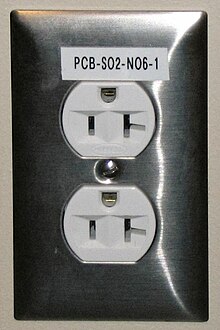
Note that many businesses, and some circuits in residential homes, are wired for 20 amps. The sockets that definitely support 20 amps have an additional slot for 20 amp connectors. See: https://upload.wikimedia.org/wikipedia/commons/thumb/4/42/El...
10 Amp 120V circuits are quite common in the US and Canada.
For what? I've never seen less than 15A in general premise wiring.
Older houses have interesting wiring. I've even seen a 5A circuit (once) in a really old place, varnished cotton clad copper wire and other interesting stuff.

Also (in NL), a fire that had started in a junction box that somehow died out without becoming more serious. That was a pretty scary find in a house that I had just bought.

> Older houses have interesting wiring. I've even seen a 5A circuit (once) in a really old place, varnished cotton clad copper wire and other interesting stuff.

I've lived in a few older homes, and have experienced some of this firsthand. My current home has some of that wire with porcelain wire nuts in the older circuits. Previously we lived in an earlier place that still had a small amount of legacy knob-and-tube wiring. (Bare copper wire kept off joists with porcelain insulators of various sorts.)

Never had to deal with fuses, or sub-10A circuits. (But the utility of a 5A household circuit seems evident in an older world where the whole-house service might be 30 or 60A.)