Hacker News new | ask | show | jobs
by ssivark 2731 days ago
> [...] we are also going to be focusing more on improving the quality of life. I think this will be the thrust of many big breakthroughs of the future. For example, software will be able to notice when you’re feeling down, connect you with your friends, give you personalized tips for sleeping and eating better, and help you use your time more efficiently.

Seems like a retrofitted use case that is more of an answer to the question "What could technology do next?" rather than the question "How to improve quality of life?"

If one started with the latter question---which is what is worth answering---a significant component of the answer would be to strengthen relationships and make them more authentic. Since the medium undeniably biases the message, it is important to prevent the disintermediation of relationships by corporations looking to insert themselves (or their technology) into positions from where they can better extract rent.

Technology can of course be useful in numerous ways, but the right solutions would put human emotions and relationships front and center, and sparingly sprinkle technical solutions only when needed -- and in many ways force people to interact more directly, even if it were temporarily (somewhat) inconvenient.

5 comments

I preface my statement below with a disclaimer that I live in a "developed" or "1st-world" country but have previously lived and experienced other less developed economies.

Anyway, it feels to me Gates is fixing a real problem but with very 1st world solutions?

> For example, software will be able to notice when you’re feeling down, connect you with your friends, give you personalized tips for sleeping and eating better, and help you use your time more efficiently.

Maybe it is just the skeptic in me but it is a lil captain obvious that more of those activities will give you a better quality of life. In fact, I will say that most people are very aware that they should sleep or eat better or even use their time efficiently and probably wouldn't need any form of software to tell them that. I will even wager that the overwhelming number of people that are feeling down, need more sleep or need to eat better can't do so easily and is possibly due to their personal circumstances such as having to work insanely hours due to (almost uncontrollable) working conditions and/or have a low to middle wage job that won't allow them to have any spare income to eat healthy/organic food.

This feels like a stereotypical 1st world solution to me that will only apply to certain type of people and I say this as someone in the privilege position to do so.

I know I sound dystopian but could someone refute my view? Am I missing something?

It feels odd that on an entire post talking about the challenges of treating diseases like Polio, Alzheimer and Malaria, and the reinvention of the toilet too, people are focusing on a single statement that he just posed as a possibility for the future.

Maybe it is just the HN mentality of nitpicking to every mention of the word "software".

I'm sure there will be comments on other aspects also. But discussion on this part is important too.
I am sad to agree with you. We in tech love to believe - with our inflated egos due to recent successes improving the world - that every problem is solved through more tech. I think we need to watch tech fail to solve some problems and experience that failure first hand to really believe that some problems are rooted in culture and social norms, not in a lack of guidance or convenience from some app.

I feel like we've lost connection and patience for each other from lack of practicing empathy. More technology is not the answer to that. I hope we find an equilibrium where we move past such an infatuation with tech that we let it be the right amount of a participant in our lives and place more of an emphasis on the human experience and condition and value our humanity first.

I guess what I'm saying is: if we need an app to remind us to call family, maybe there's a larger problem at hand.

Book 4 of the Pendragon series (The Reality Bug) comes to mind. That was a formative book in my young adulthood.

People are lonely because corporate culture - including, but not limited to, work culture - is outrageously demanding and often insane, not because they need an app to remind them to phone grandma.

Everyone - who isn't financially independent - could benefit from shorter hours and more creative freedom and financial security. Apps that try to parent us are not a solution.

"We in tech love to believe ... that every problem is solved through more tech."

As a recovering technophile [1], I remind you that Arabic numerals, alphabets, double entry accounting, and a zillion other things are also technologies.

Technology is more than modern hardware and software and algorithms.

Sometimes it's just a new take on old problems.

Sometimes it's starting with a new set of assumptions.

Sometimes it's revisiting problems after the economics have changed, identifying new opportunities.

[1] Postman's Technopoly, Wright's Nonzero.

An exception I could see to this is if somehow technology could be employed to affect those cultural/social norms? Maybe the problem is where we're aiming the technology, and not technology itself.

Though, I could be wrong about that. I agree that there are some problems not solved through more technology and the "there should be an app for that" mentality can be a problem.

> For example, software will be able to notice when you’re feeling down, connect you with your friends, give you personalized tips for sleeping and eating better, and help you use your time more efficiently.

I'm sorry, I can't let you do that Dave.

> software will be able to notice when you’re feeling down

This feels dystopian to me too, not least because in order for software to diagnose this problem you'll need to spend sufficient time generating relevant usage data... usage that will (if existing social media are anything to go by) be a net contributor to problems with self-esteem, fitness, sleep, etc.

I'm not going to pretend to know exactly what he means, or how it'll pan out, but the cynic in me is expecting a greater net benefit from just deleting your FB/Twitter/Insta account.

This reminds me of the movie _Elysium_. In it, Matt Damon's character is talking to a robot, and when he shows frustration the robot responds, "You seem to be experiencing elevated levels of anger. Would you like an antidepressant?"
Has Bill ever been good at predictions? No mention of smartphones or social media in The Road Ahead. Blindsided by how quickly the Internet developed, underestimated "bazaar" economies that enabled millions of people building both software and content. All the smart home stuff he was in love with has gone hardly anywhere.

I think he's very smart and great at setting huge goals then hitting them, but I'm not sure he's a great prognosticator.

> No mention of smartphones or social media in The Road Ahead

The road ahead is from 1995 and is about the Internet ("Information Superhighway") which Microsoft almost missed, but got right just in time.

The Smartphone he saw coming earlier than almost anyone else, and Microsoft desperately tried to conquer that market. They initially failed because existing mobile phone companies (Nokia, Motorola, Ericsson) feared Microsoft too much and refused to partner. Then Microsoft had to enter the market with third tier player HTC, which had no distribution at all. Then they executed very poorly, trying to miniaturize Windows using a pen interface and killing the much better specialized numerical ui they had. Then they got surprised by the iPhone and touch screens, and took way too long to come up with a good implementation of that, with Windows Phone 7. And then finally with Windows 8, they redid everything again for no good reason, loosing any loyalty from customers they had left.

They missed smartphones, but not because Bill Gates did not foresee them.

Microsoft was in the smart phone market with Windows Mobile (based on Windows CE) way before the iPhone was a thing and HTC was far from a third tier player. At one point, before the iPhone, HTC was one of the most successful smart phone makers in the world, manufacturing not only its own brand but also third party white label brands and was manufacturing 80% of all Windows Mobile/Pocket PC/Windows CE devices - including those sold and labeled by other vendors.
Which edition of "The Road Ahead" did you mean? From the Wikipedia article:

After the book was written, but before it hit bookstores, Gates recognized that the Internet was gaining critical mass, and on December 7, 1995 — just weeks after the release of the book — he redirected Microsoft to become an Internet-focused company; in retrospect he had "vastly underestimated how important and how quickly the internet would come to prominence".[3] Then he and coauthor Rinearson spent several months revising the book, making it 20,000 words longer and focused on the Internet.[citation needed] The revised edition was published in October 1996 as a trade paperback,[6] with the subtitle "Completely revised and up-to-date.".[3]

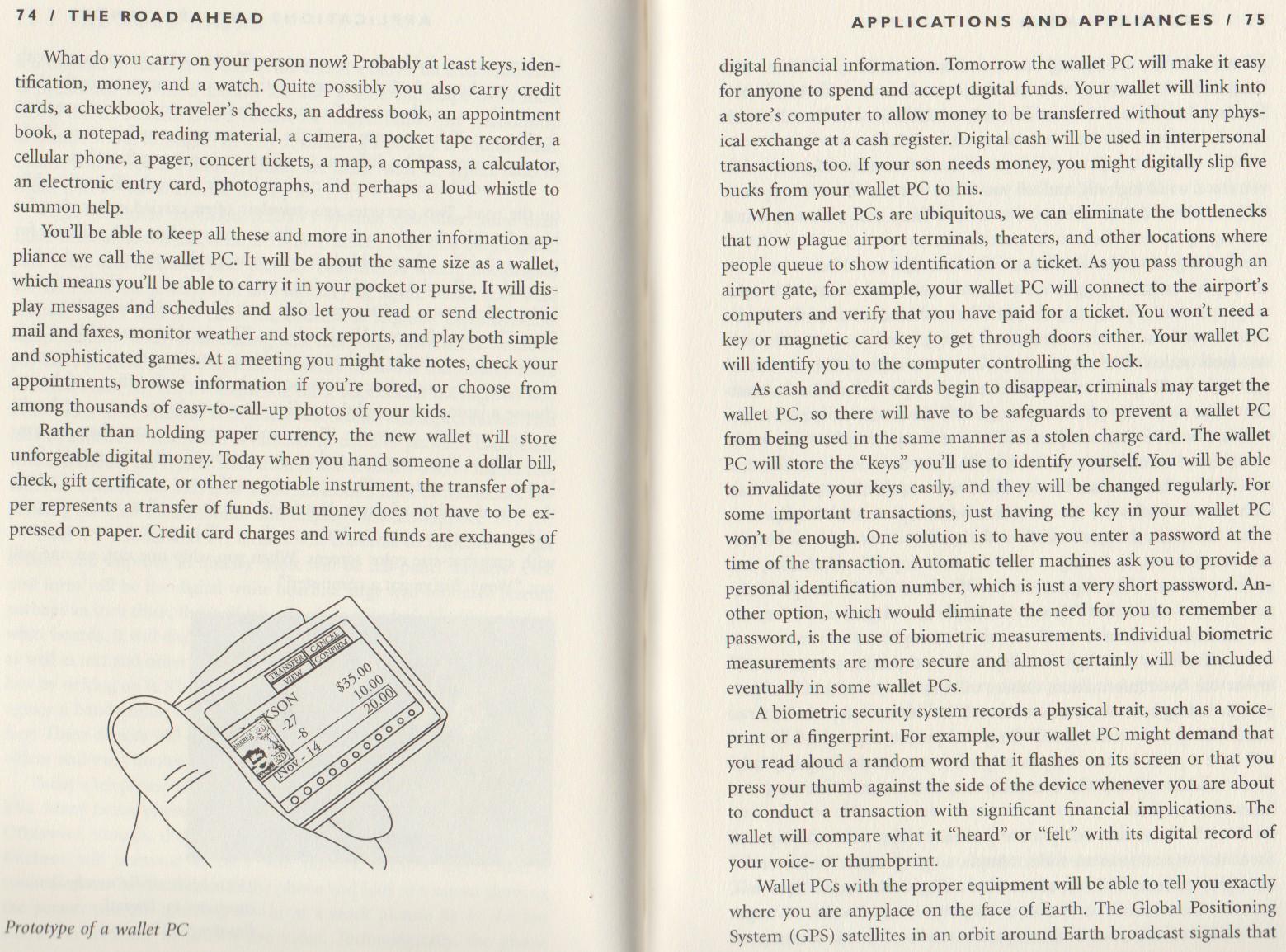
I think his vision of smartphones has held up well. From page 74 of my hardcover copy of The Road Ahead:

What do you carry on your person now? Probably at least keys, identification, money, and a watch. Quite possibly you also carry credit cards, a checkbook, traveler's checks, an address book, an appointment book, a notepad, reading material, a camera, a pocket tape recorder, a cellular phone, a pager, concert tickets, a map, a compass, a calculator, an electronic entry card, photographs, and perhaps a loud whistle to summon help.

You'll be able to keep all these and more in another information appliance we call the wallet PC.

https://pbs.twimg.com/media/A2o-6_WCYAAaNw5.jpg:large

Great comment and I guess he really did see more of it coming than I was aware of. It seems like the main thing he miscalculated, ironically, was how people would use these devices -- it turns out that all that functional stuff is totally dwarfed by being a Facebook zombie, in terms of total eyeball hours.

It's like we all had this innate drive (or susceptibility?) to zombification that we weren't aware of until the smartphone actually appeared

His most famous prediction was one he helped make true.

Microsoft's original mission statement was "A computer on every desk and in every home"

The ending seems to have been missed off most quotes, it appears to have been "A computer on every desk and in every home running Microsoft software".
In all fairness, it would be a terrible mission statement if it ended any other way.
Only if you consider first world countries and even then it’s a stretch. The smart phone market made “computers” far more accessible than Windows ever did.
Yes, there literally isn't a computer in every home. Less than 9 out of 10 households in the US currently have a computer[0]. Yes the smartphone made computers much more accessible, especially in third world countries. The iPhone was also released 23 years after the founding of Microsoft, an eternity in the tech industry. Between the founding of Microsoft and the release of Windows XP computers changed from something in a single digit percentage of households to more than half of all households in the US. That's a major accomplishment, and Microsoft played a large role in it.

[0] https://www.statista.com/statistics/214641/household-adoptio...

There is this panel discussion with Jobs and Gates, circa mid 2000s, where Gates describes the future of computing in now-obvious iPad form, and Jobs is obviously taking mental notes
History is that the iPhone project started in early 2005 and before that Apple was already prototyping touch screen tablets but decided on releasing a phone first.
They released the iPod touch before the iPhone, and it was arguably a touch screen tablet. That's how I used it.
No, they didn’t. iPhone was released in June 2007, iPod touch in September 2007. Perhaps you are thinking of outside of the US? (First iPhone was sold in the US only)
They released the iPhone in June of 2007. They released the iPod Touch around September of 2007. They announced the iPhone in January of 2007.
Gates and Jobs were both familiar with the DynaBook concept from Parc, I don't see how this would be a case where Jobs is taking Gates' ideas.
I think reducing the number of hours in the work-week would do more for this than any technological solution.
> Technology can of course be useful in numerous ways, but the right solutions would put human emotions and relationships front and center

You're looking for a technological solution to a social problem - such things don't generally exist. It's not that technology is bad per se, it simply can't do what you're expecting it to do.

Agreed.

I can imagine a huge host of compensating bad behaviors that would result from something like that. Then should it go away are you just doomed and emotionally catatonic?