Hacker News new | ask | show | jobs
by apatters 2728 days ago
Has Bill ever been good at predictions? No mention of smartphones or social media in The Road Ahead. Blindsided by how quickly the Internet developed, underestimated "bazaar" economies that enabled millions of people building both software and content. All the smart home stuff he was in love with has gone hardly anywhere.

I think he's very smart and great at setting huge goals then hitting them, but I'm not sure he's a great prognosticator.

4 comments

> No mention of smartphones or social media in The Road Ahead

The road ahead is from 1995 and is about the Internet ("Information Superhighway") which Microsoft almost missed, but got right just in time.

The Smartphone he saw coming earlier than almost anyone else, and Microsoft desperately tried to conquer that market. They initially failed because existing mobile phone companies (Nokia, Motorola, Ericsson) feared Microsoft too much and refused to partner. Then Microsoft had to enter the market with third tier player HTC, which had no distribution at all. Then they executed very poorly, trying to miniaturize Windows using a pen interface and killing the much better specialized numerical ui they had. Then they got surprised by the iPhone and touch screens, and took way too long to come up with a good implementation of that, with Windows Phone 7. And then finally with Windows 8, they redid everything again for no good reason, loosing any loyalty from customers they had left.

They missed smartphones, but not because Bill Gates did not foresee them.

Microsoft was in the smart phone market with Windows Mobile (based on Windows CE) way before the iPhone was a thing and HTC was far from a third tier player. At one point, before the iPhone, HTC was one of the most successful smart phone makers in the world, manufacturing not only its own brand but also third party white label brands and was manufacturing 80% of all Windows Mobile/Pocket PC/Windows CE devices - including those sold and labeled by other vendors.
Which edition of "The Road Ahead" did you mean? From the Wikipedia article:

After the book was written, but before it hit bookstores, Gates recognized that the Internet was gaining critical mass, and on December 7, 1995 — just weeks after the release of the book — he redirected Microsoft to become an Internet-focused company; in retrospect he had "vastly underestimated how important and how quickly the internet would come to prominence".[3] Then he and coauthor Rinearson spent several months revising the book, making it 20,000 words longer and focused on the Internet.[citation needed] The revised edition was published in October 1996 as a trade paperback,[6] with the subtitle "Completely revised and up-to-date.".[3]

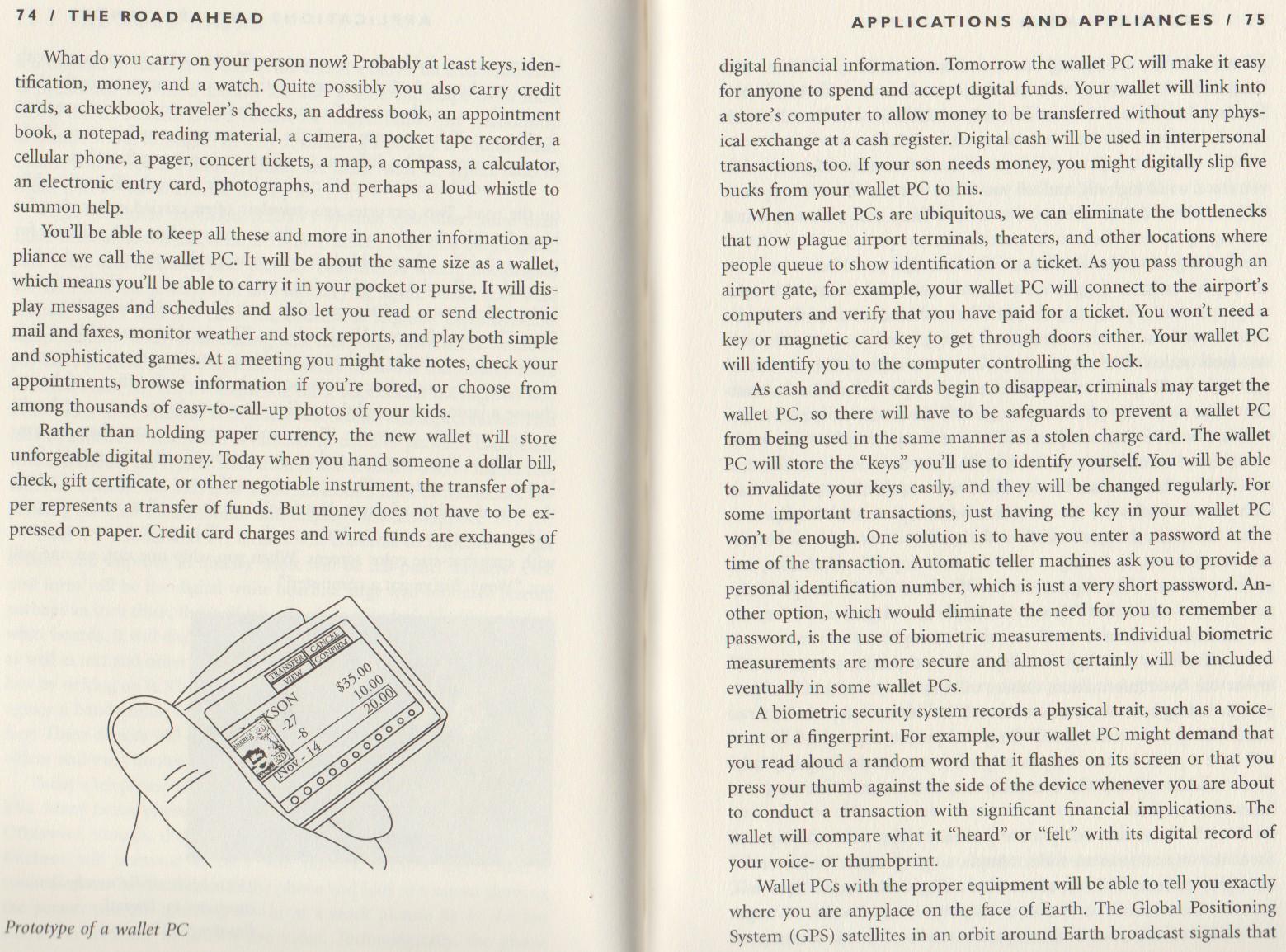
I think his vision of smartphones has held up well. From page 74 of my hardcover copy of The Road Ahead:

What do you carry on your person now? Probably at least keys, identification, money, and a watch. Quite possibly you also carry credit cards, a checkbook, traveler's checks, an address book, an appointment book, a notepad, reading material, a camera, a pocket tape recorder, a cellular phone, a pager, concert tickets, a map, a compass, a calculator, an electronic entry card, photographs, and perhaps a loud whistle to summon help.

You'll be able to keep all these and more in another information appliance we call the wallet PC.

https://pbs.twimg.com/media/A2o-6_WCYAAaNw5.jpg:large

Great comment and I guess he really did see more of it coming than I was aware of. It seems like the main thing he miscalculated, ironically, was how people would use these devices -- it turns out that all that functional stuff is totally dwarfed by being a Facebook zombie, in terms of total eyeball hours.

It's like we all had this innate drive (or susceptibility?) to zombification that we weren't aware of until the smartphone actually appeared

His most famous prediction was one he helped make true.

Microsoft's original mission statement was "A computer on every desk and in every home"

The ending seems to have been missed off most quotes, it appears to have been "A computer on every desk and in every home running Microsoft software".
In all fairness, it would be a terrible mission statement if it ended any other way.
Only if you consider first world countries and even then it’s a stretch. The smart phone market made “computers” far more accessible than Windows ever did.
Yes, there literally isn't a computer in every home. Less than 9 out of 10 households in the US currently have a computer[0]. Yes the smartphone made computers much more accessible, especially in third world countries. The iPhone was also released 23 years after the founding of Microsoft, an eternity in the tech industry. Between the founding of Microsoft and the release of Windows XP computers changed from something in a single digit percentage of households to more than half of all households in the US. That's a major accomplishment, and Microsoft played a large role in it.

[0] https://www.statista.com/statistics/214641/household-adoptio...

There is this panel discussion with Jobs and Gates, circa mid 2000s, where Gates describes the future of computing in now-obvious iPad form, and Jobs is obviously taking mental notes
History is that the iPhone project started in early 2005 and before that Apple was already prototyping touch screen tablets but decided on releasing a phone first.
They released the iPod touch before the iPhone, and it was arguably a touch screen tablet. That's how I used it.
No, they didn’t. iPhone was released in June 2007, iPod touch in September 2007. Perhaps you are thinking of outside of the US? (First iPhone was sold in the US only)
They released the iPhone in June of 2007. They released the iPod Touch around September of 2007. They announced the iPhone in January of 2007.
Gates and Jobs were both familiar with the DynaBook concept from Parc, I don't see how this would be a case where Jobs is taking Gates' ideas.