Hacker News new | ask | show | jobs
by TangoTrotFox 2754 days ago
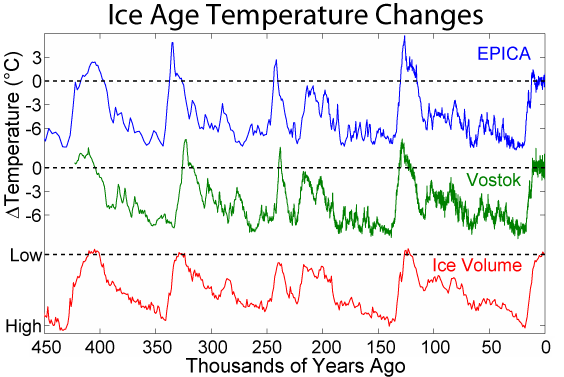
You don't have to go anywhere near that far back. Humanity (as in the species of modern humans) has already lived through quite extreme changes in temperatures. These [1] are data from ice core collections over the past 450k years.

Something that surprises me is that people don't seem to understand that the planet constantly goes in and out of heating and cooling phases for reasons that are still not all that well understood on a clear causal level. This in no way means that we are not contributing, potentially substantially, to the current heating phase. But it does mean that sometime right about now, even if humans did not exist, we'd expect to still see temperatures rapidly rising.

That little comic starts at ~20k years ago is at the exact end of the last ice age and the beginning of the current heating phase so it paints a very misleading picture if you were not aware of the trends before it -- which rather resemble a sin wave of temperatures. For instance humans already lived through the heating phase about 140k years ago where temperatures from bottom to top increased on the order of about 10 degrees celsius. And that was at a time when we had extremely minimal technological capacity to adapt and migrations were something that could take on the order of centuries.

[1] - https://upload.wikimedia.org/wikipedia/commons/f/f8/Ice_Age_...

--------

And out of curiosity can anybody explain why they're downvoting this as fast they can? So far as I can tell I've said literally nothing that is not factually correct (unlike the post I was responding to). In many ways these conversations feel like people want to freak themselves out, and interspersing facts is met with hostility. I'd really like any sort of rational explanation.

6 comments

Didn't downvote, but your premise that people don't understand that there are heating/cooling cycles is not really a thing for anyone even minutely interested in this area of study.

In fact, here's a very detailed page describing those cycles and why it appears we are deviating from the natural order.

http://ossfoundation.us/projects/environment/global-warming/...

Tangential to the topic, but your assumption there is very wrong. Due to the politicization of the topic and the media reporting, which is frequently equally sensationalistic and inaccurate, many people are extremely interested in climate change yet also know practically nothing about it. Some know less than nothing, again thanks to the media. For instance the recent report about the oceans warming even 60% than thought turns out to be wrong. The paper had a fundamental mathematical error that was detected just hours after publication by a skeptical reader. The authors' new method of measuring the warming there remains, yet now their warming figures are no different than what has already been normally reported. [1][2][3] Many media sites have run articles trying to correct their mistaken reporting, but due to the nature of social media the sensational headline gets shared a billion times, the correct indicating it was unjustified gets shared a few dozen times. So you now end up with individual basing their worldview on false facts, which is rather less than productive.

[1] - https://www.sandiegouniontribune.com/news/environment/sd-me-...

[2] - https://www.latimes.com/science/sciencenow/la-sci-sn-oceans-...

[3] - https://judithcurry.com/2018/11/06/a-major-problem-with-the-...

I agree with all of your points, but I'm less interested in whether we can survive as a species and more interested in whether or not we can sustain and continue to improve upon our current level of societal sophistication. I'd rather we didn't regress to basic aggrarianism or worse.
> Humanity (as in the species of modern humans) has already lived through quite extreme changes in temperatures.

That's a disingenuous argument. I can regularly survive changes of temperature between 0 deg Celsius and 30 deg Celsius, but give me one between 30 deg Celsius and 60 deg Celsius and I'd die.

https://www.climate.gov/news-features/understanding-climate/...

Heating and cooling periods, true. CO2 in the atmosphere? Unprecedented. Why does the record above not go further back? Because that's the earliest we can reach with the ice core records. Scientists think that the earliest we've had comparable CO2 levels was the Middle Miocene. If we're going to have Middle Miocene again, we're going to have to go through a period of terrible food insecurity and societal collapse, alongside mass failure of many biospheres.

https://en.wikipedia.org/wiki/Middle_Miocene_disruption

> But it does mean that sometime right about now, even if humans did not exist, we'd expect to still see temperatures rapidly rising.

Except that we know that changes in average temperature on Earth were, before the industrial revolution, almost entirely (>>90% correlation) due to cycles in solar insolation [1]. Now, that insolation accounts for less than half of the rising temperatures, meaning the energy is getting trapped in the atmosphere more and more.

It's nearly impossible to measure insolation from millions or billions of years ago like this paper did for 1600s onwards but all other related indicators, including those ice cores, are screaming that this is unprecedented. It wasn't until humanity came into the picture that indicators for solar insolation and temperature change began to diverge.

[1] https://agupubs.onlinelibrary.wiley.com/doi/10.1029/95GL0309...

Humanity also lived through world wars; I'd rather not see that happening again.
The argument about natural variation is pretty well known and trotted out as a talking point on climate change. It is an appeal to normality that suggests we should just accept the condition of the earth and give up any agency.