I'm a huge fan of the winding maze like structure of cities built upon the old. It's nice to be able to wander and explore. I suppose blank slate cities (like most in America) are a lot more convenient to navigate though.
I could imagine that the main factor influencing how "wander and explore"-friendly a city is, might not be age or evolved-vs-planned, but rather whether it is car-friendly or not (i.e. the degree of density). Car-friendliness can be by design or might evolve.
Wait, what? You think a 45-minute commute is good? The 1.5-hour thing is simply beyond the pale.
You need to get out of the urban megacity.
I've lived in several parts of the USA. My worst commute was 20 minutes by car, and my current commute is 3 minutes by car or 15 to 20 minutes by foot. These were all software development jobs.
The reason is that I choose small cities. I choose places that have suburban density, though they aren't technically suburbs because people aren't commuting into an urban megacity. The jobs are local.
Another nice benefit of this choice is my expenses. Houses go for 10% to 20% of what you pay in a place like the Bay Area, not even counting the extra land you get. Nearly everything else is cheaper too. Gas is half the price. Groceries are cheaper. Taxes are much lower.
Would there be a difference in commutes on work vs commutes dependent on driving? Much easier to walk in a winding maze than drive through it and you can put much more in the former than the latter dependent on the land-use and density.
American cities aren't optimized for navigation, they are optimized for sales. A parcel of terrain is easier to sell when it's not that different from the one alongside it. Selling a house is also easier when there's no quirky features or strange floorplans.
I think it's hard to look at a grid system and say that it's optimized for sales.
US urban planning in the late 1800s and early 1900s "emphasized a grid plan, partly out of extensive reliance on foot, horse and streetcars for transportation. In such earlier urban development, alleys were included to allow for deliveries of soiled supplies, such as coal, to the rear of houses which are now heated by electricity, piped natural gas or oil." - https://en.wikipedia.org/wiki/Dead_end_(street)#Suburban_use...
Sure, you might argue that people purchased those houses because of the benefits of the grid system, and hence (indirectly) optimized for sales. But that same Wikipedia page points out that post-war construction in the US emphasized cul-de-sac and crescent streets.
> "Real estate developers prefer culs-de-sac because they allow builders to fit more houses into oddly shaped tracts of land and facilitate building to the edges of rivers and property lines.[10] They also choose these discontinuous network patterns of cul-de-sac and loop streets because of the often significant economies in infrastructure costs compared to the grid plan. ... The desirability of the cul-de-sac street type among home buyers is implied by the evidence that they often pay up to a 20% premium for a home on such a street, according to one study.[10] This could be because there is considerably less passing traffic, resulting in less noise and reduced actual or perceived risk, increasing the sense of tranquility."
In other words, cul-de-sacs optimize sales, not grid patterns, and "quirky features or strange floorplans" of non-grid plats don't seem to be a problem - quite the opposite.
I believe Joseph Smith's 'Plat of the City of Zion' influence on Salt Lake City's shows that the grid system of SLC was not specifically optimized for sales, and indeed was partially designed for navigation. At the very least, you know were you are with respect to the Temple.
That doesn't compute for me - at least not in an urban environment. You're safest on the street where there are the most people; and criminals aren't going to try to break into a building if there's an audience. High foot traffic leads to safe cities. Cul-de-sacs discourage foot traffic.
While I can buy that a cul-de-sac is not always beneficial, to me it's not hard to buy that it can lower burglary. Also if high foot traffic leads to safer cities depends a lot on how likely these people are to help out in any way. In some cities I'd fear onlookers are more likely to contribute to a robbery than help me out.
First, where the cul-de-sacs are in my town, there is virtually no violent crime. (Violence directed towards persons.)
However, there is a decent amount of burglary and break-ins. Now, if you are going to do that for profit, you'll typically need some form of transportation to get away swiftly before the police gets on your track. Either a moped or a car, depending on the bulk of the loot you are planning on acquiring.
Before a burglary, you'll want to do recon. I can tell you, from the point of view of someone who was looking for property to buy, driving or walking down these cul-de-sacs will get you noted. People know each other there, if not by name, then by looks and what their car looks like. As an outsider, having your license plate number written down or a being snapped with a cell phone camera is par for the course.
Also, some of the suburban cul-de-sacs would have almost no foot traffic not intended for that street anyway, when the street in question is on a leaf or twig.
The Wikipedia article I linked references a report, which I also linked to, and summarizes the "higher foot traffic" more specifically as "local movement is beneficial, larger scale movement not so".
Presumably, local people are more likely to help out.
(As an aside, domestic violence is highly under-reported. It's almost certain violence directed towards persons occurs in some of those cul-de-sac houses.)
I've not had that experience walking down culs-de-sac.
In any case, it sounds like an easy way to do recon would be to walk a dog through the neighborhood. Making sure to pick up. Or put a camera mount on your roof and slap a sticker on the side saying "Google Street View Vehicle."
That is a 100% urban mindset. I can't even imagine thinking that way.
Other people find urban areas terrifying because each person present increases the threat. Crowds mean pickpockets and sometimes riots. Every person must be watched, and this is incredibly stressful. It's constant preparation for a fight-or-flight response.
The non-urban mindset feels much safer with completely empty streets. The next best thing would be just cars.
Conversely, if someone mugs you in the cul-de-sac and no one is there to hear you scream, are you really safe? How can you get help? There may be people driving by, but they probably only hear whatever's going on for a split second as they drive past you in a sealed car.
There are crowds everywhere there is economic activity. No one thinks the shopping mall or the beach or the park is the next coming of the Bolsheviks or the next Ferguson; that's all purely suburban American hysteria.
Cul-de-sac layouts are usually in suburban regions. Is that included in 'urban'? Or are you comparing urban cores to exurbs or rural regions?
I've walked outside at 1am in a city with no one else on the streets. I've walked at 1am in another city with a lot of people on the streets. I can tell you that I felt safer when there were more people on the street than just me. Which would make you feel safer?
FWIW, "high foot traffic" does not only mean "crowds". Neighbors walking by every few minutes would count as high traffic.
To give more concrete numbers, https://spacesyntax.com/wp-content/uploads/2011/11/Hillier-S... concerns this exact topic. The author writes "Mean pedestrian movement [for road] segments without retail the rate is 158.476 [per hour] for 317 segments", where a 'segment' is the section of street between intersections, in this case, in London.
That's roughly 2-4 people on the street at any one time - hardly a crowd that would lead to a riot!
On streets with retail, it's 640, or about 10-20 people at any one time.
That is a 100% male driver mindset. A female mindset on a deserted road is constant preparation for assault. A bicyclist or pedestrian on a road full of cars is in constant preparation for a collision.
The Wikipedia page has several paragraphs on "this disputed issue", describing both pro- and con- views. One cited paper concludes "relative affluence and the number of neighbours has a greater effect than either being on a cul-de-sac or being on a through street".
> The principle that larger the numbers of dwellings on the street segment reduces the risk of burglary, applies both to cul de sacs and grid like layouts. Small number of dwellings in a cul de sac are vulnerable, especially if the dwelling are affluent.
I’m a huge fan of grid cities. If you look at Iowa, you see a bunch of towns of 3,000 people laid out in a grid. It’s a testament to the virtue of the people.
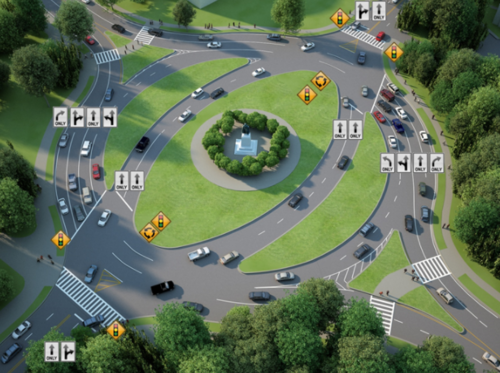
We don't do them that way. In my area, roundabouts are put in where traffic occasionally bursts from one direction, and where traffic levels are low. Because they quit working once traffic increases, because it can be impossible to get on if there's continuous flow from another direction.
Maybe the lights reported are because the roundabout has outlived its usefulness? A stopgap before ripping it out.
I think that the size of the round about matters. The larger it is, the more opportunity a driver has to get to an internal lane and not destroy on-ramping from other directions.
Also the timidness of drivers to enter a circle kills the flow and causes a backup that takes time to clear.
I hit 4 different traffic circles on my 40 mile trip home, two of them are 1 lane wide and only about 100 feet wide, the other two are a lot larger and have 2-3 lanes.
The narrow ones [1] back up much quicker during rush hour(s) especially when you have non-commuters using them (you can tell who they are).
The one that is 3 lanes wide [2] usually has a protected lane for only going to the first exit (on then off), then a middle lane that circles the entire roundabout and a middle lane that allows you to exit at any of the exits whenever you want. It works very well. I have never seen a backup on it.
The one that is only two lanes [3] backs up quite a bit during rush hour, when there is a West Point football game or because someone is too scared to enter. The backup clears relatively quickly, but I feel it wouldn't back up at all if there was protected on-ramp.
Multiple two-lane entrances. An inner lane that goes all the way around but cannot exit. An outer lane that has a single break between the incoming and outgoing sides of the same road.
Oh, and cherry on the sundae, it's in a tourist-heavy area, so many drivers have little-to-no familiarity with it. People block the outer lane waiting to move inside when the outer lane disappears. And then block the inner lane waiting to go through the outer lane to exit.
In countries where they're common place and part of the licensing curriculum, roundabouts are far superior for throughput and traffic flow than any other kind of intersection of comparable size.
To get any further improvement you start having to look at junctions with over head ramps and tunnels.
Horses for courses....roundabouts are great for low to medium traffic conditions. Sometimes the lights are there for times of the day when the traffic is heavy. The lights go out when traffic calms down.
Compare Dupont Circle to Connecticut & K st. Down at K & Conn. they need to use at least 5 traffic officers to direct the flow during peak times.
Meanwhile Dupont circle handles P street, 19th street, Connecticut avenue, Massachusetts avenue, and New Hampshire avenue. Plus there is the pedestrian traffic from the park and the metro stop at Dupont.
Can you imagine doing that with only traffic lights? How many officers would be required to massage that mess?
Unless you propose building a spaghetti mixer, I can't imagine a better system for drivers or pedestrians.
I've...never seen a roundabout with lights. Granted, the state I live in doesn't do them much, but I've visited places (like MA) that do them a lot, and they're all very much like European roundabouts, just with inferior signage.
there are a load there with lights, tram crossing it straight, pedestrian crossing that aren't on a road crossing etc. makes for some fun time crossing one at peak hour, it's not weird at that time to get stuck in one for 10 minutes or more.
You find that model in areas which in peaktime see too much traffic for a roundabout to work well. If traffic along one pair of roads is too heavy anyone on the minor roads can't get in. So the light serves to gate the heaviest traffic. During off-peak hours the light is off.
That's kind of stupid...takes the point away from roundabouts. They're designed to keep the traffic flowing in low /medium conditions when a traffic light or stop sign would bring it to a halt otherwise. Saves on fuel etc.
Properly sited roundabouts don't need lights. Anyone who "detests" them must not live or work near busy intersections governed by stop signs only. The town I'm working in now has two roundabouts and one 4-way stop. Morning and night, the 4-way stop backs up traffic for blocks, while traffic flows through the roundabouts without issue. The city council has set aside a million dollars to change the 4-way into a roundabout this coming spring.
There are lots of stoplights that should also be replaced by roundabouts. A solid line of traffic flows right through a roundabout, and most of it is delayed by a stoplight.
The only problem with roundabouts in USA is the 30% of drivers who don't know how to use them, and stop when they see the yield sign... don't be that driver.
As an American, I detest how other Americans use them. Some folks in the 'ring' slam on their brakes when they see another car approach. Others will randomly pull out in front of folks who are already in the 'ring', causing the first group to always slam on their brakes when they see someone approach. This causes the second group to always pull out into the 'ring' without yielding right of way.
No one uses turn signals on them, and you never know when, where, or if someone is going to turn. It's haphazard maneuvering. 4-way stops are far more predictable and functional.
Yeah, cities with lots of quirky personality are lovely to visit, but if I'm going to live somewhere I'd prefer it was designed to be livable. There's more compelling character in people, places, and institutions than in street layout.
It sounds indeed convenient for large cities where millions of people travel daily from one end of the city to the other. But does it matter for smaller cities (<200,000)? I have lived my whole life in "non-grid" cities in various countries and I couldn't imagine to live in a city with straight roads. Where is the fun? Finding an alley that you can use as a short cut, wandering around and discovering a nice house or garden that you cannot see from the main street, being scared as a kid of that small street where the big dog lives, etc.
Even if you're not traveling from one end to another. It's great to be able to figure out where you're going without a map. I may never have been to 90th St. and 3rd Ave in Manhattan, but I know exactly where it is and how to get there from anywhere else in the grid.
as someone who lives on the other end of the continent, this system was utterly confusing to me because streets are very long in US cities.
Like, alright, ending up at 90th street is relatively easy, except that i ended up at the wrong end of this street, and the walk to the correct house is 2 kilometer...
The parent comment specified "90th and 3rd" which would give you both axes needed to avoid the mistake you describe- The specification of 3rd street helps you avoid being at the wrong end of 90th.
Sure, but if you already know the city just a little bit, you'll know which end 3rd ave is close to. You don't have to memorize the location of a zillion randomly named streets (where is the intersection of Grove Lane and Daffodil St?) You just have to know which direction streets increase in, which avenues increase in, and roughly how far between each. That's the benefit of the grid.
Not at all, many cities evolved from towns, that evolved from villages, that evolved settlements, etc. That slow organic growth is different from the very accelerated "add one more tile" or "do it in one go" growth.
Imagine the difference between having a baby that grows into an adult, and having an adult from the get go.
One interesting city to contrast the differences is Edinburgh, Scotland. The city was established by royal charter in the early 12th century, so it has been around a while, and a lot of the older parts are as you'd expect.
The part which we now call "New Town" was built in stages between 1767 and around 1850 and has an explicit "block-based" design.
> At one point there was nothing where every single city now stands. Everywhere it started with a blank slate.
Before the city there was a town, or a village. It's not blank slate > city, it's blank slate > something > something else > city. There's some evolution in the middle and that makes the difference. One grows organically over time and goes through different stages until it reaches the "city" stage, one is planned as a city from the start.
The key isn't planning, the key is population. A city without people is a ghost city. The city is as much the people as it is the infrastructure. Cities are alive.
It's like arguing that you can build a person by assembling organs in the right place. You can build a humanoid structure which mimics the human, but it's missing the most important feature: life. You can't simply instil life into something. It needs nurturing.