Hacker News new | ask | show | jobs
by nmstoker 2806 days ago
Question for professional pilots here: does this feel like normal behaviour for a pilot?

From my limited experience of pilots, this seems entirely unlike the kind of behaviour you'd expect - they're usually conservative when it comes to safety or is that just the projected image to reassure the public?!

6 comments

Unfortunately don’t have time for a long post at the moment, but as an airline pilot and instructor/check pilot, I can say that extreme incompetence exists in the airline world, especially in Africa, India, SE Asia. There could be some very good reasons that they chose to continue, and often I learn those reasons when the facts are released, discovering that a good decision was made. I’ll be following the investigation, but this one seems somewhat alarming to me. Here’s another of mind-blowing incompetence, also from India - https://www.ajc.com/news/national/airliner-forced-land-after....

Also, more automated, single-pilot/ground operated or pilotless aircraft can’t come soon enough.

More like Air India in specific. Other Indian airlines are pretty good.
--I can say that extreme incompetence exists in the airline world, especially in Africa, India, SE Asia

including Hong Kong?

Cathay has a pretty good reputation, I believe. The HK civil aviation authorities, so-so, but all right. Struggling to get the expensive new ATC center to work.

(Note that HK is considered part of East Asia.)

Self-reply to add:

See here for some news articles on the ATC centre:

https://duckduckgo.com/?q=HK+atc+site%3Ascmp.com

Hong Kong is East Asia.
I stand corrected.
No, plus that's not what he said.
My, what a broad brush you have. With of course no ‘time’ to back it up with facts.
Some facts:

Hull loss rates by region of operator per million departures (Jet / Turboprop) 2012-2016: [0]

- 2.21 / 7.38 Africa

- 1.17 / 20.59 CIS

- 0.74 / 3.42 Middle East / North Africa

- 0.53 / 1.55 Latin America / Caribbean

- 0.48 / 1.45 Asia Pacific

- 0.22 / 0.98 North America

- 0.14 / 0.73 Europe

- 0.00 / 8.73 North Asia

India falls below Myanmar, Nepal, Pakistan in air safety audit[1]

>The audit — ICAO Universal Safety Oversight Audit Programme — seeks to identify if countries have effectively and consistently implemented the critical elements of a safety-oversight system.

>India is one of the 15 countries that are below the minimum target rates.

[0] https://www.iata.org/pressroom/pr/Pages/2018-02-22-01.aspx

[1] https://economictimes.indiatimes.com/industry/transportation...

I appreciate the hull-loss facts, but do they directly support "pilot incompetence"? I've read enough NTSB reports to know it's usually multiple congruent factors (aircraft maintenance, organisational culture, pilot work-load).
“extreme incompetence exists in the airline world” does not equal “pilot incompetence” but would rather include aircraft maintenance, organizational culture, ... So the facts support the statement perfectly well.
This is highly misleading and deceptive. You are mixing up the headline and data from link 2 which is mainly focused on which government agency licenses ATCs as the reason for lower scores, to the IATA hull loss data from link 1 which does not single out any country or region for below 'minimum safety target rates'.

This is the IATA data for hull loss rates for 2017 per million departures:

Asia Pacific - 0.18

CIS - 0.92

Europe - 0.13

Latin America and the Caribbean - 0.41

Middle East and North Africa - ​​0.00

North America - 0.00

The second link does not mention or link to anything about hull loss, safety issues, aircraft, training but talks about lower ranking due to ATC licensing by government agencies.

These are two independent data points.

The first is the bulk loss stats.

The second is an article discussing India's poor audit results in the ICAO safety audit, per the quote above the link and sourced to it.

I'm not sure how you can claim that the second link doesn't "link to anything about hull loss, safety issues, aircraft, training". It is the result of an independent safety audit by the ICAO, which encompasses licensing, operations, airworthiness, and a number of other categories[0].

[0] https://www.icao.int/safety/pages/usoap-results.aspx

For uncommon events like aircraft hull losses, I very much prefer the larger sample size of a few years, even if it does put the data slightly out of date. Though note - the IATA there notes that 2017 indicates a recent (last-few-years) trend of increased safety in sub-Saharan Africa.

GP poster was quite clear that the two pieces of data were from different sources, and the five-year data shows clear trends (though with

There are different failure modes

Asiana missing a landing in SFO on a perfectly clear day is one example https://en.wikipedia.org/wiki/Asiana_Airlines_Flight_214

Cultures where hierarchy prevails over CRM and recent graduates can recall page 243 of the manual but can't do a visual landing in a perfect day are also dangerous.

About aviation in India, two recent incidents:

Jet Airways 9W-697 where crew apparently "forgot" to pressurize the plane. http://avherald.com/h?article=4bded8e6&opt=0

Air India AI-676 had "inexplicable loss of performance". Crew "forgot" to retract the landing gear: http://avherald.com/h?article=4ac18ec7&opt=0

Or I was going to sleep and didn’t want to stay up to write a report on my phone. Use your data but consider my anecdotal comment above. The aviation world is more opaque than one might think, and the governing bodies in certain areas are extremely protective of what is a great source of pride for their countries. I’ve worked with many people from these regions, talked with many people who work with people from these regions, and know many people who have worked in these regions, in addition to the exposure that comes from simply being in this industry. The system is designed to protect you and does its job, even when certain operators aren’t up to par, including the pilots.
The accidents rates by country paints a completely different picture. [1] This wikipedia list of glaring pilot incompetence leading to fatalities doesn't seem to show any bias for specific regions. [2]

When using anecdotal data one just can't make sweeping judgements and conclusions data does not support, that takes discussion into the region of prejudice and bigotry.

This anecdotal one person usually 'an insider' finding one thing wrong or incident in some country and casually conflating it to the whole is seen too often and creates grossly inaccurate stereotypes, when the exact same issue or incident exists everywhere else.

This is not harmless and derails informed discussion. It creates prejudice and in this case stress among travelers when they travel to other countries thinking about 'training, hull loss, safety' based on uninformed discussion not supported by data on the ground. If you are going to travel in a Cessna the standards including pilot training is not comparable to jets whichever country you are in. But no stable functioning country in the world takes passenger and running jets casually as the accident and safety data shows.

1. https://www.independent.co.uk/news/world/america-russia-and-...

2. https://en.wikipedia.org/wiki/Pilot_error#Notable_examples

That first link is pretty inapplicable - the numbers it shows are total fatalities and total accidents since 1945, not scaled for population of the country, not scaled for the quantity of air travel (in a time range where, especially early on where air travel was least safe, there were vast regional differences in wealth and frequency of flying), and over a long enough period that it doesn't really reflect the current reality.

Your second link is exactly the same kind of anecdotal BS you're complaining about - a list compiled by English-speaking editors on a Western-centric website of pilot errors they've personally heard about.

Discussion with actual numbers is here: https://news.ycombinator.com/item?id=18206505

These numbers seem correct, but I don't see how they add up to "extreme [pilot] incompetence" mentioned upthread. The countries that do worse are poorer, and therefore consistently fly older airframes with worse maintenance schedules, and regulations aren't as strict.

For all we know Africa has the best pilots in the world but the crappiest airframes, or fantastic pilots and awesome airframes but their maintenance is atrocious.

I'm not saying I find that especially plausible, but until these numbers are at the very least adjusted for hull loss rates by region of operator per million departures per age of airframe we're comparing apples to oranges.

This is the IATA data for hull loss rates for 2017 per million departures from your link:

Asia Pacific - 0.18

CIS - 0.92

Europe - 0.13

Latin America and the Caribbean - 0.41

Middle East and North Africa - ​​0.00

North America - 0.00

And it ends there. No mention of any problems or concern for 'safety limits' for any region. Infact the IATA data is overall happy with the rates across regions. If you can find anything on that page that points out a problem for a specific region please link to it.

From same link: "2017 was a very good year for aviation safety."

The link includes a comparison with the previous year (2016) - onboard fatalities were ~90% lower and jet hull losses were ~75% lower. You're cherry-picking a very atypical year.

I don’t think your links show that.

That first link tells you little without knowing the denominator for each country. How many flights did they have over that period of time?

And it covers more than 70 years, which is way too long to tell us whether a country or region has a bad safety record today...maybe America had 99% of its crashes in 1945, whereas the other countries on the list had all of theirs last year.

I used to work as a flight instructor and flew corporate. I’ve flown small airplanes with a bunch of airline pilots, whatever that is worth.

This does not seem like normal behavior from an airline pilot at all. I can see about 10% of private pilots doing something like this. It would probably be someone who has been flying a long time and gotten way too comfortable. Things always work out, so why not this time? The difference with an airline is its incredibly public flying. Even if the pilots disregard everyone’s safety (including their own) they know that they’ll be caught. You do something dumb and it’s going to be on the news, even if it all works out. How many of us can say that about or jobs?

The fact that the crew thought that this was a risk worth taking reflects really poorly on the safety culture of that airline. They thought that flying an airplane that was compromised some unknown amount was worth keeping the schedule going (or maybe people just wouldn’t find out?). That idea got informed somehow.

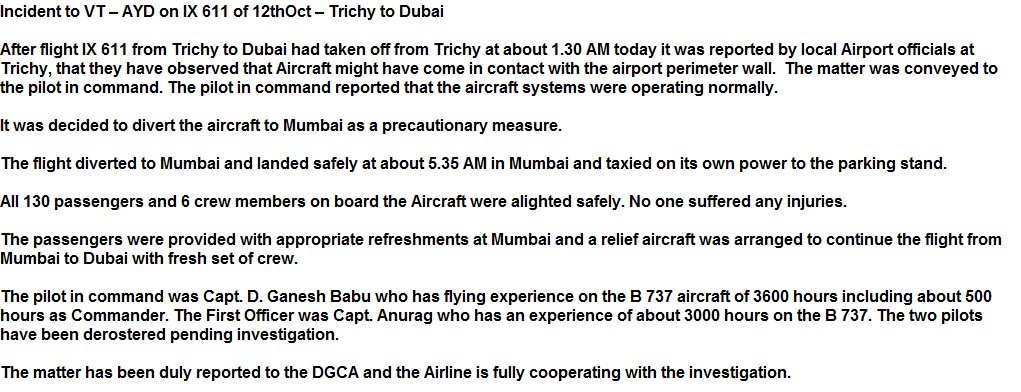
Here's the statement from the Airline. Not sure if 3600 hours is good experience in the industry? May be it is.. https://pbs.twimg.com/media/DpSNZO4V4AAPjKa.jpg:large
3600 hours is a good measure for routine, not for skills. I saw stupid accidents done by pilots with over 20 years and 10,000 hours of flying.
Note: 3600 hours on type, not total flight hours.
No, it isn't normal behavior. And it is not unknown that some airlines are more lax than others.
There is nothing about the ‚why’. Maybe they had an engine problem past V1 and decided to go. The long go around can be explained with them having to focus on stabilizing the situation, maybe involving problems with the landing gear. Even with the severe damage, the inner cabin and pressurization must have been intact. Assuming human failure should come last, when we have no details about the cause.
> The long go around can be explained

... by their desire to overwrite the CVR??

Well, I hope the pilots were not so dumb. I mean, there is still the FDR and recorded radio comms. If they took that time to overwrite the CVR, then they will probably lose their job anyway due to the suspicion of hiding, even when they would be acquitted of wrongdoing in a legal proceeding.
Not a pilot but familiar with the aviation world and procedures.

Obviously the plane had issues getting off the ground. Probably because it was too heavy. Typically, pilots calculate a speed beyond which they can no longer safely abort the takeoff. Beyond that speed, the plane is basically going to fly or shoot off the runway and crash. That point is decided based on weight, wind, runway length, etc. It's entirely possible mistakes were made with that or with loading the plane. Maybe there was some wind shear as well, which could explain a sudden drop or unexpected challenges getting off the ground.

Usually the co-pilot's job is to call these speeds out and if either of them calls to abort, there is supposed to be no discussion or debate on this and pilots are trained to act right away because every second counts. Obviously that did not happen

So, the pilots were not aware of issues before the abort speed (or they should have aborted) and committed to getting off the ground. I'm sure the in cockpit recordings will be part of the investigation. They sort of succeeded in the sense that they hit some objects but ultimately did not crash and got off the ground. Their climb rate must have been terrible. Usually the gear comes up as soon as you have a positive rate of climb (reduces drag). I imagine they called gear up seconds after leaving the ground before they hit anything even and the gear was likely transitioning.

Wind shear could have caused enough change in airspeed to cause the plane to not climb or even descend a bit. A heavy plane would have used up most of the runway in any case.

They then proceeded with what looks like normal procedure to get to altitude. Presumably they would have almost climbed out and changed frequencies from tower to local traffic controllers after 20-30 seconds or so. Recordings of that are going to be interesting. Presumably the damage to the ILS equipment would not have been noticed right away on the ground and people would have needed some time to figure out what the hell happened and what caused it and what plane hit it. Likewise the damage to the wall would not have been reported right away. By then the plane would have transitioned out of their area.

The question is whether the pilots noticed that they hit any objects and what the communication was with these controllers on this. The plane would have been pitched up (restricts visibility to the ground in front of you) and the damage occurred pretty far behind the pilots. So they may not have seen the obstacles immediately in front of them or heard/felt hitting them. These planes are big and heavy and there's lots of noise and vibrations when a plane takes off.

The damage looks dramatic but you wouldn't be able to see it until after the landing. Obviously the plane was flying and climbing and cruising normally. And they also landed safely. So flight operations seem to not have been directly affected. So, I can see them concluding that they had a stressful takeoff but had gotten in the air successfully. Then some time later they got the news that they hit some obstacles and that there is probably damage to the plane.

The big question is why that took 3 hours. I imagine it involved a lot of communication on the ground.

No. Go-around and assess the damage on the deck.
A go-around wouldn't give much chance to assess the damage beyond superficial. Would be much better to fully land and stop.
Not before consuming fuel. If overload was a factor, immediate landing is not a good idea.