Hacker News new | ask | show | jobs
by aw3c2 2825 days ago
Warning, this series of fantastically written articles on generative art might make you feel very small and sad compared to those who are capable of not only creating but communicating beauty like this.

In other words, I highly recommend you try some generative art yourself and see that at its core, it is not that hard and YOU can do it too!

5 comments

They feel like a more relatable human if you follow them on Twitter where you can see some of the ideas they're testing out:

@inconvergent: https://twitter.com/inconvergent?s=09

It's easy to forget that art and creativity is an iterative / scientific process when you just see the finished products.

I was thinking that it couldn’t feel so bad, but once I clicked on the link I was definitely in awe and then felt bad...
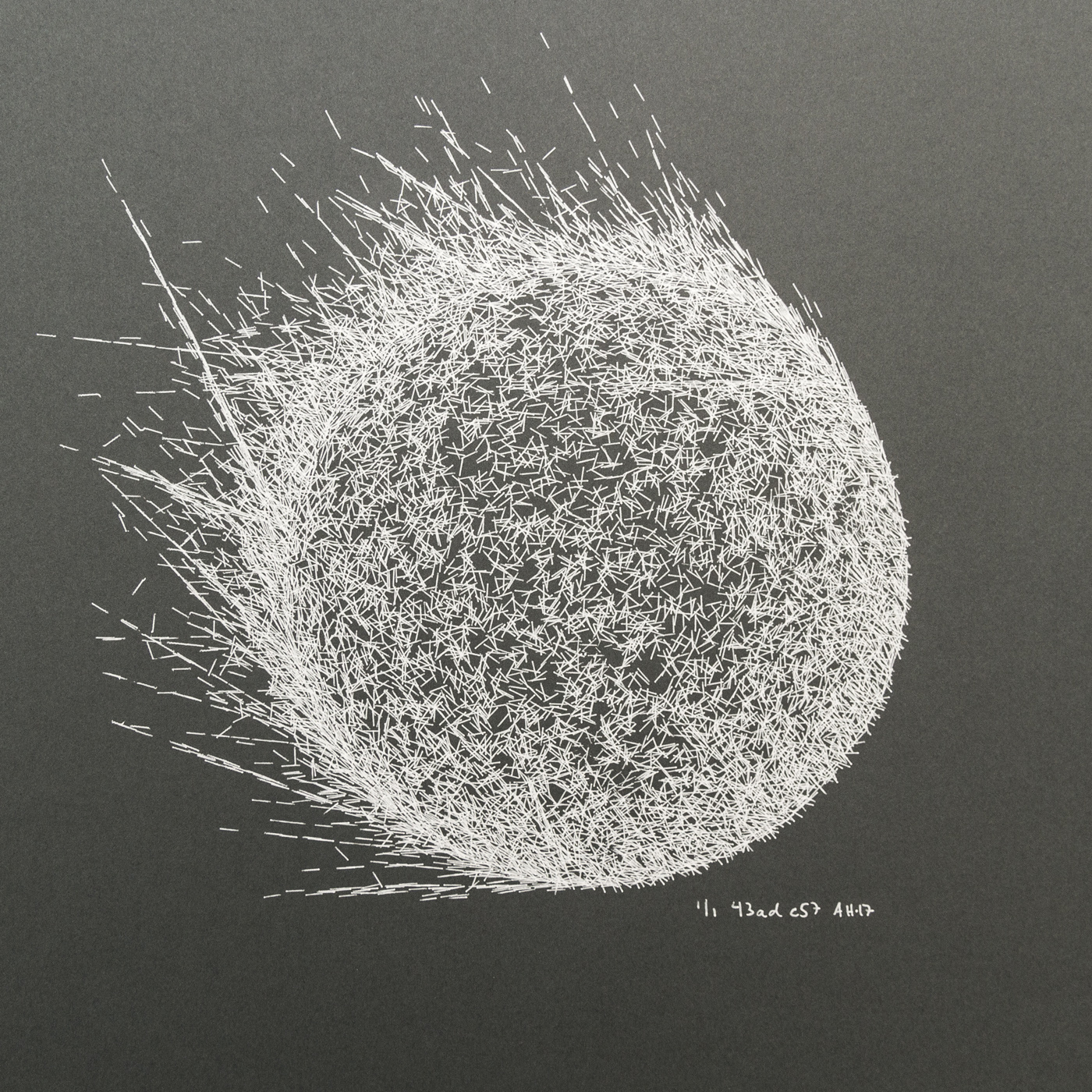
Any idea on what they used to generate patterns like this?

https://img.inconvergent.net/img/plot/43adc57.jpg

There seems to be two pieces to generating that particular image. The first appears to be just a sphere with lines drawn at random points on its surface. The second piece are the "motion" lines that tend to point away from the sphere's direction of motion.

The first piece seems simple enough. Pick and random point on a sphere, and draw a few lines at random orientations a very small distance from that spot with no correction for persepective.

The second piece, the motion lines, seem to be a bit more complex. But they appear to be done by choosing a random spot on a circle's circumference, choosing an angle at random which is heavily biased towards the tangent line at that point on the circumference. Choosing a magnitude (length) for that motion line. And drawing some dashed lines along that path. Then repeating some new lines along that same path but shifted a random amount perpendicular to the motion line.

[I doubt I explained that second part very well, so don't try to re-read it if you didn't get it.]

If you're asking software-wise, I believe Anders Hoff has his own big suite of Lisp code that he uses for his generative stuff.

Physically, I think he printed that one using an AxiDraw plotter.

From the looks of the repos, they're primarily using Python + Numpy + the Cairo graphics library.
Do you have any recommendations of where to start?
Processing is very popular and easy to pick up for generative art. This youtube channel has some great tutorials and walkthroughs on creating various things with it: https://www.youtube.com/channel/UCvjgXvBlbQiydffZU7m1_aw

Beyond the basics, it's also quite useful to pick out a piece of art or an effect you like and attempt to recreate it. You'll learn a lot of tricks very quickly that way.

Some amazing stuff here - https://www.contextfreeart.org/

There is also p5.js - https://p5js.org/

Kadenze has some courses that might be of interest - https://www.kadenze.com/, for example this one : https://www.kadenze.com/courses/generative-art-and-computati...

Pick any geometry library in your favorite language and start doing random things.

Create random points, connect them in random ways, create random polygons.

Then start adding constraints like minimum distances, lengths or topological ones like overlap or touch.

Processing, p5.js, Max/MSP (if you want to do audio/video), CFDG (context-free design grammars). CFDG (contextfreeart.org) has a lot of bang for the buck in terms of effort in to quality of output out.
Hmm, no need to feel like that. There are so many wonderful things in the world. Creativity is additive — even if you only do something small, it still matters.
> Creativity is additive — even if you only do something small, it still matters.

This is a wonderful quote, which I'll probably steal. (Is it original to you?) Thank you!

Creativity is additive as far as money's not involved.