Hacker News new | ask | show | jobs
by akerro 2876 days ago
I'm sure air conditioners in US banks or public offices consume more energy than Bitcoin mining worldwide. They never turn off computers at night, insurance companies require to leave lights on at night, each office has a few TVs with chomecast showing pictures of nature (irony ha!) all day and night long... but it's BTC mining they're fighting with.
4 comments

Yea, I did a similar analysis on the energy wasted due to the new reddit layout (I got 3 TWh per year, or ~10% of bitcoin electricity usage): https://news.ycombinator.com/item?id=17619025

I'd love to see someone go more in depth with these types of "how much energy is wasted on x" estimates. Including just addressable grid and power plant inefficiencies. I suspect bitcoin is simply not a big deal (at this point), so this entire issue is concern trolling.

And then you come to the problem of what it means for the electricity to be "wasted". Eg, is going to church "wasting electricity"? What about the entire alcohol industry? Playing videogames? Preparing and storing deserts?

There's many criticisms to make about cryptocurrencies, but people in glass houses shouldn't throw stones. (I live in a country which uses more energy per capita then virtually every country on Earth)

https://phys.org/news/2015-12-christmas-energy-entire-countr...

> I suspect bitcoin is simply not a big deal (at this point), so this entire issue is concern trolling.

Or people actually care. The fact there are existing, worse ways to use energy doesn't mean we shouldn't care about Bitcoin. For the same reason I'm composting, even though the nearby supermarket throws out way more packaged food than I'd ever buy.

>"The fact there are existing, worse ways to use energy doesn't mean we shouldn't care about Bitcoin."

Its more like you are trying to catch rainwater in a strainer full of holes but are worried about a tiny pinhole in the side. So sure people may actually care about it, it just makes no sense and living your life that way is not a recipe for success.

For 2013 we have the estimate for total energy supply of 157,500 TWh/yr https://en.wikipedia.org/wiki/World_energy_consumption

Lets say bitcoin used 1000 TWh/yr worldwide (~15-30x what is estimated to use now). That'd work out to:

  100*1000/157,500 ~ 0.63 %
Currently its more like 0.02-0.04%. As someone else posted, just christmas lights in the US alone is ~6 TWh/yr (~.004%).

EDIT: That energy supply number is actually TPES, which ignores efficiency:

"Closely related to energy consumption is the concept of total primary energy supply (TPES), which - on a global level - is the sum of energy production minus storage changes. Since changes of energy storage over the year are minor, TPES values can be used as an estimator for energy consumption. However, TPES ignores conversion efficiency, overstating forms of energy with poor conversion efficiency (e.g. coal, gas and nuclear) and understating forms already accounted for in converted forms (e.g. photovoltaic or hydroelectricity)."

I suspect that if mining encourages even tiny innovations in power plant and grid efficiency it will have a net negative effect on energy waste. Apparently its that about 65% is lost due to powerplant, and 10% due to transmission/distribution, for ~75% total:

http://insideenergy.org/2015/11/06/lost-in-transmission-how-...

Even with 0.04%, we have around 25 power plants [0] operating just for Bitcoin. You say it's tiny just like Christmas light, I say it we could get rid of PoW and improve/chill on Christmas lights we could reduce demand on 30 or so power plants and maybe not build new ones immediately. (Yes, average are bad, we're in a back of the napkin territory)

[0] https://www.washingtonpost.com/news/wonk/wp/2012/12/08/all-o...

"if mining encourages even tiny innovations in power plant and grid efficiency "

But it won't. All the incentives to increase power plant and grid efficiency are already there. Moreover, as you state quite clearly, bitcoin energy use is a small proportion of energy usage.

Mining is somewhat unique in that it doesnt really matter where it is done and it is very easy to tie profitability to electricity cost (since that is the main cost).

So I disagree, at least if it gets big enough to matter. I'd expect power plants, towns, etc to find it more worthwhile to invest in more efficient tech to attract the miners.

Why would they want to attract? The article summarises it well: ignores local workforce, requires resources, can relocate quickly - it doesn't sound useful for the towns.
"Lets say bitcoin used 1000 TWh/yr worldwide (~15-30x what is estimated to use now). That'd work out to:

  100*1000/157,500 ~ 0.63 %
Currently its more like 0.02-0.04%. As someone else posted, just christmas lights in the US alone is ~6 TWh/yr (~.004%)."

So, THREE ORDERS OF MAGNITUDE are no big deal? Okay.

Sorry, not sure what you are referring to here. Ie, What three orders of magnitude?
your link's off, it links to the parent rather than your comment: https://news.ycombinator.com/item?id=17619264
>Including just addressable grid and power plant inefficiencies. I suspect bitcoin is simply not a big deal (at this point), so this entire issue is concern trolling.

This isn't a zero-sum game. We can address multiple inefficiencies. Bitcoin is just one of the more flagrant sources of tech-based waste that doesn't actually benefit anyone.

>And then you come to the problem of what it means for the electricity to be "wasted".

Nobody's going to ever fully agree but I think we can reach a quorum agreeing that fake money made up by libertarians who think a couple hundred years of bank regulations are totally gay bullshit put in place purely to stifle people and not to address totally legitimate concerns of abusive behaviour is enough of a waste to curtail it.

> Eg, is going to church "wasting electricity"? What about the entire alcohol industry? Playing videogames? Preparing and storing deserts?

Alcohol and food are tangible physical products that have had demand for thousands of years, video games are entertainment, and church builds community. Some people will have problems with all of these, but they are almost certainly going to be the minority.

Thanks, I appreciate this more honest position. You dont like energy being used on bitcoin because you dont like bitcoin. If enough people think that way then it should be considered "waste". Simple enough, but what is enough people, 50%?
Air conditioners actually create value though, in the form of making people comfortable. Most people do not see Bitcoin mining as something that creates real value in the world, so it's a bit more understandable that people might be upset about a huge amount of electricity being consumed by something they see as pointless.
It's not just making people comfortable, it's making sure they don't collapse from heat exhaustion.
>Air conditioners actually create value though,

Cryptocurrency mining creates literally value.

What value does the new reddit layout offer? How many people actually like it?
The Reddit analysis is pretty suspect - you can't assume that power usage scales anywhere close to linearly with data usage. If you look at all the devices connected to the Internet, I would bet that a huge majority of the power consumption stems from time that desktop computers/servers/switches/etc are either idle or underutilized.
>"you can't assume that power usage scales anywhere close to linearly with data usage."

As noted in the original post, its based on 5 kWh per GB of data transferred as described here: https://aceee.org/files/proceedings/2012/data/papers/0193-00...

If you have a better method, I'd love to see it. This is back of the napkin stuff, it doesnt need to be perfect.

And using he same methods, HN is ~70 KB which is decent for a text-content site. The OP wired page is about 700 KB (but wired.com is 4.3 MB), slashdot is ~1.9 MB, and reddit now like 4.3 MB, etc. Pretty much the entire internet is over 90% unnecessary junk at this point even if you allow that the content has value.

This is back of the napkin stuff, it doesnt need to be perfect.

It doesn't need to be perfect, but if the result is off by an order of magnitude or more than it's pretty useless.

If you have a better method, I'd love to see it.

I'm not saying I have a better way of answering the same question, but that doesn't make your analysis more valid.

As noted in the original post, its based on 5 kWh per GB of data transferred

Yes, I believe that if you take the entire amount of data transferred by the Internet, then divide it by the total amount of power used by all internet-connected devices, then you get 5 kWh per GB (or at least you do if you base it off of the data available in 2012 when that paper was written). But that doesn't mean that if I download an extra GB of data that it took anywhere near 5 kWh to do that.

That paper you linked includes things like "total power consumed by all connected desktop computers" as part of the power budget, but this is obviously flawed reasoning. There are many things that computers do besides transferring data, and even if a computer is sitting idle it consumes a good deal of power as long as it's switched on. If I spend 1 kWh of electricity playing an offline computer game for an hour, then download a 1kB file, that doesn't mean that it costs me 1kWh/kB to download data.

We can check from another perspective. Apparently the whole internet is around 70 TWh/year from datacenters alone in 2016 (link to actual study is broke): https://www.forbes.com/sites/christopherhelman/2016/06/28/ho...

Reddit is apparently the 3rd most popular website: https://old.reddit.com/r/technology/comments/8n959q/reddit_j...

No idea where this info comes from but it gives 1.8 TWh/yr for (the now fourth most popular site) facebook in 2016: https://www.statista.com/statistics/580087/energy-use-of-fac...

Does it make sense for total reddit usage to be ~3.5 TWh/year in 2018? It seems to be in the right ballpark, but who knows how circular these calculations are.

This is whataboutism that contributes nothing to the current conversation.
Not really. I dont see why anyone would complain about bitcoin wasting energy but not crappy web design when the latter wastes more (reddit is just one example of this).

Afaict, you should complain about both or prioritize the larger waste if your true goal is to reduce the amount of wasted energy.

"Not really."

Yes, really. You're trying to deflect to another subject using extremely shoddy calculations (and don't use the "It's a back of the envelope calculation" excuse) because you have no defense for the topic at hand.

"Afaict, you should complain about both or prioritize the larger waste if your true goal is to reduce the amount of wasted energy."

AFAICT, you should stop deflecting and concentrate at the subject at hand before trying to veer off.

>"Yes, really. You're trying to deflect to another subject using extremely shoddy calculations (and don't use the "It's a back of the envelope calculation" excuse) because you have no defense for the topic at hand."

My defense is that bitcoin energy usage is really not that high even if it was all a waste (as some seem to think). I offered some rough estimates and at least showed some evidence of effort.

You apparently think the energy usage is very high, based on nothing (at least that you have shared).

>"AFAICT, you should stop deflecting and concentrate at the subject at hand before trying to veer off."

How far did you get through school and where did you go? If you had success, how did you decide which class to study for first, etc, without understanding the reasons to prioritize?

EDIT:

I use school only as a general example most people on this site are probably familiar with. Pretty much any project requires prioritization...

And the energy btc "wastes" is to secure the vaults and the money flow. Other fiat currencies "waste" energy on security with bright security lights, guns, bombs.

However, I do like how things like PrimeCoin have a residual product from their security.

If the incentive to do so was there, banks could become more energy efficient. Bitcoin, however, cannot do this, by definition. PoW systems require server farms to bang out hashes as fast as possible, and the complexity of that calculation increases as the mining pool increases. So there's more power being used than several entire small countries to perform something like 100 transactions a second. Say what you will about the traditional banking system, but it's not set up to burn massive amounts of power by design, and it actually manages a throughput of tens of thousands of transactions a second for actual business purposes rather than just making play money for money-flush nerds and criminals.
>"banks could become more energy efficient. Bitcoin, however, cannot do this, by definition...there's more power being used than several entire small countries to perform something like 100 transactions a second."

I don't see how bitcoin cannot become more efficient "by definition". In fact it is a very straightforward process. All you have to do is add more zeros onto here and get people to use it.

  /** The maximum allowed weight for a block, see BIP 141 (network rule) */
  static const unsigned int MAX_BLOCK_WEIGHT = 4000000;
https://github.com/bitcoin/bitcoin/blob/master/src/consensus...

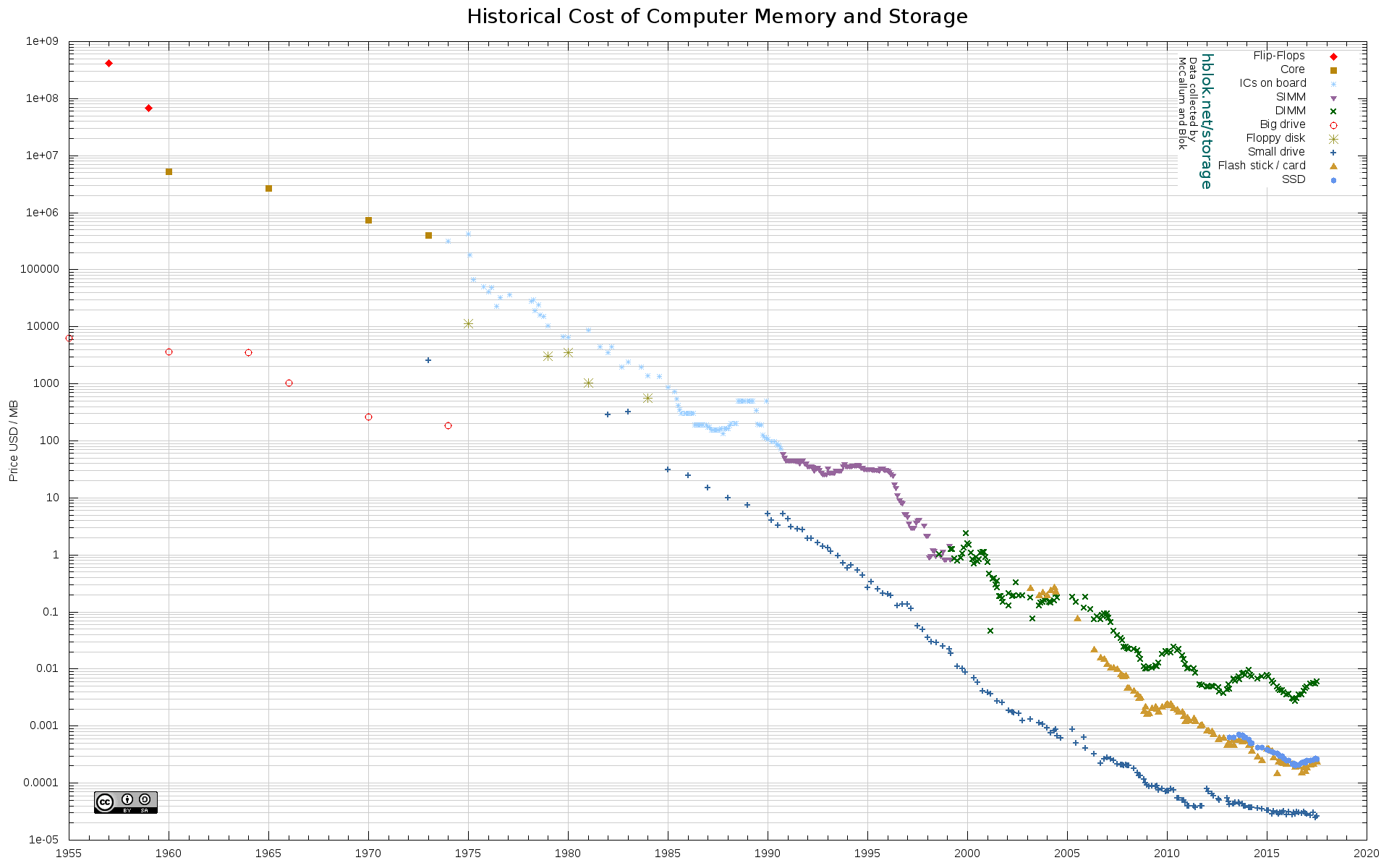
The actual limitation is storage, bandwidth, and memory costs. If those become cheaper then there is no reason not to increase that value.

Sure, theoretically, except in practice when they actually try to do that, the community flips its shit and we end up with hard forks into shit like Bitcoin Cash and the shit show keeps rolling.
As mentioned, the problem is that increasing that value enough to matter could increase the storage/etc costs of monitoring the blockchain to an extent that would be prohibitive for many people.

If those costs come down then the "efficiency" can be increased without any impact. It looks like in the last decade they dropped about 10-100x:

https://hblok.net/storage_data/storage_memory_prices-2017-12...

http://drpeering.net/FAQ/What-are-the-historical-transit-pri...

Even if you increase the block size, PoS is still 99% more efficient.
Your logic seems okay-ish... but do you have all these numbers/stats?