Hacker News new | ask | show | jobs
by aventrix 2908 days ago
How does the popularity of bikes compare to electric scooters? Anecdotally, I see a lot more Bird and Lime S scooters flying around than I do bicycles these days - and we do have docked bicycle and Lime bikes and Ofo options available in my city.

Having tried many of these services, I find the electric scooters to be the most enjoyable, although the electric bikes are quite fun too and can be a better experience if you're carrying something which can be put in the basket.

10 comments

Bird just opened in SLC and they are suddenly everywhere. Park City, just a few miles away, launched the country's first ebike share system and it's wildly popular. They are also everywhere.

I have no hard data to prove this, though I'm sure it's out there- I don't think it's bike vs scooter, it's electric vs human powered that's driving bird's popularity over bike shares.

I think you're exactly right. I'm a pretty hardcore cyclist and I commute 20 miles total every day but the number of people willing to exert massive effort for their commute is super small. My company is working on self-delivering shared ebikes and we recently made the decision to include a throttle because most folks won't ever be capital-B Bikers.

The scooters have been a good lesson for us as they've highlighted the importance of fun and friendliness in a shared vehicle. I don't think any of the shared ebikes are coming close to the right combination of factors that make people want to ride them. Scooters have nailed it, but their big problem is how easy it is to copy the model.

Thats interesting. Are you in the US? How are you thinking about the legislative landscape that seems to be eager to classify anything non-pedal assist as an e-motorcycle?
Yeah, Seattle. Legislators and city govs have been super friendly and eager to help us, and we're still keeping really good pedal assist. The worst case scenario is in some areas we can disable throttles and make our pedal assist boost factor absurdly high. Making the case to govs for throttles on our bikes is easier than with a company who wants to sell ebikes to the public because we're not trying to get bicyclists to purchase our bikes. We're trying to get people to skip car trips and make connecting to public transit actually doable for them. So far this resonates with city planners.
For me, it breaks down to:

0-2miles - Scooters (or walk),

2-5miles - Electric Bikes (or Uber),

5-15miles - Uber/Lyft

It is a nice little transportation stack Uber and Lyft are fighting over.

No room for buses, trains, or regular bicycles? The nice thing about a regular bicycle is the unlimited range. Whereas the nice thing about an electric bike is the speed. My personal hierarchy is more like this:

0-1 miles: walk 1-10 miles: e-bike or bus or lyft 10-100 miles: regular bike or train > 100 miles: car

No buses for me. I've given it a try many times but in SF, unless you're on a popular commuting line, it's filled with crazy, aggressive homeless people.

I've given up traveling via bike after losing my wheels to theft. My friend got his u-lock + loop locked bike's seat stolen while grabbing food to go at the Westfield food court around lunchtime.

> 10-100 miles: regular bike or train

SF to San Jose is 55 miles. To think you'd consider biking twice that is... crazy to me. More power to you I suppose.

I used to work with someone who cycled about 40km (25 miles) to work.

I admired his general health and determination. His alternative was a reasonably fast train; including walking at each end it was at most ⅓ of the time.

I think the most I ever cycled is about 80km/day, for a five-day cycling "holiday" in the low countries. It was a great trip, but I was completely exhausted at the end of each day.

The people I know who bike to work probably operate on different calculus than just viewing it as a commute choice. On days where I drive in or WFH, I still end up on my bike for X hours/day - so bike commuting is basically doubling up commuting and exercise for me, meaning
When I was living in the valley I took the bus from Menlo Park to Cupertino. It took me 2 hours! By cars that's 25 minutes.
Am normal person, can confirm. Normal people don't use public transit because normal people don't use public transit, therefore normal people shouldn't use public transit.
They are great too, but if you live in a high bike crime area, you don't want to deal with super locking your bike at your destination. Dealing with stolen tires , seats and handlebars is aggravating as hell after the 3rd time.

Also bring your bike on the train, and then going the last 2 miles to your actual destination is pretty annoying too. It's much nicer to just grab a bike at the station and then leave it at work.

That's my situation -- bike to the train on my own bike, leave it in a locker so I don't have to deal carrying it around, then grab a shared bike at the end of my trip and leave it near the office. If I had bikeshare near my home, I'd skip using my own bike for commuting entirely. Not having to worry about whether or not my bike will have all of its pieces is wonderful.
I love taking trains. BART is my jam.

Buses being at the whim of traffic while costing only 15-20% less than Uber Express for 5-10miles while offering none of the live-information means its a no-go for me.

I've spent far too long waiting in various weather conditions, hoping the bus arrives on time. So even up to a 30-40% premium to just hop into a car makes sense to me.

> Buses being at the whim of traffic while costing only 15-20% less than Uber Express for 5-10miles while offering none of the live-information means its a no-go for me.

In Seattle, buses have had GPS trackers for years. A lot of stops use that data for "time of arrival" displays. There is also a publicly available feed of that data, lots of apps out there that remind people when to leave their office to go out and catch their bus.

More bus only lanes would be nice!

Most of the busses are GPS tracked, but some less frequent lines still have no GPS, while others mix fixed data with busses that have GPS data. Its a patchwork, better than many other cities bus tracking systems, but still we have a ways to go.

At this point, I think signal prioritization and finishing the planned bus/streetcar jumps should yield significant reliability improvements in Seattle. If the #8 could just be timely, it would be a boon for anyone going from Queen Anne to downtown, Cap Hill, South Seattle or vice versa. Its sad that the I-5 commuters essentially wreck its schedule by parking in the road on Denny.

Imagine if you could combine the two - take a scooter to your Uber/Lyft drive for a discount/bounty so it can get recharged?
Why do you find that electric bikes work better for longer trips?
deleted
Close. Less likely I'm gonna hit one of

a) Potholes

b) Uphill (where the electric bikes fare much better)

The scooters are just much less of a hassle (no need to lock etc.) for quick rides and more fun

I think Scooters are ideal for the ~1 mile range.
Here in NYC I haven't really seen any scooters ever, whereas Citibike is everywhere.
I also haven't seen any here yet. I ride Citibike daily (Brooklyn and Manhattan) and would be wary of using the scooters because the roads are so badly maintained. It's already pretty bad even on a bike.
They haven't launched here. We barely even have dockless bikeshares (and even then they're not allowed in the exclusive Citibike coverage area). We're a rough regulatory environment.
It sucks to be in the largest city and yet could not try the scooters or electric bikes. I think it makes more sense for NYC to have them and would be a great way to avoid subway for like 2 miles.
NYC is also the most densely packed city in the US. There are places in the city where the sidewalks get so dense during commute/tourist hours that people cannot fit, pushing pedestrians out into the streets and bike lanes. 8th Ave north of Penn Station at 5:30pm is a prime example of this.

There's simply no room to have lots of discarded dockless bikes/scooters in such an environment where there isn't even enough room to walk, and they would be treated poorly. Docks/exclusion zones for the most congested foot traffic areas are necessary.

My assumption is that New Yorkers are too cool for scooters to take off. Maybe in Brooklyn, ironically.
Motivate provides detailed data on usage. You can download it at [1]. Do Lime, Bird, etc provide it?

https://s3.amazonaws.com/fordgobike-data/index.html

Worth noting that those Bird and Lime scooters are illegal in some countries, like the UK. Bird cannot expand to the UK without laws changing (which I'm sure there's plenty of lobbying going on to ensure).
Can you elaborate on the legality? In what way are they illegal?
They're illegal in the same way that if you sticking four wheels on a fridge and driving it down the street is also illegal. They're not road worthy, and you can't use them on footpaths in the same way you can't cycle on footpaths.
FWIW I was just in london and saw a bunch of people riding their own Mi scooters in the street. (That's the same scooter Bird uses.)
I'm seeing more and more on my commute, but it's the difference between a few people buying their own from Alibaba and a company installing them across the city. The former's unlikely to draw attention from the police, the latter much more so.
Sure, and people smoke week or break the speed limit despite the legality.
Err, why is it illegal? They're more than fast enough to keep up with bike traffic in the city, especially if there are dedicated lanes.
This is fairly easy to investigate online, but here's an article I found for example: https://www.techadvisor.co.uk/buying-advice/gadget/is-it-leg...
Motor vehicles require a license plate and insurance to be legal
A few months after bird first launched in Santa Monica I decided to start scraping the app to see how many rides they were doing and estimate their revenue.

I was surprised at how much, so started to do the same thing with the local bike share which had been around for a couple years and covered exactly the same area (with more bikes than bird had scooters at the time).

Bird was already doing 7x the daily rides that the bike share was!

I have never seen an electric scooter in Philly. I bike or take public transit usually, and there are bikeshare docks all over.
The stat I heard was that a bike is likely to be used 1-2 times per day by a user, whereas the same user will use a scooter 3-4 times per day.

So in this scenario you might see someone ride the bike from their apartment downtown, but during the day use a scoot to get between meetings, to a lunch venue, to the bar after work again and then maybe ride a bicycle home at the end of the day if not catch a car.

The bikes are super heavy; they require docking, which somewhat removes the purposes of using them to get from point to point in the first place. I don't know many people who aren't already cyclists who use it.

Off hand I'd say scooters are much more filling a vacant market, whereas the bike sharing competes more with uber or lyft in the first place.

Here is what you mean when you say a scooter:

https://www.limebike.com/hubfs/Assets/bike-s-2.jpg?t=1530481...

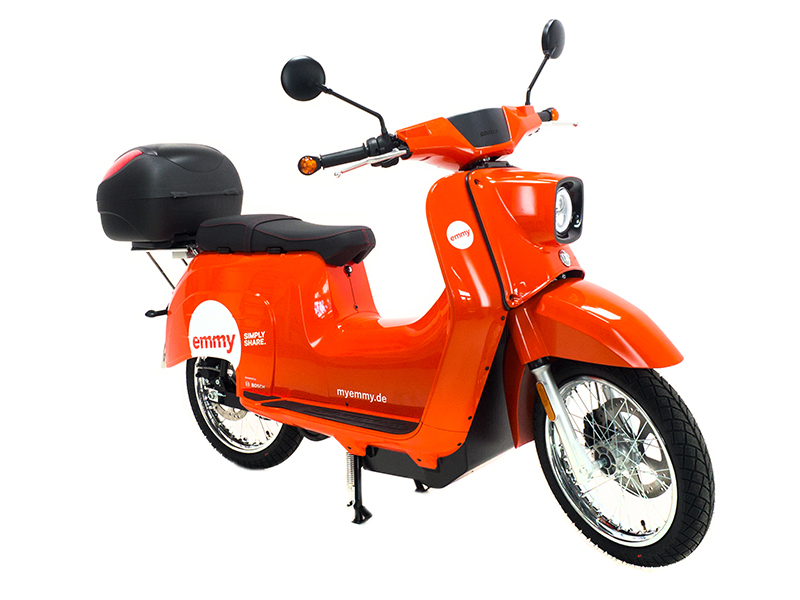
Here is what much of the world thinks is a scooter:

https://emmy-sharing.de/wp-content/uploads/Schwalbe_45-links...

Just to clear that up. If it was between those two I'd take the latter given that hitting a pothole on that Lime thing is liable to stop all forward momentum suddenly and precariously. But really I'd want the electric bike.

Though I think the unstated single most important selling point for the Lime scooter over the electric bike is that you don't need to deal with the homicidal, low awareness, little education American driver and the abhorrent infrastructure (and policies) that enable them.

Nationalistic swipes are intellectually boring and perturbative—a bad combination. Please resist the temptation and stick with just the substantive content instead.

https://news.ycombinator.com/newsguidelines.html

> Though I think the unstated single most important selling point for the Lime scooter over the electric bike is that you don't need to deal with the homicidal, low awareness, little education American driver and the abhorrent infrastructure (and policies) that enable them.

Except you do some places. In San Francisco it is illegal to ride an e-scooter on the sidewalk. You are supposed to ride in the bicycle lanes.

In San Diego, it is legal to ride on the sidewalk, but pedestrians have the right away. I believe this stems from the city's desire to be bike friendly with their inability/unwillingness to fund proper and adequate bike lanes.
Not sure if you've seen Scoot, but they have all the versions of a "scooter"! :) https://scoot.co/
> Though I think the unstated single most important selling point for the Lime scooter over the electric bike is that you don't need to deal with the homicidal, low awareness, little education American driver and the abhorrent infrastructure (and policies) that enable them.

How so? Both Lime scooters and electric bikes are supposed to be ridden in bike lanes on the road, although enforcement can be hit-or-miss.

When necessary, they're called "kick scooters" and "motor scooters".

There are electric versions of both.

Probably half the younger children round here have a normal kick scooter. They can "walk" with their parents much further without getting tired.

> hitting a pothole on that Lime thing is liable to stop all forward momentum suddenly and precariously

Didn't think of this. Makes sense why they're doing well on the West Coast but not yet rolling out on New York's ice-torn streets.

Oakland, California has some of the worst streets in America, and getting worse. There are Limes and Birds on every corner of downtown.
I live near Downtown Oakland and have yet to see one of these Scooters on the road -- so far the primary use case in Oakland seems to be teenagers blasting around Lake Merritt on the weekends.
There were 6 on each corner of Broadway & Grand at 7am today.
According to the Lime app, there are at least 50 Lime-S scooters within 1km of the corner of Broadway and Telegraph right now. There are 9 outside 12th St BART alone.
I don't think that's the reason. Huge swaths of midtown, particularly, have near perfect pavement.
The latter bit seems unnecessary.
Ok, I know we like to dump on Americans with impunity, and I'm not even going to get into whether it's deserved or not, but have you driven in much of the rest of the world?