Hacker News new | ask | show | jobs
by Mbioguy 2941 days ago
There's an interesting cognitive bias where people who are intelligent and informed about one domain, try to interpret information outside that domain. This stereotypically affects doctors or engineers making pronouncements of things as laypersons, and underestimating their own ignorance, commit errors without realizing it. Hacker News is an excellent place to get insight on technology. However, the lack of formal training often means that when other domains are discussed, we get armchair biologists or historians. That is happening here. (The loss of Y-diversity is much, much earlier in date than the Late Bronze Age collapse: starts at roughly 10k years ago, with a little variation depending on what part of the globe you are looking at.)

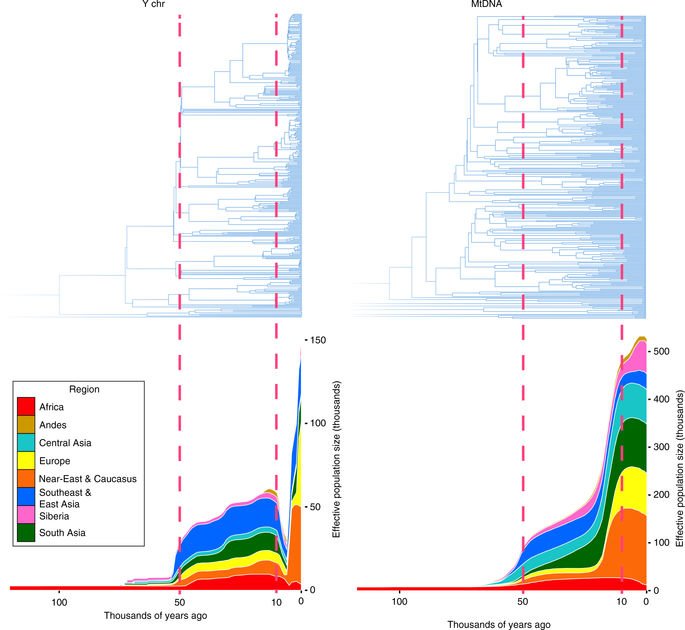
Here's the original article that caused such a stir in 2015. Figure 2 shows the sudden drop in the reproducing Y-population globally (meaning it cannot be explained by genes or migration).

https://www.ncbi.nlm.nih.gov/pmc/articles/PMC4381518/

The paper cited in the article alters the date of the event, but really there's a lot of uncertainty remaining.

https://www.nature.com/articles/s41467-018-04375-6

The best current hypothesis to explain this drop (and that no similar one occurred for the reproducing X-population) is the conflict between predominantly agricultural societies versus predominantly hunter-gatherer societies. Until sufficient evidence has been found to rule out this or alternatives, take any explanation with a grain of salt.

Look at Figure 2, and you'll notice the Y-axis are different. Between 50-10kya, the effective reproductive population was 3-4 times larger for women than men, globally. This fits with modern anthropological evidence of polygyny in early hunter-gatherer cultures (loose polygyny with on average 3-4 wives per successful male over a lifetime, but with limited ability to enforce fidelity). Y chromosome diversity tends to accumulate, albeit at a lower rate than the X.

An agricultural community is likely to be much more homogenous in terms of Y-chromosomes, than a hunter-gatherer one. Power is much more effectively concentrated in these communities, allowing leaders to amass more wives and enforce fidelity much more strictly than in hunter-gatherer societies. Stories of King Solomon's wives, or Sultan Moulay Ismail of Morocco (who reportedly sired hundreds of children) are an easy way to visualize this.

While man-for-man, a hunter-gatherer may be healthier and stronger, a hunter-gatherer society may find themselves vastly outnumbered by an agricultural community. Over time, hunter-gatherers would find themselves pushed off of prime land onto marginal land. The newer article mentions a founder effect. Where are these Neolithic pioneers coming from and where are they going to? From agricultural communities, expanding into territory previously held by hunter-gatherers. While certainly many deaths occurred due to combat, Y-chromosomal diversity loss also would have occurred to disease and famine. The agricultural population would continue to rise, while the hunter-gatherers would struggle to maintain on more marginal land. History is replete with stories of taking women, so if this scenario is the best explanation, it is unsurprising that there was not a corresponding drop in X-diversity.

This sort of scenario occurred globally. Agriculture independently arose in many places: the near-east, sub-saharan Africa, China, Mexico, the Andes, and possibly others. We've seen what happened to the Americas after Columbus. Similar mechanisms help explain the population-level Y-cide on smaller scales that probably occurred during each of the agricultural expansions above.

This hypothesis, while probably the most widely-accepted at present, is challenged by some of the evidence in the newer paper. It will be interesting to see how it falls out once the original authors have a chance to respond or additional voices join the conversation.

7 comments

Your first paragraph is gold. It succinctly summarizes some of the problems with reactions to science articles on HN - especially science articles in certain subject areas.
An apparent molecular biologist speaking about cognitive biases... no irony there.
Two points:

1. How, in layman's terms, are they reconstructing the history of the genomes from current genome samples? (I think that's what the paper you mention says, but I'm not sure.)

2. My understanding is that the creation of agriculture was separated by thousands of years between the centers (near East, China, etc.), followed by thousands of years spreading from each center. The figure in your first paper makes the bottleneck appear essentially simultaneous world-wide. What's up with that?

1. In addition to using public data, they sampled mitochondrial DNA and Y chromosomes from individuals in diverse geographical locations around the world (456 individuals). This had been done before for mtDNA but not Y chromosomes at anywhere near the level of resolution they attained. Phylogenetic tree analysis is performed to organize the variations into clades and estimate the genetic distance between them.

2. I'm very interested to know the answer to your second point myself. As displayed in figure 2, it looks like it wasn't exactly simultaneous or equal in magnitude everywhere. It does look like most geographic clusters did see something of a drop, at some point. Eyeballing it, it appears that the near-East and the Caucasus had the relatively most-significant drop. The African cluster appears to have had a more modest drop and at a later date. However, I wouldn't rely too heavily on trying to read more into the figures than the authors did (and as I just tried to do).

I suspect the resolving power their data sample gave them was insufficient to resolve your question. While it was enough to demonstrate the existence of such a drop, I would be skeptical of its power to demonstrate the relative severity or timing between each geographical cluster. (If I was the author, this finding would be begging for more grant money to do exactly that: gather more data and nail down exactly how much, when, and where the Y diversity was lost.)

Final point: it's not necessary to assume everyday life was brutal or violent. I'm not an anthropologist, so take my reference to Napoleon Chagnon with a grain of salt. The Amazonian Yanomamo people he lived among had high rates of violent death compared to other causes of death, yet everyday life was peaceful. Most of the bloodshed and conflict he documented occurred over very few days in quick moments. When a population is low, it doesn't take much to move the % up a lot.

Whatever caused the drop in Y diversity, if it happened over several thousand years, the yearly attrition rate could have been very low also.

While we are reading into things, what about the "Andes" bump? :-)

Excellent point about small populations.

Probably them discovering maca.

(Take this with a grain of salt or two.)

The first paragraph is fun to read: someone on HN says people on HN are not competent to comment on the subject except for him/her.

Seriously, you might have missed it but people on HN have an astonishing variety of professional backgrounds. On many occasions, I've read the most enlightening comment on some news here on HN.

Also slavery, I bet. Standard practice for victors was killing all defeated adult males, and taking everyone else as slaves. Females got to breed as wives or prostitutes. Young males were sometimes castrated.
I wonder what the competing groups were eating. Also a very standard practice to replace the Conquered's diet with that of the Conquerors.
It sounds reasonable, but I get lost on the idea that there wasn't enough land to go around. Small populations and plenty of land / resources. Why fight?

That said, would it be (semi) safe to presume that the most fittest survived, and those likely being the most (for lack of a better term) ruthless? That is, the gene pool (on the male side) leaned towards violence (as a means of survival). That in turn served as the foundation of white Western Europe repeatedly exerting itself as a superior culture.

And at the extremes, this helps explains serial killers, mass murders, etc. That is, today's violence was yesterday's survival skills. Some of those genes remain in the gene pool. At least in theory, yes?

>That is, the gene pool (on the male side) leaned towards violence (as a means of survival). That in turn served as the foundation of white Western Europe repeatedly exerting itself as a superior culture.

this replacement (sedentary agriculturalists killing/pushing out hunter-gatherers) happened everywhere in the world, not just 'white western europe'

Just eye-balling, but it does seem as though these drops in Y-diversity were far less extreme outside of europe and the mideast region.

That said, chiefalchemist is jumping to conclusions not supported by the data in the papers when he offers his conjectures on violence etc. The only thing we can really conclude with authority based on this data is that whatever happened, more of it happened in europe and the mideast.

> From the article: "It appears over the course of the next 2,000 years, the Old World male population plummeted to one-twentieth of what it had been beforehand"

With that said, let me rephrase then...the "rise" of the "violence gene profile":

1) Was more effective in some parts of the world then in others.

2) That profile is still with us today. Perhaps not as dominant but none rhe less not gone.

3) We may think we're a peace loving species but our gene pool says other wise.

Again, yesterday's "winning effort" is today's murder. Today's mental health issues arw yesterday's hero (e.g., an unfiltered willingness to kill).

We can talk about being rational, intelligent, etc. but the fact is we still have a gene pool that historically says otherwise.

>it does seem as though these drops in Y-diversity were far less extreme outside of europe and the mideast region.

???

https://pbs.twimg.com/media/DeoJ3lXWsAAfbvF.jpg

In the long run there is never enough of any resource to go round. The population expands until there’s just barely enough, overshoots, collapses and then does it again and again or dies off. That’s the Malthusian trap.

The collapse of Y chromosome diversity around the transition to agriculture and civilisation is far from being exclusive to white or European culture. It happened in every human population that took up agriculture, to greater and lesser extent.

Violence is absolutely part of human nature. Serial killers are probably pathological but mass murder is definitely within normal human behaviour. The Mongols were less especially brutal than especially organised, ditto for the Nazis at a later date.

Kill everybody and take their land is more or less what happened to both the Neanderthals and the first H. Sapiens in Europe. Kill all the men is practically a humanitarian innovation.

"Violence is absolutely part of human nature. Serial killers are probably pathological but mass murder is definitely within normal human behaviour. The Mongols were less especially brutal than especially organised, ditto for the Nazis at a later date.

Kill everybody and take their land is more or less what happened to both the Neanderthals and the first H. Sapiens in Europe. Kill all the men is practically a humanitarian innovation."

That's the crux of my point. My sense is there's a perception that humans are "highly advanced" and that (e.g.) people with violent tendencies are highly "abnormal" and should - in extreme cases - be put to death.

The irony being their genes are what saved the species in previous generations. But today those genes are not advantageous.

Serial killers are dysfunctional people, acting more instinctually.

Systematic violence is ultimately very rational. Your worst enemy is always your neighbor or a trespasser. Agriculture requires ownership of land, so hunters are always the enemy of the farmer.

males are more susceptible to diseases than women, and probably not just genetic ones: https://www.eurekalert.org/pub_releases/2006-03/jaaj-xck0316...

other explanations included, its no surprise that there's a sudden die off of male lineages in the Y with agriculture coming into the scene.

to me, its another example of yin/yang creation/destruction push/pull where males drive evolution through destruction and females preserve the species dna.

you should check out geodakyan's theories:

https://web.archive.org/web/20170213235609/https://en.wikipe...

(wiki was inexplicably deleted recently, i suspect for political reasons via rules lawyering)

> Geodakyan suggested that sex dimorphism gives a species the benefit of having two functional partitions, or subsystems. The male sex is considered an operative, variation subsystem, while the female sex is a conservative one. Sex differentiation allows a species to use the male partition to try out various genetic changes, including parasitic and cooperative co-existence for possible inter-species co-evolution and expansion of ecological niches. In Geodakyan's terms, species use males as an experimental partition of sex and use another partition (female) to maintain the features of the species that were proven to be beneficial.

This theory, though, seems a bit misguided. Binary sexual dimorphism is probably just the "stupidest thing that works" from an evolutionary perspective, and evolution is nothing if not pragmatic.

Many species don't care for it one bit, though.

Unfortunately, you arguments suggest that you will never understand Figure 2.
Slightly better: Your statements contradict Figure 2.

Somewhat better: Statement X contradicts Figure 2.

Much better: Statement X contradicts Figure 2 because Y.

A one sentence assertion with no evidence or explanation that casually dismisses a 10 paragraph essay that is well reasoned.

Typical hn. Typical.