I think HN could do with some older folks on it. Heck, I remember growing up and using insurance was rare. You paid cash for your doctor visits, and typically only used insurance for major hospital stays as that's more or less all it covered.
Doctor visits just 30 year ago did not cost what they do today. You could get a clean break in your arm, go into your GP, have it fully fixed and be out the door for less than a week's wages for an average blue collar worker. This was actually considered very expensive, but it prices were held down for the simple fact that people cared and there was a hard limit - can't get blood from a stone.
When insurance started to become "cadillac" plans I very much noticed an insane explosion in everyday medical costs and a nosedive in quality of care. It's now a corporate factory system where everyone is miserable - the doctors and the patients. The only winners are executives and shareholders. The insanity of average cases of stuff like the flu now going to a doctor also is very new, and only is happening due to the incentives of "free visit" for the average consumer.
The typical argument used against a return to "free market" health care where insurance is actually insurance again is one much like yours - if you're sick you don't care about the price. This was proven untrue just in my recent childhood, and something like 90%+ of all healthcare is not urgent or emergency related. If 90% of the market is setting prices via free market discovery the remaining 10% will be drug along or can be forced to via limited regulation.
Healthcare costs in the US are almost entirely a principal agent problem. Absolutely no one has a damn clue of what anything costs at any point in the entire process. And the real issue is the consumers don't actually care since they are only harmed in an indirect sense.
"People cared" maybe plays a bigger role than you realize here. There were stronger social norms back then about the role of medical care in society. Most hospitals were community or religious owned, physicians were content with merely above average professional salaries, and you never saw any kind of advertisement that ended with "ask your doctor about X".
I think it's naive to assume the 16.5%-of-GDP octopus we've created wouldn't figure out a way to profit from the removal of all regulations.
You also wonder how much consolidation has had to do with the erosion of social norms. An owner of a community practice might feel constrained in a different way than an employee at a healthcare company.
So much this! I broke my leg a decade ago and asked my doctor how much did it cost to get X done if I wanted to pay in cash. He didn’t know and looked dumbfounded by such a simple question.
In what other profession can a professional perform a task not knowing what he’s charging for the services being rendered?
Plenty of professions, actually. Especially those where skills cultivated by individuals become highly specialized, and companies thus maintain a large number of employees to ensure their business requirements (including billing and bookkeeping) are met by dedicated staff of sufficient skill level. Not all medical practice can be done like sole-proprietor design shops.
Heath care has gotten vastly better over time. Look at 5 year cancer survival rates for example. However, this improvement takes a lot of effort and really does mean higher prices.
So, all you are proposing is rationing care aka if people can't get care then cost is not a problem.
I would suggest a public option that excluded any patented medication or extensive intervention could be really cheap if you also removed most paper work and the ability to sue. But, nobody would accept a significantly lower standard of care.
>Heath care has gotten vastly better over time. Look at 5 year cancer survival rates for example.
No. These rates are affected by more screening procedures. Some nipped a potentially fatal cancer in the bud, others just found and removed something that wouldn't have killed the person.
To first order there is no change in the effectiveness of cancer treatment as compared to 50 years ago.
That's demonstrably false. Early screening is useful, but that's also a medical procedure.
Really what we care about is cancer deaths at a specific age AKA what % of 15 year old people die of cancer and that really has dropped. Even beyond that the absolute rate of cancer deaths in the US peaked in 1990 216 per 100k vs 2015 at 158 per 100k. Which is a massive drop even over 1950's pre screening and younger population numbers of 193 per 100k.
PS: Stomach cancer is flat out much less common because we understand a major cause now. Cervical cancer rates will similarly drop from the HPV vaccine.
> Even beyond that the absolute rate of cancer deaths in the US peaked in 1990 216 per 100k vs 2015 at 158 per 100k. Which is a massive drop even over 1950's pre screening and younger population numbers of 193 per 100k.
>PS: Stomach cancer is flat out much less common because we understand a major cause now. Cervical cancer rates will similarly drop from the HPV vaccine.
Yes...lots of progress in infectious disease treatment, very little with cancer treatment.
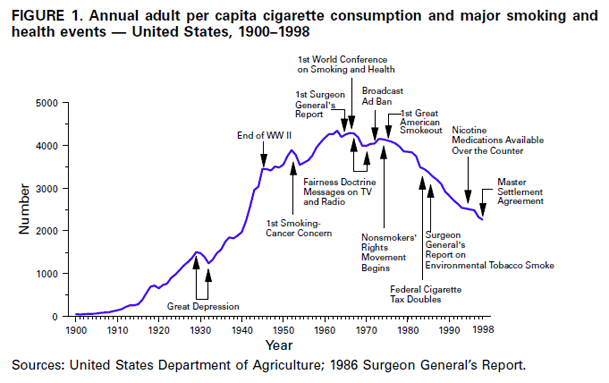
Lung cancer has not changed overall numbers all that much from 1990. https://seer.cancer.gov/statfacts/html/lungb.html So, no it's not responsible for the massive drop in cancer deaths by age group.
I included HPV and Stomach cancer in a PS specifically because they are minor changes to overall numbers. Sunscreen also impacts the rates people get cancer, but it's a very minor effect.
I'm not sure I follow. Screening detects cancer that is already there, hopefully in early stages when it might be treated more easily. In both cases, cancer is already present.
>Unless one can follow a cohort over time, there is no way of accurately estimating the probability that a subclinically detected abnormality will naturally progress to an adverse outcome. The probability of such an outcome is mathematically constrained, however, by the prevalence of the detected abnormality. The upper limit of this probability can be derived from reasoning that dates to the 17th century, when vital statistics were first collected. If the number of persons dying from a specific disease is fixed, then the probability that a person with the disease will eventually die from it is inversely related to the prevalence of the disease. Therefore, given fixed mortality rates, an increase in the detection of a potentially fatal disease decreases the likelihood that the disease detected in any one person will be fatal..... Lead-time and length biases pertain not only to changes that lower the threshold for detecting disease, but also to new treatments that are applied at the same time. Whether or not new therapy is more effective than old therapy, patients given diagnoses with the use of lower detection thresholds will appear to have better outcomes than their historical controls because of these biases. Consequently, new therapies often appear promising and could even replace older therapies that are more effective or have fewer side effects. Because the decision to treat or to investigate the need for treatment further is increasingly influenced by the results of diagnostic imaging, lead-time and length biases increasingly pervade medical practice.
>There is another complication that these more powerful imaging modalities can lead to that wasn’t discussed in the paper, stage migration. This is a phenomenon that occurs when more sophisticated imaging studies or more aggressive surgery leads to the detection of tumor spread that wouldn’t have been noted in an identical patient using previously used tests. This phenomenon is colloquially known in the cancer biz as the Will Rogers effect. The name is based on Will Rogers’ famous joke: “When the Okies left Oklahoma and moved to California, they raised the average intelligence level in both states.” This little joke describes very well what can happen in cancer. What in essence happens is that technology results in a migration of patients from one stage to another that does the same thing for cancer prognosis that Will Rogers’ famous quip did for intelligence. Consider this example. Patients who would formerly have been classified as, for example, stage II cancer (any cancer), thanks to better imaging or more aggressive surgery, have additional disease or metastases detected that wouldn’t have been detected in the past. They are now, under the new conditions and using the new test, classified as stage III, even though in the past they would have been classified as stage II. This leads to the paradoxical statistical effect of making the survival of both groups (stage II and III) appear better, without any actual change in the overall survival of the group as a whole. This paradox comes about because the patients who “migrate” to stage III tend to have a lower volume of disease or less aggressive disease compared to the average stage III patient and thus a better prognosis. Adding them to the stage III patients from before thus improves the apparent survival of stage III patients as a group. The converse is that patients with more disease that was previously undetected, tended to be the stage II patients who would have recurred and done more poorly compared to the average patient with stage II disease; i.e., the worst prognosis stage II patients. But now, they have “migrated” to stage III, leaving behind stage II patients who truly do not have as advanced disease and thus in general have a better prognosis. Thus, the prognosis of the stage II group also ends up appearing to be better with no real change in the overall survival from this cancer.
That's a problem if you want to compare the effectiveness of specific treatments. AKA, is doing A, or B, better than C. Or even more basically are screenings useful?
If you want to look overall you can look at the number of people dying at each age of each type of cancer independent of both diagnosis and treatment. AKA how many 43 year old women died of breast cancer. That also has some problems for people that died of cancer before it was detected as cancer, or people who died of suicide or related complications but not necessarily cancer on it's own. Even more critical is reduction in the rate people get cancer in the first place.
Still we are not talking about a small gap, when you start seeing a 30+% drop for a wide range of cancers it's easy to see that yes treatments are extremely useful. Even if you only get an extra say 2 years that's still 2 years to die of a car crash and not cancer.
Add a regulation that says every hospital must publish anonimized aggregated patient outcomes. Remove as many other regulations as it would take for them to be willing to compromise and accept this one.
Either make that count as a forfeit or hire specialized diagnosticians who make the prognosis and rate the surgeons on how well they do relative to the prognosis.
Doctor visits just 30 year ago did not cost what they do today. You could get a clean break in your arm, go into your GP, have it fully fixed and be out the door for less than a week's wages for an average blue collar worker. This was actually considered very expensive, but it prices were held down for the simple fact that people cared and there was a hard limit - can't get blood from a stone.
When insurance started to become "cadillac" plans I very much noticed an insane explosion in everyday medical costs and a nosedive in quality of care. It's now a corporate factory system where everyone is miserable - the doctors and the patients. The only winners are executives and shareholders. The insanity of average cases of stuff like the flu now going to a doctor also is very new, and only is happening due to the incentives of "free visit" for the average consumer.
The typical argument used against a return to "free market" health care where insurance is actually insurance again is one much like yours - if you're sick you don't care about the price. This was proven untrue just in my recent childhood, and something like 90%+ of all healthcare is not urgent or emergency related. If 90% of the market is setting prices via free market discovery the remaining 10% will be drug along or can be forced to via limited regulation.
Healthcare costs in the US are almost entirely a principal agent problem. Absolutely no one has a damn clue of what anything costs at any point in the entire process. And the real issue is the consumers don't actually care since they are only harmed in an indirect sense.