Hacker News new | ask | show | jobs
by lmm 3087 days ago
Because, while it does occasionally happen, the risk of a cyclist killing or seriously injuring another road user is much lower than the risk of a car driver doing so. Unlicensed cyclists are a much lower risk to other road users than licensed drivers; if anything we should be looking to impose stricter licensing requirements on drivers.
2 comments

They're still a risk. Not knowing the rules can cause a motorist who did absolutely nothing wrong to kill said cyclist or swerve away from the cyclist and kill someone else not even involved, all because of a negligent cyclist.

That said, demanding a license for cyclists I agree is completely unreasonable.

In my country all school children are taught the rules of the road at traffic school where they ride their bikes around a miniature road layout that comprises of most road scenarios.
To be fair that happens in Britain too, or at least it did at both my primary and secondary school.
Could you add some more explanation here? What is unreasonable about it?
What is the actual gain to society from requiring a cyclist license? Today, without licenses, police can and do hand out moving violations to cyclists. Today, drivers who have their license revoked or car impounded still find ways to drive cars, at least in the US. The barrier to picking up a new bike after having yours impounded by police is far lower. If it's forcing a baseline requirement for skills and knowledge, well we've already seen how well that's worked out for drivers (most drivers suck at it).

Licensing cyclists seems like a feel good idea to make things "fair". The fact is, things can never be fair between to such disparate classes of vehicles. Can someone explain how a world with licensed cyclists would be fundamentally different than today?

> What is the actual gain to society from requiring a cyclist license? Today, without licenses, police can and do hand out moving violations to cyclists.

I could, as someone who doesn't have a driving license, or has never learned to drive, go out on the road with my bicycle and more or less ride whenever and wherever I like.

I don't know what any of the road signs mean and I have no experience or training in hazard perception and collision avoidance. The law doesn't require me to. If I tried to do the same thing in a car I'd be arrested.

Kinetic energy = 1/2 m v^2

In a typical city scenario, a car has KE of 1/2 (2000 kg) (50 kph)^2 ~= 2e5 Joules. A bicyclist has 1/2 (100 kg) (30 kph)^2 ~= 3.5e3 Joules. Almost 100x less capable of inflicting damage on a typical pedestrian. Add onto this that bikes are way more maneuverable, less collision surface area, are totally exposed to the same forces exerted on the pedestrian with which they may collide... your comparison with cars is intellectually dishonest because you are comparing a human on top of a 10-20kg machine with a human inside a 2000kg metal box with an incredible array of safety features for the driver and hardly any for pedestrians outside.

Also, 30 kph is practically the top speed for a majority of cyclists - there's a level, narrow, short (200 m), 30-max-speed, all-traffic (except pedestrians) tunnel on my usual route. Do I temporarily reach 30 kph there, in order to be polite and get out of there as fast as possible? Yes, with some difficulty. (Do drivers honk at me for being unbearably slow while going the max legal speed? Yes.)

So, I'd say a typical city scenario is <20 kph, more than halving the estimate.

> I could, as someone who doesn't have a driving license, or has never learned to drive, go out on the road with my bicycle and more or less ride whenever and wherever I like.

Sure. Realistically, how much danger do people doing this represent to society? There are plenty of dangerous things that people could do, but the heavy machinery of law should be reserved for actual problems rather than hypothetical ones.

> If I tried to do the same thing in a car I'd be arrested.

And quite rightly, because if you weren't there's a good chance you'd kill people. Car drivers kill a lot of people, they're something like the 4th biggest cause of death in the UK IIRC.

For 5-19 YO it is 3rd most common, but when you look at the whole population it doesn’t even make the list.

source: https://www.gov.uk/government/publications/health-profile-fo...

If you choose to venture out onto the roads with no idea what the signs mean or how to avoid obstacles, good luck to you.

Realistically, every 5 year old knows what the colors on a traffic light mean and what a stop sign tells you.

There are many more rules that just red, yellow green and the stop sign. It would be nice if the highway code was that simple though.

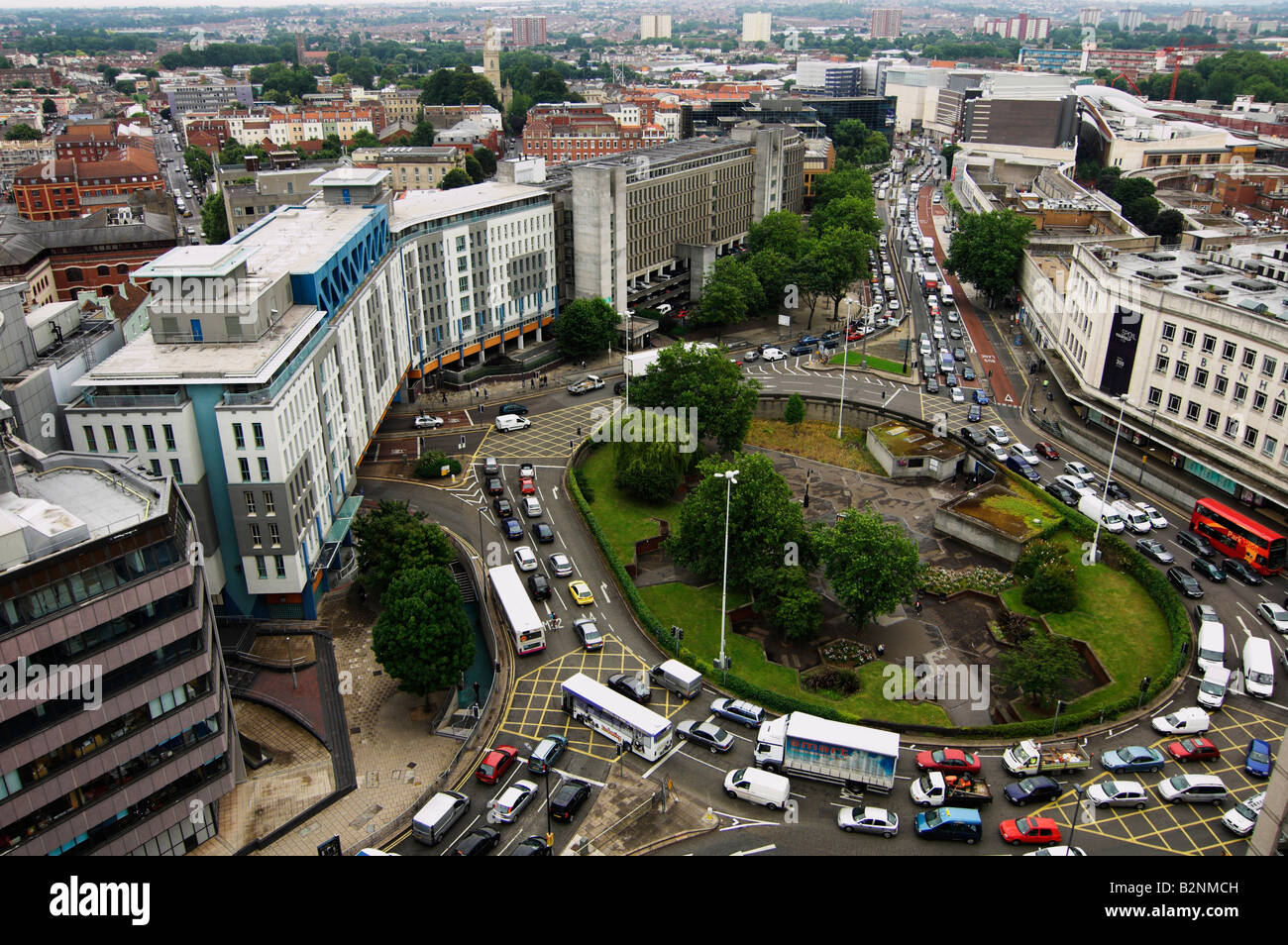
For example, how to navigate a busy multi-lane roundabout safely as a cyclist, such as Old Street roundabout in London, which looks like this: https://upload.wikimedia.org/wikipedia/commons/d/dc/Old_Stre..., or this roundabout in Bristol, UK: http://c8.alamy.com/comp/B2NMCH/aerial-view-looking-down-on-...

The law does require you to understand road signs and behave accordingly. It doesn't require you to get a piece of paper from a bureaucrat to attest to it.

I very much doubt that you would be arrested if you tried to drive a car without a license. Anecdotally, I've never had my driving license checked by a traffic officer. The large number of undocumented residents who are presumptively driving without a valid license is another point.

> I very much doubt that you would be arrested if you tried to drive a car without a license.

Without a valid driving license you will not be able to get insurance, unless you stole an insured vehicle from your parents or off the street.

Patrol cars in the UK and Europe have cameras that read number plates and check a database against all insured vehicles. If the car is not insured you will get pulled over, upon which you will be asked to present your driving license.

The number of people on bikes running up the inside of vehicles on narrow streets is too high. I’d walk through Bank (a junction in London) 5 times a week and I’d see time and time again people riding up the inside of tipper trucks and buses indicating to turn left. It happens all the time. I’d witness 3-4 near misses a month.

Rule 73 of the Highway Code:

> Pay particular attention to long vehicles which need a lot of room to manoeuvre at corners. Be aware that drivers may not see you. They may have to move over to the right before turning left. Wait until they have completed the manoeuvre because the rear wheels come very close to the kerb while turning. Do not be tempted to ride in the space between them and the kerb.

Let's be careful not to conflate two things: conforming to red lights isn't a goal in itself, safety is the goal. A lot of drivers get exercised about "cyclists running red lights" in cases that are actually safer than the alternatives, e.g. cyclists crossing a junction ahead of motor traffic when the junction doesn't have a dedicated light phase for cyclists.

Cyclists running up the inside mostly happens because waiting in a queue of traffic at a light or junction is very dangerous for a cyclist; stopping and starting are inherently dangerous and made much more so when you're starting in the middle of a queue that's anxious to start moving. In many cases road design endorses this - you'll see junctions with a cycle lane on the left running up to the light, and cyclists are expected to pass on the left even when a vehicle in line is turning left.

The solution that I've seen work best is a marked cycle-only box immediately before the junction - that provides cyclists a place to wait for the light, but it also makes for a clear dividing line between the section where cyclists are expected to pass the queue on the left versus the entry into the junction where that would be unsafe. Unfortunately cars often occupy those boxes and are seemingly not penalised for doing so. More of those boxes and more enforcement of those that exist would help, IMO, as would giving cyclists a dedicated light phase (as is done at e.g. some of the junctions on CS2) to let them clear the junction before motorists enter.

In terms of Bank specifically, it's an outlier: it's an extremely complex junction (7 roads) that simply has too much traffic demand for the space available. The junction has now been restricted to buses, cycles and pedestrians only during the daytime, and there's talk of removing the buses as well. That's appropriate: it's both safer and more efficient in terms of person throughput than allowing cars to use the very limited space there.

  waiting in a queue of traffic at a light or junction
  is very dangerous for a cyclist
When I'm approaching traffic lights and there's a queue of traffic and no bike box, I stop my bike at the tail of the queue, in the middle of the lane - just like I would on my motorbike or in my car.

I'm curious as to what you think the danger is in that situation?

A driver coming up behind you as you're starting to set off ( or immediately after you've fallen down) when the queue ahead of you is already moving. Somehow you tend to blend into the queue visually - the driver doesn't see you as separate from the vehicle in front of you, and doesn't realise you're still there when the vehicle starts moving (or does realise you're there, but rushes past you unsafely) - and the risk of falling over is much higher as you're starting off than at any other point.
Personally I see running red lights as a much higher accident risk than drivers of stationary vehicles failing to see me when I'm stopped right in front of them.
It's not the stationary drivers I'd worry about, it's those arriving behind them.

"Running red lights" with no further context seems to describe something extremely dangerous, but many specific classes of running red lights are completely safe.

Depends on the length of the queue. I find if I'm too far back from the intersection, cars will get up to speed and want to overtake me before I get through. If I continue to take the lane the driver behind me is likely to start honking and/or pass me dangerously. If I move over then I risk getting hooked as I go through the intersection.

So I find that it's usually safer to filter to the front at intersections. Even in the absence of a bike box I can squeeze into the crosswalk and get ahead of the lead car, allowing me to go safely through.

I'm also surprised by that. I do not feel safe trying to filter through traffic unless I know the light periods very well. And in a queue is one of the places I feel safest starting and stopping. I can accept an argument about how a slow bicycle is wobbly, but from a pure power standpoint, there is much less acceleration involved in a queue than in many other cases. If motorists have a problem with cyclists, its often about acceleration.
I generally wait with the traffic also when there is no bike lane/box. The only thing I ever worry about is getting hit from behind by some idiot not paying attention. I do try to mitigate this by turning my bike at an angle so that I look a little bigger.

This is all dependent on the traffic/intersection though, things vary depending on the circumstances.

It's a mistake to conflate cyclists filtering through traffic and undertaking.

The Highways Code specifically mentions that motorcycles do this also Rule 88 [1] and tells drivers that that they should be aware of other road users including cyclists doing this too [2] Rule 21.

[1] https://www.gov.uk/guidance/the-highway-code/rules-for-motor...

[2] https://www.gov.uk/guidance/the-highway-code/road-users-requ...

How many drivers were killed or injured by these riders?