That doesn't make any sense. Just think how much power the engine would have to be able to produce near the redline if it produced anything decent at 5 MPH for that to be true (considering that Tesla's mainstream cars only have 1 gear).
Edit: Just to be clear, a constant torque would imply a linearly increasing power output when increasing the revs. Of course Tesla doesn't have that – what they have is high torque, and thus significant power output already at very low revolutions. A typical small DC electric engine has an almost linearly decreasing torque curve (unless capped), although I don't really know specifics about Tesla's engines.
Basically: for an internal combustion engine the force is the force of the explosion averaged over time, so the higher the RPM the shorter the time between explosions the higher the average force (until you get to a point where your cylinders are moving so fast the start fighting against each other).
For an electric car the force is the voltage, there's no impulse to average out, it's just continuous force.
Now of course in reality it's not that simple and you actually do have a torque curve, but compared to ICE it's basically a square wave.
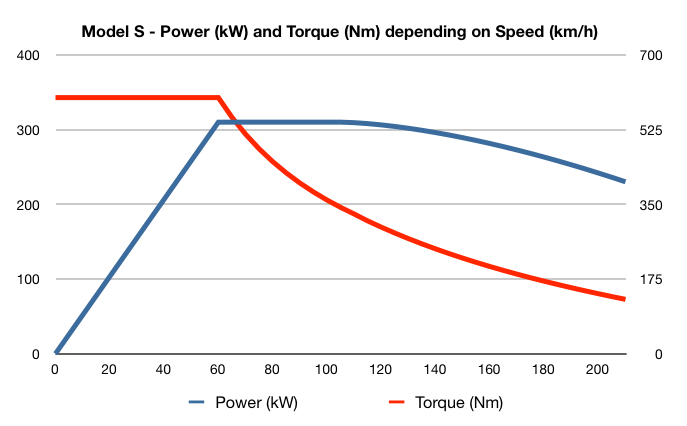
That's not true, the other poster had it right. You have peak torque at stall and it decreases mostly linearly all the way to zero at peak rpm. Power is simply torque times speed. Also torque has a basically linear relationship with current, not voltage.
It's a shame seeing people just downvote comments without doing even the most basic research to try to disprove someone.
For proof, here's the actual torque curve for a Model S. http://mihalache.free.fr/TSLA/ModelS.png And you can see very clearly the torque curve looks nothing like a square wave.
Also your assertion about internal combustion engines is wrong as well. At higher RPMs you get less duration with the valves open and you can't get as much fuel and air into the cylinder. It's not that mechanical losses are taking away that force, it's that those explosions are less powerful as you approach redline. Then once you're right up at max RPM you start having to deal with stuff like valve float where the springs pushing the valves back up can't keep up with the camshaft but that's over complicating it for a basic explanation.
Edit: Just to be clear, a constant torque would imply a linearly increasing power output when increasing the revs. Of course Tesla doesn't have that – what they have is high torque, and thus significant power output already at very low revolutions. A typical small DC electric engine has an almost linearly decreasing torque curve (unless capped), although I don't really know specifics about Tesla's engines.