|
|
|
|
|
|
by MertsA
3153 days ago
|
|
|
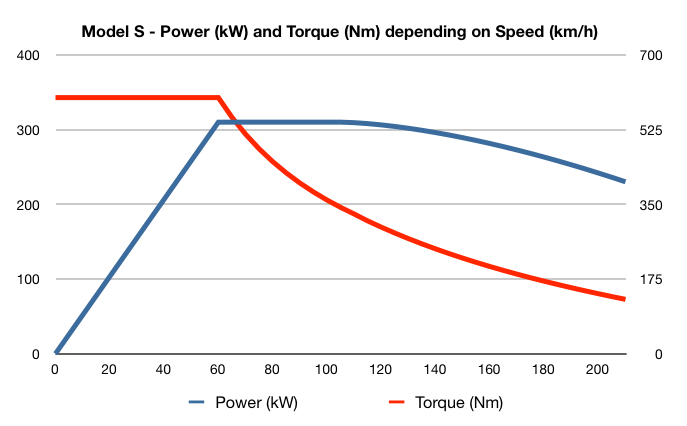
That's not true, the other poster had it right. You have peak torque at stall and it decreases mostly linearly all the way to zero at peak rpm. Power is simply torque times speed. Also torque has a basically linear relationship with current, not voltage. It's a shame seeing people just downvote comments without doing even the most basic research to try to disprove someone. For proof, here's the actual torque curve for a Model S. http://mihalache.free.fr/TSLA/ModelS.png And you can see very clearly the torque curve looks nothing like a square wave. Also your assertion about internal combustion engines is wrong as well. At higher RPMs you get less duration with the valves open and you can't get as much fuel and air into the cylinder. It's not that mechanical losses are taking away that force, it's that those explosions are less powerful as you approach redline. Then once you're right up at max RPM you start having to deal with stuff like valve float where the springs pushing the valves back up can't keep up with the camshaft but that's over complicating it for a basic explanation. |
|
|