Hacker News new | ask | show | jobs
by veli_joza 3156 days ago
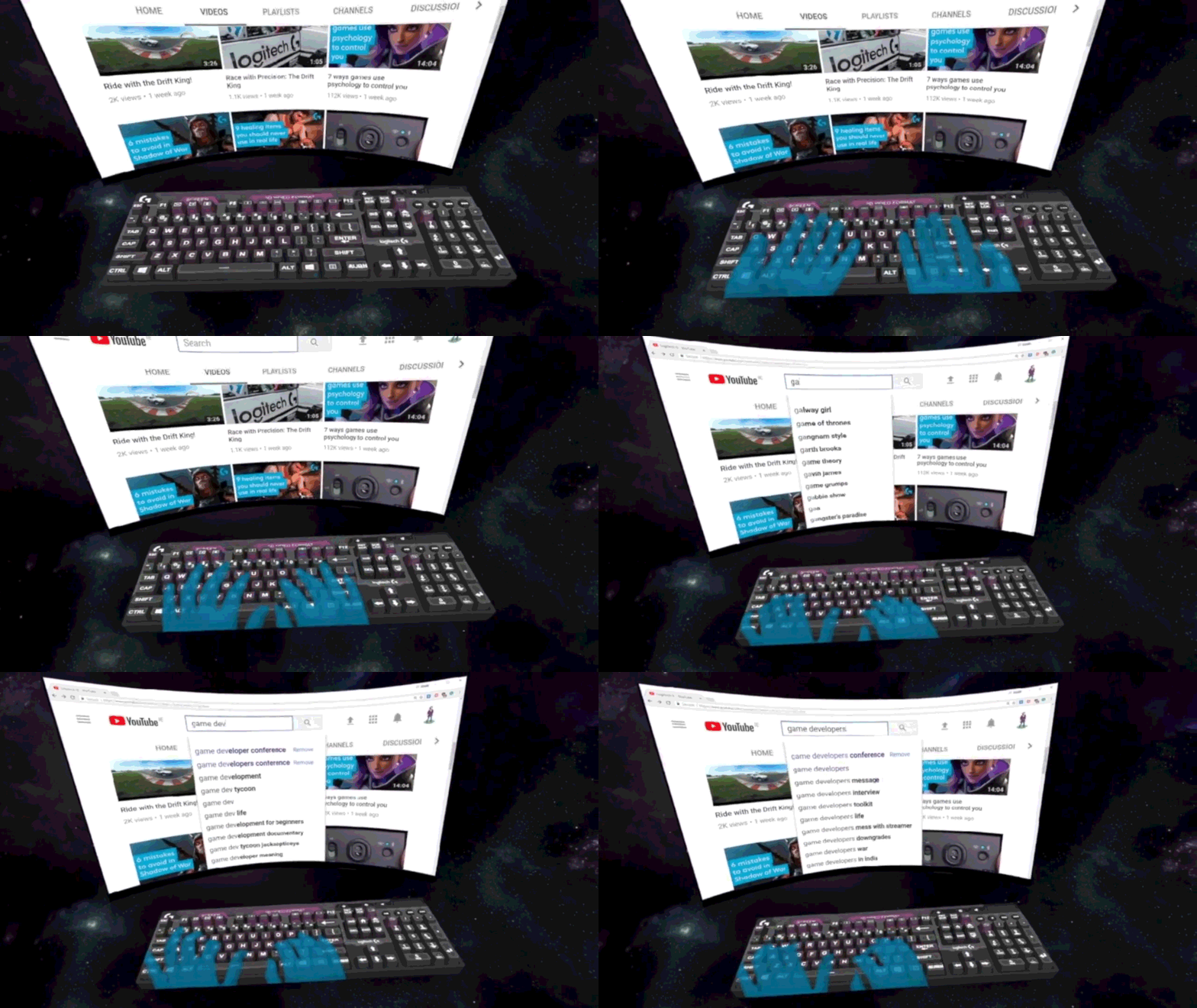
Just look at this nonsense [1]. We have brand new technology with unlimited potential for new abstractions and paradigms. So, what do we do? We make a virtual desktop workstation, the same one we had since 70s! We limit all rendering to a 2D surface, make it curved and put a nebula in the background. Is this really the cutting edge of information technologies?

Also, we need both mechanical keyboard to sense key presses and 3D tracking of finger movements? I get it, Logitech wants to keep selling keyboards, but for VR experience I would rather have tracking of facial features and eye movement.

[1] https://d201n44z4ifond.cloudfront.net/wp-content/uploads/sit...

12 comments

That was the same thinking behind Elon Musk's startup Neuralink, but given that there really aren't any options that are substantially better, Logitech isn't being stupid.

Perhaps some combination of voice, gesture, and 3D could be useful specifically while in-game. But for productivity, I don't think there's anything better than a traditional workstation.

Voice has privacy issues. Gesture recognition is inaccurate and causes "gorilla arm" syndrome.

3D doesn't really add much, and in fact for productivity some people think even 2D Window-based GUIs are cumbersome, and that is the entire motivation for tiling window managers. From that perspective, 3D is even more chaotic and cumbersome.

Voice not only has privacy issues, but could you imagine working in one of those god awful “open floor plan” offices with a bunch of people speaking in JavaScript all day?
We'd all need to get the Cone of Silence.

https://www.youtube.com/watch?v=g1eUIK9CihA

https://en.m.wikipedia.org/wiki/QWERTY#History

QWERTY

All that needs to be said about the difficulty of changing a primary interface method.

Very much aware. I use colemak, because I was convinced by the arguments of QWERTY's insufficiency.

Although, the costs of switching outweigh the benefits for almost everyone, except for those with repetitive stress injury.

WHY? There's a reason we have the keyboard, and it wasn't a limitation of technology. The reason the "typewriter" interface was carried over to the PC is because it's GOOD. This is almost as bad as when MS decided Kinect would replace all game controllers because look hands free. It turns out we have hands for a reason. The speed and precision we can do things with our hands far exceeds basically anything else beyond a direct link to your brain.

Have you ever watched someone who is handicapped who has eye tracking for a keyboard? Have you paid attention to how slow and error prone it is? What on earth makes you want to have THAT as your primary input method???

I absolutely do not want facial features and eye movement to completely replace finger movement for input. I can neither control my eyes nor face at anywhere near the rate that I can control my fingers. If VR wants to replace my desktop environment for anything other than games, it'll need to retain some sort of high fidelity, high frequency input vector.
Yeah, I wouldn't use facial and eye tracking instead of traditional input interface. They are meant to enrich interaction with other people. Eye tracking could be used for some optimizations, like dynamic LoD based on user focus.

I thought about input interface that could replace keyboard for VR and mobile devices. Brain implant would be perfect, but that's not feasible with today's technology. Voice is good contender, except for privacy issues, and it's not really usable in work environments. Keyboards are our best solution so far, but they don't evolve and to me they seem like a dead end (plus, they are not portable and require both hands to use effectively).

I was thinking about touch sensitive surface that recognizes drawn glyphs. The idea is that anyone who is literate can start using it without any training, just draw letters instead of typing them. With machine learning and some clever visual feedback, both user and machine could adapt to each other to increase the input speed (by simplifying glyphs and by defining 'snippets'). Interface could be expanded to both hands to double the speed, but it would be completely functional with just one hand. It could even be used blindly. For mobile devices, such sensitive surface could be placed on backside - virtual keyboards that take half of screen are just horrible.

> I was thinking about touch sensitive surface that recognizes drawn glyphs.

I'd like a touch sensitive surface... on a keyboard.

Consider an expert keyboard user. With a nice keyboard. Adding downward-facing hand tracking, such as a head-mounted Leap Motion, adds value. Now you can gesture on the keyboard, and above it in 3D. Permitting a very rich input vocabulary. And, for example, using the entire keyboard as a touch surface. Except... while fingers are highly sensitive to tactile contact, neither traditional keyboards, nor current hand tracking, can provide good contact information. Finger-tip position tracking isn't quite good enough to infer contact existence and pressure. So while you can use say the J-key keycap surface as a trackpad, and even infer touch-untouch events from gross finger motion (better than requiring a keypress, but not by much), you still can't get light-touch events (eg "I was clearly pressing harder when I stroked down, but just skimming when I moved back up - I clearly felt the difference, so why didn't the keyboard?") So, I'd love a contact sensing mesh which could be laid over an existing nice keyboard, without compromising key feel. I can get position information elsewhere, and keypresses from the keyboard of course, but there's no existing source of multitouch contact, let alone pressure. Any ideas?

Exactly!

One of the first things I did with my Rift (well, after Superhot...) was try out the Virtual Desktop kit.

It's lacking. I thought it'd give me a 3D frustrum to throw window back/forward, drop Spotify out to the peripheral, have VisStudio in glorious megapixel size.

Instead, you get your regular desktop screens mirrored and constrained to a 2D plane. Gods help you if you've got mismatched DPI screens, like my 1080p & 2160p pair.

(Go on, I'll await some smart sod to tell me "Product" is exactly what I'm looking for...)

I'm not sure it's nonsense. What I see is incremental change. Take the workstation, and move it to virtual space. Then add more 2D screens. Then try a different input or display method, one small step at a time. Sounds reasonable to me, much more so than re-inventing every part of the interface at the same time, and hoping to get it all within spitting distance of what's right.
It’s as stupid as creating a fancy raster graphics system with windowing and fast refresh rates and hardware acceleration for 3D rendering, and then using it to display a bunch of programs that pretend to be a 1960s teletype.

Using new technology to incrementally improve existing ideas and techniques usually works better than trying to start completely from scratch.

I would also hope for such incremental change, but I don't see it happening. If you take a look at historical development of desktop OS UIs, you'll see all concepts established in 80s and not much (any) progress since then. Icons, buttons, menues, windows, even whole applications (file manager) are unchanged, while there's very few new UI elements (date picker, for example).

VR should be considered as completely new medium. 2D windows in VR should only be used as backwards-compatibility layer. Re-inventing every part of interface at the same time sounds great to me. Let's make as many competing solutions and then pick ones that work the best. This paves the way not only for rich VR experience, but also for AR.

> VR should be considered as completely new medium.

I think you're throwing the baby out with the bathwater here. There are plenty of teams working on brand new UI/UX experiences in VR, and I'm sure that in time the old 2d paradigms will have more competition. But also, I still choose to use a terminal for git when I could use a GUI, so I'm not actually convinced that "2D windows in VR" are going to or should go away.

The OP shows a great step towards being able to replace your workstation with some VR goggles, a keyboard, and a CPU. That prospect excites me more than any "new medium" VR experiences that I can see on the immediate horizon; being able to work from a beach hammock and not compromise on workspace efficiency is incredibly appealing.

Until someone invents a neural interface, keyboards might be the best option for text input. That or develop purely conversational interfaces, but the issue with conversational interfaces is they lack the privacy of a physical interface.
I keep wondering if chording keyboards could be the answer for VR text input. It would require learning a new input system, but I'm curious if one could eventually become proficient enough to reach average qwerty speeds. I can't remember the name but I remember seeing a google-produced chip that tracked small finger movements, and I imagine something like this clip from Children of Men could work: https://youtu.be/sJO0n6kvPRU?t=2m4s

I spent a few hours the other day searching for existing chording keyboards and they were all really clunky.

> We make a virtual desktop workstation, the same one we had since 70s!

...plus the QWERTY keyboard design goes back to 1870 ( https://en.wikipedia.org/wiki/QWERTY )

And the Latin alphabet goes back more than two millenia![1]

[1] https://en.wikipedia.org/wiki/Latin_alphabet

Keyboards are still a highly precise and versatile text input method. Voice isn't good enough yet (and you may never get good enough voice recognition, thanks to homophones and the issue of making up new words).

While just putting a window on a nebula background works as a Proof of Concept, it does need further innovation. The keyboard, however, does not.

An infinite real estate computing environment is a pretty damn good value prop imo; a hell of a lot better than vr is being pushed atm (360 vid and games).

The problem with the gif is that it doesn't make any use of the "virtual" environment, but this is where vr should be heading at least as the intermediate before fully interactive vr.

That, and porn

>Also, we need both mechanical keyboard to sense key presses and 3D tracking of finger movements? I get it, Logitech wants to keep selling keyboards, but for VR experience I would rather have tracking of facial features and eye movement.

No. You don't get it. This doesn't do 3d finger tracking. It just figures out where the keyboard is and does some edge detection to give a rough idea of where your hands are.

Maybe, but the current state of VR makes it clumsy to use in some scenarios. I expect this to go away with time and further development, but right now there's a gap to fill. One step at a time allows us to go far.
Well, you could build a wall of those screens.